
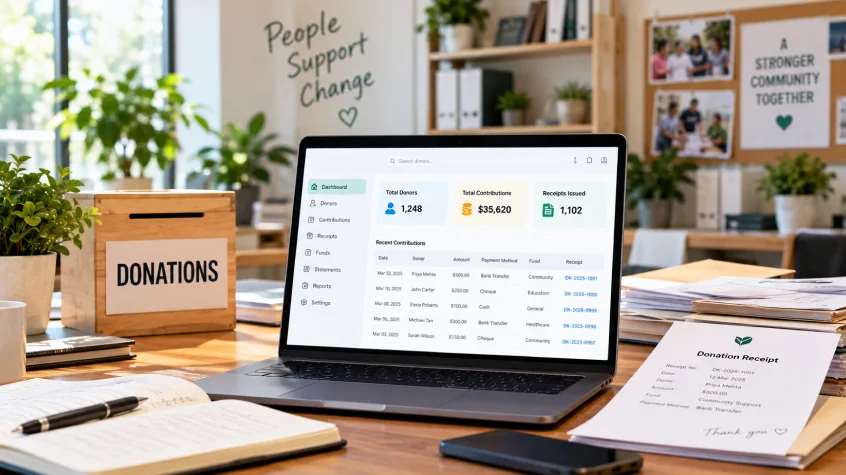
Managing donations is about more than recording the amount an organisation receives. Every contribution comes with important details, including donor information, payment methods, donation dates, fund allocations and receipt records. Keeping all this information accurate becomes increasingly challenging when nonprofits rely on spreadsheets, paper records and separate tools.
For nonprofits, charities, churches and community organisations that regularly receive cash donations, cheques, bank transfers and other offline contributions, having an organised donor management process is essential. Without a centralised system, staff may spend unnecessary time searching for donor details, updating contribution records and preparing individual donation receipts.
A Nonprofit CRM for Offline Donations helps bring these activities together. Instead of managing donor profiles, contributions and receipts separately, organisations can maintain connected records that make donation administration more efficient.
DonorKite is designed to support this approach. Its nonprofit CRM software helps organisations manage donor information, record offline donations, generate receipts, send acknowledgements by email and maintain giving histories in one platform.
Whether you are running a small charity, managing church contributions or overseeing donations for multiple programmes, having the right Donor Management Software for Nonprofits can make everyday administration simpler and more reliable.
What Is a Nonprofit CRM for Offline Donations?
A Nonprofit CRM for Offline Donations is a donor relationship management system designed to help charitable organisations organise donor information and track contributions received outside an online payment platform.
Unlike traditional CRM software, which is often focused on sales pipelines and commercial customer relationships, nonprofit CRM software is built around donors and their giving activities.
It allows organisations to maintain essential donor information, including contact details, contribution history, donation amounts, payment methods and receipt records.
Consider a charity that receives a £250 cheque from a supporter for its education programme. A few months later, the same supporter makes another contribution through a bank transfer.
If both donations are recorded in separate spreadsheets, identifying the donor's complete contribution history may require manually checking multiple files.
With a nonprofit CRM, both contributions can be linked to the same donor profile. Staff can review the donor's giving history, identify the relevant fund and locate associated receipts without searching through disconnected records.
This is particularly valuable for organisations that receive donations through existing offline channels but need a more structured way to manage what happens after each contribution.
A dedicated CRM for Nonprofit Organizations helps connect these responsibilities, making donor information more accessible and donation records easier to maintain.
Why Offline Donation Management Becomes Difficult Without a CRM
Many nonprofits begin with spreadsheets because they are familiar, accessible and easy to use for basic recordkeeping. However, as donor numbers and contribution volumes grow, these manual processes can become harder to manage.
The challenges usually appear gradually. A donor's address is updated in one file but not another. A receipt is saved without a clear reference to its donation. Two staff members create separate records for the same supporter.
Over time, these small inconsistencies can affect record accuracy and increase administrative work.
Donor Information Gets Scattered Across Different Systems
When donor contact details, donation histories and receipt records are stored separately, staff do not have a complete view of each supporter.
For example, a charity administrator may know that a donor contributed to a healthcare fund but may struggle to identify when the donation was made or whether the receipt was emailed.
Centralised Nonprofit Donor Management Software helps connect these details so staff can access relevant information through one system.
Duplicate Donor Records Create Confusion
Duplicate donor entries can make donation histories difficult to understand.
A supporter may be recorded under a full name in one spreadsheet and an abbreviated name in another. If those entries remain separate, the organisation may underestimate the donor's total contributions or produce incomplete statements.
A nonprofit CRM with donor database management capabilities makes it easier to maintain consistent donor profiles and merge duplicate records where appropriate.
Manual Donation Receipts Take Extra Time
When donation receipts are prepared manually, staff often need to enter the same information repeatedly.
A typical process might involve locating donor details, copying the donation amount into a document, assigning a receipt number, creating a PDF and sending an email.
This may be manageable for a handful of donations, but it becomes repetitive when an organisation handles contributions throughout the year.
Connecting donation records with receipt generation reduces the need to recreate information and helps maintain a more consistent acknowledgement process.
Manage Donor Records and Giving Histories in One Place
A reliable donor database is the foundation of effective nonprofit donation management.
Organisations need to know who their supporters are, how they have contributed and where to find their records when questions arise.
A Nonprofit CRM with Donor Management provides a structured way to maintain this information.
Maintain Accurate Donor Profiles
Donor profiles typically include names, email addresses, phone numbers, postal addresses and other details relevant to the organisation's recordkeeping requirements.
DonorKite helps organisations create and manage these records without maintaining separate databases for contact information and donation history.
When an existing donor makes another contribution, staff can locate the relevant profile and record the donation against it.
This keeps information connected and helps prevent unnecessary duplicate entries.
DonorKite also supports importing and exporting donor information, making it easier for organisations to move existing records from spreadsheets and maintain their database over time.
Understand Each Donor's Contribution History
A donor's giving history offers a clearer understanding of their relationship with an organisation.
For example, a supporter may contribute regularly to a general fund while occasionally making additional donations to a specific programme.
With Donor CRM Software, staff can review these recorded contributions together rather than treating each donation as an isolated entry.
This information can also be useful when preparing donor statements, answering contribution enquiries or reviewing support received for individual programmes.
Improve Donor Communication
Donor relationships depend partly on how organisations handle everyday interactions.
When a supporter requests a previous receipt or asks for a summary of donations, staff should be able to locate the relevant records without lengthy searches.
Having accurate donor profiles and contribution histories allows organisations to respond more efficiently.
It also helps maintain continuity when volunteers or administrative staff change, because important donation information remains in the organisation's records rather than individual spreadsheets or email inboxes.
Track Cash, Cheque and Bank Transfer Donations With Greater Accuracy
Offline contributions remain an important source of support for many charitable organisations.
Cash donations may be collected during community events, cheques may arrive through the post, and regular supporters may contribute through direct bank transfers.
Although these contributions arrive through different methods, organisations still need a consistent process for recording them.
Offline Donation Tracking Software helps establish that consistency.
Cash Donation Management
Cash contributions are common for churches, local charities, community groups and organisations conducting in-person activities.
Because cash donations may initially be documented through paper forms or manual registers, maintaining accurate records is particularly important.
Using Cash Donation Management Software, organisations can record the donation amount, date, donor information when available and the intended fund.
For example, a community charity collecting cash contributions for a food assistance programme can maintain individual donation records rather than relying entirely on handwritten notes.
These records provide a clearer account of the contributions received and help simplify future reviews.
Cheque Donation Tracking
Cheques often contain donor information that needs to be associated with an existing record.
When a cheque is received and processed, staff can enter the relevant contribution details into the donation management system.
This may include the donor's name, amount, donation date, payment method and fund allocation.
Keeping these details connected allows staff to review cheque contributions alongside donations received through other methods.
Bank Transfer Donation Records
Bank transfers are another common method of supporting charitable organisations.
A bank statement confirms the financial transaction, but it may not contain all the donor information needed for an acknowledgement or donation statement.
A nonprofit CRM allows the organisation to maintain a separate contribution record containing the details required for donor administration.
The donation can then be associated with the correct supporter and included in their giving history.
Manage Donations Across Multiple Funds
Many nonprofits manage more than one fund or programme.
A charity might receive donations for education, healthcare and emergency assistance. A church may manage general contributions alongside community support initiatives.
Recording each donation against the correct fund makes it easier to understand where contributions have been allocated.
DonorKite allows organisations to configure funds and payment methods to reflect their donation management requirements.
For organisations looking to improve their contribution records, Donation Tracking Software for Nonprofits provides a useful starting point for understanding how donor histories, funds and donation records can work together.
Connect Donation Records With Automatic Receipt Generation
Recording a donation is only part of the administrative process. Organisations also need to acknowledge contributions and maintain suitable documentation.
Donation receipts play an important role in this process. They confirm that a contribution was recorded and provide donors with information about their support.
However, when receipts are created separately from donor and donation records, the process can become unnecessarily repetitive.
A Nonprofit CRM with Donation Receipt Management helps connect these activities.
Generate Receipts Using Existing Donation Information
When donor information and contribution details are already available in one system, staff should not need to manually recreate the same information for every receipt.
DonorKite supports automatic PDF donation receipt generation based on the recorded donation information.
This helps organisations maintain consistency between the contribution record and the document issued to the donor.
It also reduces the likelihood of mistakes caused by copying details between separate systems.
Maintain Organised Receipt Numbering
Receipt numbering is important for identifying and managing individual donation records.
A structured numbering process makes it easier to distinguish receipts, locate previous documents and maintain consistent administrative records.
DonorKite offers receipt numbering features that allow organisations to manage this process according to their configured requirements.
Receipt information remains associated with the relevant donation, helping staff locate documents when needed.
Customise Donation Receipt Details
Professional donation receipts should clearly communicate the required information while reflecting the organisation's identity.
DonorKite supports receipt customisation, including organisation logos, signatures, labels and fonts.
This flexibility allows charities and nonprofits to create consistent receipt formats without preparing a new document design for every contribution.
Organisations should still review their receipt content to ensure that it meets the applicable requirements in their country.
Send Donation Receipts by Email
Email delivery is another important part of the acknowledgement process.
Instead of downloading a receipt, opening a separate email application and manually attaching the PDF, organisations can send receipts through DonorKite's donation management workflow.
This is especially helpful for small nonprofit teams that manage a growing number of contributions.
Using Donation Receipt Software for Nonprofits alongside donor management features creates a more connected process for recording contributions and acknowledging supporters.
How Donor Management, Contributions and Receipts Work Together
The real value of an integrated nonprofit CRM becomes clear when looking at a typical donation workflow.
Imagine a charity receives a $300 bank transfer from an existing donor for its community education fund.
The organisation needs to identify the donor, record the contribution, allocate it to the correct fund and provide a receipt.
Without connected software, each task may be completed using a different spreadsheet, document or email account.
With DonorKite, the organisation can follow a more organised process.
Identify the Existing Donor
Staff can search the donor database and locate the supporter's existing profile. If the contributor is new, a donor record can be created.
This helps ensure that contributions are associated with the correct person.
Record the Contribution
The donation amount, date, fund and payment method can be recorded in the system.
Because this information is connected to the donor, the contribution becomes part of their giving history.
Generate the Receipt
Once the required donation information is available, the organisation can generate a PDF receipt using the configured receipt settings.
This avoids preparing a separate document manually.
Email the Receipt
The receipt can be emailed to the donor through the platform, providing a convenient way to acknowledge the contribution.
Maintain the Record for Future Reference
The donation and its associated information remain accessible for later review.
If the donor contributes again, requests a receipt or needs a statement, staff can refer to the existing records.
This connected approach helps reduce repetitive administrative work while maintaining a more dependable history of donor activity.
Simplify Annual Donation Statements and Reporting
Donation administration continues beyond individual contributions and receipts.
Many supporters make several donations throughout the year. They may later request a consolidated statement summarising their contributions over a particular period.
Preparing these statements manually can be difficult when donation records are distributed across different files.
Donor Management Software with Donation Statements makes the process more manageable by keeping contribution histories connected to individual donors.
Prepare Annual Donation Statements
Annual donation statements provide donors with an overview of their recorded contributions during a selected year.
DonorKite supports annual donor statements, helping organisations prepare these summaries using the donation information already maintained in the system.
This reduces the need to manually combine information from multiple individual receipts.
Generate Statements for Custom Periods
Not every donor statement request relates to a complete year.
A supporter may require contribution information for a particular period, or an organisation may need records associated with a specific reporting timeframe.
Custom-period donation statements allow organisations to prepare summaries based on the relevant dates.
Support More Consistent Recordkeeping
When donations are connected to donor profiles, funds and payment methods, staff can review information more easily.
This can help with administrative reporting, donation record reviews and reconciling contribution information with accounting records.
A nonprofit CRM does not replace an organisation's accounting system or financial controls, but it can provide organised donor-level information that supports those processes.
Why Tax Receipt Management Matters for Nonprofits
Donation receipts can also have tax-related importance, depending on the organisation's country, registration status and the nature of the contribution.
For nonprofits operating internationally, it is important to understand that receipt requirements are not identical across jurisdictions.
In the United States, nonprofits may need to provide written acknowledgements that meet IRS requirements for certain charitable contributions.
In Canada, registered charities must follow CRA rules when issuing official donation receipts for income tax purposes.
UK charities need to maintain appropriate records for applicable HMRC requirements, including Gift Aid documentation where relevant.
Australian charities and not-for-profit organisations must consider ATO rules when providing documentation for tax-deductible gifts, while eligible New Zealand donee organisations need to maintain records in accordance with applicable IRD requirements.
A Tax-Compliant Donation Receipt Software solution can help organisations manage the underlying donor and contribution information, but the organisation remains responsible for confirming eligibility and meeting the relevant legal requirements.
DonorKite helps maintain structured donation records and supports receipt generation and email delivery across its supported regions.
Organisations that want to improve this part of their workflow can also explore Email Tax Receipt Software for Nonprofits to understand how email acknowledgements and donation records can be managed together.
What to Look for in Nonprofit CRM Software for Offline Donations
Not every nonprofit needs a complex fundraising platform with extensive features that may never be used.
For organisations primarily managing offline contributions, the most useful CRM is often one that makes core administrative tasks straightforward.
Easy Donor Database Management
The software should make it simple to create donor records, update contact information, locate existing supporters and review contribution histories.
Import and export options are also helpful for organisations moving away from spreadsheets.
Flexible Offline Donation Recording
Organisations should be able to record different types of contributions without changing their established payment collection processes.
Support for cash donations, cheques, bank transfers and configurable payment methods is particularly useful.
Connected Donation Receipt Management
Receipt generation should work directly with recorded donor and donation information.
The ability to create PDF receipts, maintain numbering and send documents by email can reduce repetitive administrative tasks.
Fund Management
Nonprofits operating multiple programmes need a clear way to identify the purpose of each contribution.
Fund-based donation tracking helps maintain that distinction and makes donation histories more informative.
Donor Statements and Accessible Records
A nonprofit CRM should help staff locate previous contributions and prepare donor statements without manually rebuilding donation histories.
These capabilities are especially valuable during year-end administrative activities.
A Simple, Practical Workflow
The Best Nonprofit CRM for Small Nonprofits is not necessarily the platform offering the largest number of features.
It is the one that supports the organisation's actual responsibilities without creating unnecessary complexity.
A straightforward interface, connected donor records and reliable receipt management can be more valuable than advanced tools that do not fit the organisation's donation process.
How DonorKite Helps Nonprofits Manage Offline Contributions
DonorKite is designed for organisations that need a centralised way to manage donors, record offline contributions and maintain donation receipts.
Rather than functioning as a payment gateway, DonorKite focuses on the administration that follows when an organisation receives a donation.
This distinction makes it especially relevant for charities, churches, foundations and other nonprofits that already collect contributions through their preferred payment methods.
Centralised Donor Management
DonorKite helps organisations maintain donor profiles, update contact information, merge duplicate entries and review giving histories.
Keeping these records connected makes it easier to understand contributions made by individual supporters over time.
Offline Contribution Tracking
Staff can record donations received through cash, cheques, bank transfers and other configured methods.
Each contribution can be associated with the relevant donor, fund and payment method, providing a clearer record of donation activity.
Automatic Donation Receipts
DonorKite supports PDF receipt generation, customisable receipt details and email delivery.
This helps organisations reduce the repetitive work involved in acknowledging contributions.
Donation Statements
Annual and custom-period statements help organisations provide donors with consolidated information about their recorded contributions.
These capabilities are useful when preparing year-end donation summaries and responding to donor requests.
A Connected Administrative Process
The main advantage of DonorKite is how these features work together.
Donor information supports contribution recording. Contribution records support receipt generation. Recorded donations also provide the information needed for donor histories and statements.
For smaller teams that manage several administrative responsibilities, this connected approach can make donation management more organised without requiring a complicated system.
Build a More Organised Donation Management Process With DonorKite
Managing offline donations should not mean maintaining separate spreadsheets for donor information, payment records, receipt numbering and contribution histories.
As an organisation grows, disconnected records can create unnecessary work and make even simple administrative tasks difficult.
A Nonprofit CRM for Offline Donations brings these responsibilities together by connecting donor profiles, contribution records, funds, payment methods and donation receipts.
With the right system, staff can spend less time recreating information, searching for previous donations and preparing documents manually.
DonorKite provides a practical solution for nonprofits, charities, churches and other organisations that want to improve the way they manage offline contributions.
From maintaining donor databases and recording cash or bank transfer donations to generating PDF receipts and preparing donor statements, DonorKite helps keep important information organised in one place.
If your organisation is still relying on spreadsheets or separate tools to manage donors and donation records, moving to a connected nonprofit CRM can be a meaningful step towards more efficient administration.
Manage Your Donors, Offline Donations and Receipts With DonorKite
Simplify donation recordkeeping, keep donor histories organised and manage receipts through one connected platform.
Register Now and Start Your 7-Day Free Trial to explore how DonorKite can support your organisation's offline donation management needs.