
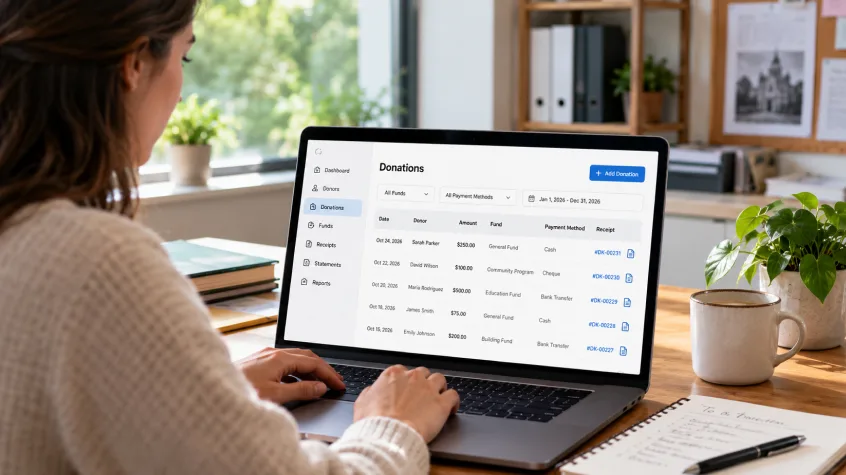
For a small nonprofit, managing contributions should be straightforward. A donor gives $100, the organization records the contribution, sends the appropriate acknowledgment or receipt, and keeps the information available for future reporting.
In practice, it often becomes much more complicated.
Donor information may be stored in one spreadsheet, cash contributions in another, receipts in individual PDF files, and year-end records somewhere else entirely. Churches may have separate records for tithes, offerings and designated funds. A charity receiving cash, cheques or bank transfers may need staff to manually create and email receipts after every contribution.
That is where Contribution Management Software for Nonprofits becomes valuable.
The right system should not simply record an amount. It should help a small organization manage the entire administrative journey of a contribution: who gave, how much they gave, how the contribution was received, which fund it belongs to, what receipt was generated, whether that receipt was delivered and how that contribution appears in the donor's history.
For organizations in the United States, Canada, United Kingdom, Australia and New Zealand, contribution management also intersects with different Charitable Contributions Receipt Requirements, tax acknowledgment rules and recordkeeping expectations.
DonorKite is built around this everyday workflow. It combines donor management, offline contribution recording, funds, payment methods, receipt generation, email delivery, donor histories, statements and reporting in one cloud-based system. Rather than requiring small teams to build complicated processes, staff can add the donor, record the contribution, select the appropriate fund and payment method, save the donation and send its receipt by email.
What Is Contribution Management Software for Nonprofits?
Contribution Management Software for Nonprofits is a system that helps nonprofit organizations maintain structured records of the money they receive from donors and connect those contributions with donor information, funds, receipts, acknowledgments and reports.
It overlaps with Donation Management Software, but the idea of contribution management is especially useful for organizations receiving several types of support.
A contribution record may need to identify the donor, contribution date, amount, fund or campaign, payment method, internal remarks, receipt number and acknowledgment status. When those details stay together, staff can understand exactly what happened without moving between spreadsheets, document folders and email accounts.
Good Donation Management Software should therefore do more than maintain a list of transactions. It should create a useful history for each donor and each contribution.
That distinction matters to small organizations.
A spreadsheet can tell you that $500 was received. Contribution Management Software for Nonprofits should also tell you who gave the $500, where it was allocated, whether it arrived through cash or cheque, which receipt belongs to it and whether that receipt was delivered.
DonorKite follows this connected approach. Each recorded donation can retain information such as the donor, amount, fund, payment method, receipt number and status, while an activity log helps authorized staff understand what has happened with the record.
Why Small Nonprofits Quickly Outgrow Spreadsheets
Spreadsheets are useful when an organization is getting started. The problem is not the spreadsheet itself. The problem appears when the spreadsheet becomes responsible for donor management, contribution tracking, receipt creation, receipt numbering, email delivery and reporting at the same time.
Imagine a nonprofit receiving 300 contributions during the year.
Some arrive in cash at community events. Others come through cheque or bank transfer. Several supporters donate more than once. A donor changes their address. Another asks for a replacement receipt. The treasurer needs a report for one particular fund. At the end of the year, regular donors ask for contribution statements.
Suddenly, what looked like a simple spreadsheet has become an administrative system built from multiple files.
Purpose-built Contribution Management Software for Nonprofits creates a repeatable workflow instead.
The organization records the donor once, keeps their information in a donor profile and adds new contributions to the same history. Donation records can remain connected with funds, payment methods and receipts.
For a small team, that means less time re-entering information and a lower chance of creating disconnected records.
What Small Organizations Actually Need From Contribution Management Software
Many nonprofit platforms advertise hundreds of features. Small organizations rarely need hundreds of features.
They need the important features to work properly.
For most nonprofits, charities, churches, foundations and community organizations, useful Contribution Management Software for Nonprofits should provide centralized donor records, simple contribution entry, cash and offline donation tracking, funds and payment methods, receipt creation, receipt numbering, email receipt delivery, donor histories, statements, reports and configurable receipt details.
DonorKite focuses heavily on these everyday activities rather than forcing small teams into an unnecessarily complicated fundraising system. Its current workflow connects donor profiles, donations, funds, payment methods, receipt numbers, email receipts and reporting in one system.
Centralized Donor Records
Contribution management begins with the donor.
If a supporter contributes five times during the year, your organization should not need five separate donor records. Staff should be able to open the donor profile and understand the relationship immediately.
DonorKite maintains donor contact details along with information such as total donations, lifetime contribution value, latest donation and complete donation history. Records can also be searched, filtered and sorted.
This makes Contribution Management Software for Nonprofits more useful than a basic donation receipt generator.
The system is not merely creating a document after each gift. It is building a structured record of the donor's relationship with the organization.
Simple Contribution Recording
Small organizations should not need a specialist administrator simply to enter a donation.
Useful Donation Management Software should allow staff or volunteers to select the donor, enter the contribution amount, choose the fund, identify the payment method, add any relevant remarks and save the record.
DonorKite is designed around that straightforward workflow.
That simplicity becomes important when different people help with administration. A system that only one experienced employee understands can become another operational problem rather than a solution.
Cash Donation Management Software
Cash remains important for churches, religious organizations, community groups, small charities, events and local nonprofit organizations.
That creates a specific need for Cash Donation Management Software.
A cash gift does not automatically arrive with the structured information generated by an online payment system. Someone within the organization needs to record it correctly.
Effective Cash Donation Management Software should allow the team to record the amount, date, donor where known, fund, payment method and relevant receipt details without maintaining a separate cash spreadsheet.
DonorKite can record contributions received through the organization's existing methods, including offline payment methods such as cash, cheques and bank transfers. It focuses on managing the donation after the organization receives it rather than operating as an online payment gateway.
For organizations evaluating Cash Donation Management Software, that distinction is important. You may already have ways of receiving money. What your staff actually needs is a reliable system for what happens next.
Funds and Payment Methods
Knowing that your organization received $10,000 is useful. Knowing that $4,000 belongs to an education fund, $3,500 to a community program and $2,500 to a general fund is much more useful.
Good Contribution Management Software for Nonprofits should therefore allow contributions to be associated with funds or campaigns.
Payment methods are equally important.
Cash, cheque, bank transfer and other offline contribution methods should not all appear as identical transactions. Recording the method helps provide context when staff later review or reconcile contribution records.
DonorKite allows donations to be organized around funds and payment methods, keeping that information connected with the individual donation.
Donation Tax Acknowledgment Software Should Start With Accurate Donation Data
A tax acknowledgment is only as accurate as the contribution information behind it.
That is why Donation Tax Acknowledgment Software should not be treated as a standalone document generator.
Before an acknowledgment can be generated, the organization needs the correct donor, contribution amount, date and relevant tax or receipt information.
When Donation Tax Acknowledgment Software is connected directly with contribution records, staff do not have to repeatedly copy the donor name and amount into separate templates.
DonorKite generates PDF receipts from recorded donation data and keeps the receipt associated with the underlying contribution. Receipt numbers can also be assigned to donation records, while receipt customization allows organizations to adapt details such as logos, signatures, labels and formatting to their requirements.
This is particularly useful for organizations researching tax-compliant donation receipts software.
No software can determine the legal treatment of every possible contribution automatically. The organization remains responsible for confirming that a gift qualifies and that the final document contains the information required in its jurisdiction.
The better approach is to choose tax-compliant donation receipts software that gives your organization the donor data, receipt numbering, organization details, customization and historical records needed to apply the appropriate requirements consistently.
Email Donation Receipts Software Removes Repetitive Work
Creating a receipt is only half of the administrative process.
Someone still has to send it.
Without Email Donation Receipts software, staff may generate a PDF, download it, find the donor's email address, open an email account, attach the document, write a message and then try to remember whether the receipt was sent.
Repeat that process hundreds of times and receipt delivery becomes a significant administrative task.
DonorKite connects receipt delivery with the donation workflow. Once the relevant contribution has been recorded, a professional receipt can be emailed to the donor using the donor information already maintained in the system.
For a small organization, this is one of the most practical advantages of Email Donation Receipts software.
The organization does not need another disconnected email process. The receipt, donor and contribution remain part of the same record.
That also makes it easier to respond when a donor says, “Can you send me my receipt again?”
Instead of searching an employee's inbox, staff can return to the donation record.
Charitable Contributions Receipt Requirements Are Different in Every Country
Organizations should be careful when evaluating tax-compliant donation receipts software because charitable receipt rules are not universal.
The United States, Canada, United Kingdom, Australia and New Zealand each approach charitable contributions differently.
Country | Main Receipt or Acknowledgment Consideration |
United States | IRS written acknowledgment and disclosure requirements can apply depending on contribution value and circumstances |
Canada | Registered charities issuing official donation receipts must include prescribed CRA information |
United Kingdom | Gift Aid generally depends on an appropriate donor declaration and supporting records |
Australia | DGRs are not generally required by tax law to issue a receipt, but prescribed details apply when a receipt is issued |
New Zealand | Approved donee organisations should provide receipts containing the information required by Inland Revenue for donation tax credit purposes |
Understanding these differences is essential when setting up Contribution Management Software for Nonprofits across multiple countries.
United States: Contribution Management and IRS Acknowledgments
For nonprofits in the United States, Donation Tax Acknowledgment Software can help organize information needed for charitable contribution documentation.
Under current IRS guidance, a donor needs a written acknowledgment from the charitable organization to substantiate a single charitable contribution of $250 or more. The acknowledgment should include the organization's name, the amount of a cash contribution or a description of non-cash property, and the appropriate statement concerning whether goods or services were provided in exchange.
There is also a separate rule for quid pro quo contributions. When a donor makes a payment of more than $75 that is partly a charitable contribution and partly payment for goods or services, the charity generally needs to provide a written disclosure containing the required information.
This is why Charitable Contributions Receipt Requirements should influence the way U.S. nonprofits configure their receipt workflow.
DonorKite can help keep the donor, amount, payment method, contribution record, receipt number and receipt document connected. Customizable receipt elements can then support the organization's chosen acknowledgment format.
For small U.S. nonprofits comparing Contribution Management Software for Nonprofits, the practical requirement is not merely “Can it generate a PDF?” The more useful question is “Can our team maintain the information required to prepare accurate acknowledgments without repeatedly rebuilding donor records?”
Canada: Official Donation Receipts Require More Detail
Canadian registered charities have particularly detailed Charitable Contributions Receipt Requirements.
The Canada Revenue Agency states that an official receipt for a cash gift must contain prescribed information including the official income-tax receipt statement, registered charity name and address, registration number, unique serial number, location of issue, donation date, receipt issue date, donor name and address, amount, information about any advantage, eligible amount, authorized signature, and CRA name and website address.
Canadian charities should also remember that an organization must be authorized to issue an official donation receipt and must first establish that the transfer qualifies as a gift. The CRA notes that registered charities are not required to receipt every gift, although donors generally need an official receipt to claim the related charitable tax credit.
This makes Donation Management Software particularly useful for Canadian charities when it combines structured donor information with unique receipt numbering, signatures and configurable receipt details.
DonorKite provides those administrative building blocks through donor profiles, donation records, receipt numbering and receipt customization.
A Canadian charity looking for tax-compliant donation receipts software should still review a finished sample against current CRA requirements before issuing official receipts.
United Kingdom: Contribution Records and Gift Aid Are Not the Same as a Tax Receipt
UK charities operate under a different structure.
A donation acknowledgment or receipt should not be confused with a Gift Aid declaration.
To claim Gift Aid on an eligible donation, HMRC requires the donor to make an appropriate Gift Aid declaration. Current guidance says the declaration should contain information including the charity's name, donor's full name and home address, identification of the gifts covered and the donor's agreement for Gift Aid to apply.
HMRC also requires charities to maintain records that provide an audit trail linking claimed donations with identifiable donors who made valid declarations. Current GOV.UK guidance says declarations should generally be retained for six years after the most recent donation on which Gift Aid was claimed.
For that reason, UK charities need Contribution Management Software for Nonprofits that supports reliable contribution histories, even when their Gift Aid declaration process is maintained alongside it.
DonorKite can help UK charities maintain the donor, amount, date, fund, payment method, receipt and giving history in one place. The charity should then maintain any required Gift Aid declarations and supporting evidence as part of its broader compliance process.
A receipt emailed through Email Donation Receipts software does not itself replace a valid Gift Aid declaration.
Australia: Cash Donation Management and DGR Receipts
Australian charities and not-for-profits need to consider whether the recipient has deductible gift recipient status.
The Australian Taxation Office states that a DGR does not generally have to issue a receipt for a tax-deductible gift. However, when a DGR does issue a receipt for a deductible gift, it must contain the name of the relevant fund, authority or institution, the DGR's ABN where applicable, and a statement that the receipt is for a gift.
This is particularly relevant when evaluating Cash Donation Management Software for an Australian charity.
Cash may arrive at events, offices, religious gatherings or community programs. A structured system lets staff record the contribution first and then prepare the appropriate acknowledgment from the recorded information.
DonorKite supports this type of offline workflow. Donation records can retain the amount, fund and payment method before the corresponding receipt is emailed to the donor.
For Australian organizations searching for tax-compliant donation receipts software, the software should support the organization's DGR receipt process rather than suggesting that every nonprofit automatically has authority to issue tax-deductible receipts.
New Zealand: IRD Donation Receipt Requirements
New Zealand charities, not-for-profits and approved donee organisations have another distinct set of Charitable Contributions Receipt Requirements.
Inland Revenue states that appropriate donation receipts need information including the donor's full name or their partner's name, monetary donation amount, donation date or tax year, a clear statement that the payment was a donation, the organization's name and IRD number, Charities Services registration number where applicable, official letterhead or stamp, and the full name, designation and signature of an authorized person. A unique receipt number should be used where applicable, and replacement receipts should be identified accordingly.
Inland Revenue also says that an individual donating at least NZ$5 to an approved donee organisation may be able to claim a donation tax credit when the eligibility conditions and receipt requirements are met.
This makes structured receipt numbering, donor information and configurable organization details valuable for New Zealand organizations.
DonorKite's receipt numbering, donor records, signature customization and receipt templates can support this administrative process, while the organization remains responsible for ensuring that its finished receipt meets the current IRD requirements.
Software for Church Contributions Needs to Handle More Than Sunday Giving
Churches have many of the same contribution management problems as other nonprofits, but the terminology and workflows can be different.
Contributions may include tithes, offerings, designated gifts, building funds, mission support, special collections and other charitable donations.
That is why software for church contributions should allow each contribution to remain connected with both the donor and its intended fund.
Basic accounting software may show that money entered a bank account. Good software for church contributions should help the church understand who gave, what they contributed, which fund received the contribution and what receipt or acknowledgment belongs to it.
DonorKite can be used as software for church contributions because churches can maintain donor profiles, record contributions, allocate funds, select payment methods, generate receipts and review giving history through the same system. DonorKite's current platform is designed for nonprofits, charities, churches, religious organizations, trusts, foundations and community organizations.
The same workflow also makes DonorKite useful as church donation tracking software and Cash Donation Management Software where a church receives physical cash or cheques.
Churches in different countries should still apply their local Charitable Contributions Receipt Requirements. A U.S. church acknowledgment is not the same as a Canadian official donation receipt, UK Gift Aid record, Australian DGR receipt or New Zealand donation tax credit receipt.
Automatic Receipt Numbers Matter More Than They Seem
Receipt numbering may sound like a small feature until an organization has issued hundreds of receipts.
A structured numbering system makes it easier to identify a receipt, connect it with a contribution and respond when someone asks about an older document.
DonorKite assigns receipt numbers to donation records and supports organized receipt management. Its donation records also maintain an activity history, helping staff understand what happened with a contribution over time.
For Donation Tax Acknowledgment Software, this creates a more reliable process than manually naming PDF files such as “receipt-final-new-2.pdf.”
It is also particularly useful where local Charitable Contributions Receipt Requirements include unique serial or receipt numbers, such as Canadian official donation receipts and relevant New Zealand receipts.
Annual Donor Statements Make Repeat Giving Easier to Manage
Some supporters contribute once.
Others contribute every month.
If a donor gives twelve times during the year, staff should not need to manually total twelve spreadsheet rows when the donor requests a giving summary.
This is another reason Contribution Management Software for Nonprofits should maintain a complete contribution history rather than treating every receipt as an isolated file.
DonorKite supports annual and custom-period donor statements alongside PDF receipts and donation records. Its current plans include donor and donation management, PDF receipts and statements, and reporting.
For churches, this feature can complement software for church contributions by helping staff review repeat giving without manually reconstructing an entire year's contribution history.
Customizable Receipts Are More Useful Than Generic Templates
A generic receipt template is rarely suitable for every organization in every country.
A U.S. nonprofit may need specific acknowledgment language. A Canadian registered charity may need CRA information. An Australian DGR needs appropriate organization and gift details. A New Zealand donee organisation may need IRD-related information and an authorized signature.
That is why tax-compliant donation receipts software should provide customization rather than forcing every organization into the same template.
DonorKite allows organizations to customize receipt elements including logos, signatures, labels, fonts and organization information.
This also helps smaller organizations produce professional receipts without manually redesigning a Word or PDF template every time something changes.
What DonorKite Brings Together
The biggest benefit of DonorKite is not one isolated feature.
It is the connection between the features.
A donor profile connects to the contribution. The contribution connects to its fund and payment method. The contribution can receive a receipt number. The receipt is generated from the recorded information. The receipt can be emailed to the donor. The contribution remains in the donor's giving history. That history can later support reports and statements.
That is what small organizations should expect from modern Contribution Management Software for Nonprofits.
DonorKite currently provides donor management, donation management, email receipts, funds and campaigns, donation reports, searchable donor histories, receipt numbering, donation activity logs and cloud access for authorized teams.
For organizations specifically searching for Donation Management Software, Cash Donation Management Software, Donation Tax Acknowledgment Software, Email Donation Receipts software, software for church contributions or nonprofit donation receipt software, these features solve related parts of the same administrative problem.
DonorKite is Designed for Contributions You Already Receive
An important distinction is that DonorKite is not designed to replace the payment method an organization already uses.
It is focused on managing contributions after they are received.
For example, your nonprofit may receive cash at its office, a cheque by post, a bank transfer from a supporter or another offline contribution through an existing process.
The administrative work begins after the money arrives.
Your team needs to record the donor, contribution, fund and payment method. Then it may need to prepare and email an acknowledgment, preserve the receipt, update donor history and include the contribution in future reporting.
That is the workflow DonorKite is designed to simplify.
For a small organization that does not need another complicated online fundraising platform, this focused approach can make Contribution Management Software for Nonprofits much easier to use.
Contribution Management Software Should Be Affordable for Small Organizations
Features matter, but small nonprofits also need predictable costs.
As of September 2026, DonorKite lists a monthly plan at $29 USD per month and an annual plan at $299 USD per year. The annual subscription works out to approximately $24.92 per month when billed yearly. Both plans include unlimited donation receipts, donor and donation management, PDF receipts and statements, and reporting.
DonorKite also currently offers a 7-day free trial, allowing an organization to test the workflow with its own donor and donation process before subscribing.
That trial is particularly useful when evaluating Contribution Management Software for Nonprofits because a feature list alone does not tell you whether volunteers and staff will actually find a platform easy to use.
Try adding a donor, recording a cash contribution, assigning a fund, selecting the payment method and sending a test receipt. That simple workflow will tell you much more than a long software specification.
Choosing Contribution Management Software for Nonprofits in 2026
The best contribution system for a small organization is not necessarily the platform with the longest feature list.
It is the system your team can use consistently.
Look for Contribution Management Software for Nonprofits that keeps donor information centralized, makes contribution entry straightforward, handles cash and offline gifts, supports funds and payment methods, creates organized receipts, sends receipts by email, preserves giving histories and makes reports easier to prepare.
Organizations should also review how the software supports their local Charitable Contributions Receipt Requirements.
U.S. nonprofits need to consider IRS acknowledgment rules. Canadian registered charities need appropriate official receipt processes. UK charities need reliable contribution records alongside Gift Aid declarations. Australian charities and not-for-profits need to understand DGR requirements. New Zealand charities and donee organisations should consider IRD donation receipt requirements.
The software should make those responsibilities easier to administer without pretending that one universal receipt template works everywhere.
Manage Contributions, Donors and Receipts in One Place With DonorKite
Small nonprofits should not have to choose between spreadsheets for contribution tracking, document templates for receipts, separate files for donor details and email inboxes for acknowledgment history.
Contribution Management Software for Nonprofits works best when those activities are connected.
DonorKite brings donor management, Donation Management Software, Cash Donation Management Software, receipt creation, Donation Tax Acknowledgment Software capabilities, Email Donation Receipts software, fund management, contribution histories, statements and reporting into one focused workflow.
For churches, it can also serve as practical software for church contributions, keeping offerings, donations and designated contributions connected with donors, funds and receipts.
And for organizations operating in the United States, Canada, United Kingdom, Australia or New Zealand, configurable contribution and receipt records provide a stronger foundation for applying the appropriate Charitable Contributions Receipt Requirements in their jurisdiction.
Instead of rebuilding the same information across multiple systems, your team can record the contribution once and keep its donor, fund, payment method, receipt and history connected.
Start a 7-day DonorKite free trial and test the complete workflow with your own organization, from adding a donor and recording a contribution to generating and emailing the receipt.