
Nonprofits across the United States receive more than just cash donations. Supporters often give clothing, furniture, vehicles, equipment, stocks, artwork, and professional services. These contributions matter just as much as monetary gifts—but they follow different IRS rules.
If your organization issues incorrect receipts for non-cash gifts, donors may lose tax deductions, and your nonprofit could face compliance issues during an audit. This guide explains exactly how to issue IRS-compliant receipts for non-cash gifts, step by step, in plain language.
This article is written specifically for 501(c)(3) organizations in the U.S. and focuses on accuracy, clarity, and best practices that help nonprofits stay compliant while building donor trust.
What Are Non-Cash Gifts (In-Kind Donations)?
Non-cash gifts are donations that do not involve money. The correct IRS term for non-cash gifts is In-Kind Donations.
An in-kind donation is any contribution of property or goods instead of cash. These donations support nonprofit missions in practical ways and often reduce operational costs.
Common Examples of In-Kind Donations
Clothing, shoes, and household goods
Furniture and office equipment
Computers, printers, and electronics
Vehicles, boats, or aircraft
Artwork and collectibles
Real estate or land
Stocks and securities
Inventory donated by businesses
In-kind donations can be extremely valuable, but they require special handling when issuing receipts.
Why Receipt Compliance Matters
Donation receipts are not optional. They are a legal requirement under U.S. tax law.
When a nonprofit issues an incorrect receipt for a non-cash gift, several problems can occur:
Donors may lose their tax deduction
Donors may request corrected documentation
The nonprofit may fail an IRS audit
The organization’s credibility may suffer
IRS Audits Focus on Documentation
The IRS often reviews:
Whether receipts include required language
Whether nonprofits avoid assigning value to donated property
Whether acknowledgments were issued on time
Proper receipts protect both the donor and the nonprofit.
IRS Rules for 501(c)(3) Organizations
All donation receipts must follow rules established by the Internal Revenue Service.
For non-cash gifts, the IRS requires written acknowledgment when:
A single donation exceeds $250
Multiple non-cash donations total $250 or more
Key IRS Principles for Non-Cash Gifts
The donor, not the nonprofit, determines the fair market value
The nonprofit must never assign a dollar value
Receipts must clearly describe the donated items
Receipts must include required disclosure language
Required Information in Non-Cash Gift Receipts
A compliant non-cash donation receipt must include specific elements. Missing even one can invalidate a donor’s tax deduction.
Mandatory Receipt Elements
Every non-cash donation receipt must include:
Organization name
Organization EIN
501(c)(3) status statement
Date the donation was received
Detailed description of donated property
Statement regarding goods or services provided
Authorized organization representative
Example of a Proper Description
Instead of:
“Donation of furniture”
Use:
“One wooden office desk, two office chairs, and one metal filing cabinet”
Descriptions must be clear but not valued.
Example of an IRS-Compliant Non-Cash Donation Receipt
Below is an actual-style sample receipt that meets IRS standards.
Helping Hands Community Foundation
EIN: 12-3456789
123 Charity Lane
Chicago, IL 60601
IN-KIND DONATION RECEIPT
Donor Name: Jane Smith
Donation Date: March 14, 2026
Description of Donation:
One gently used laptop computer and one office printer.
Goods or Services Statement:
No goods or services were provided by the organization in exchange for this donation.
Helping Hands Community Foundation is a tax-exempt organization under Section 501(c)(3) of the Internal Revenue Code.
Authorized Signature:
John Williams
Development Director
This receipt allows the donor to claim a deduction while keeping the nonprofit compliant.
Sample Receipt Image for Reference
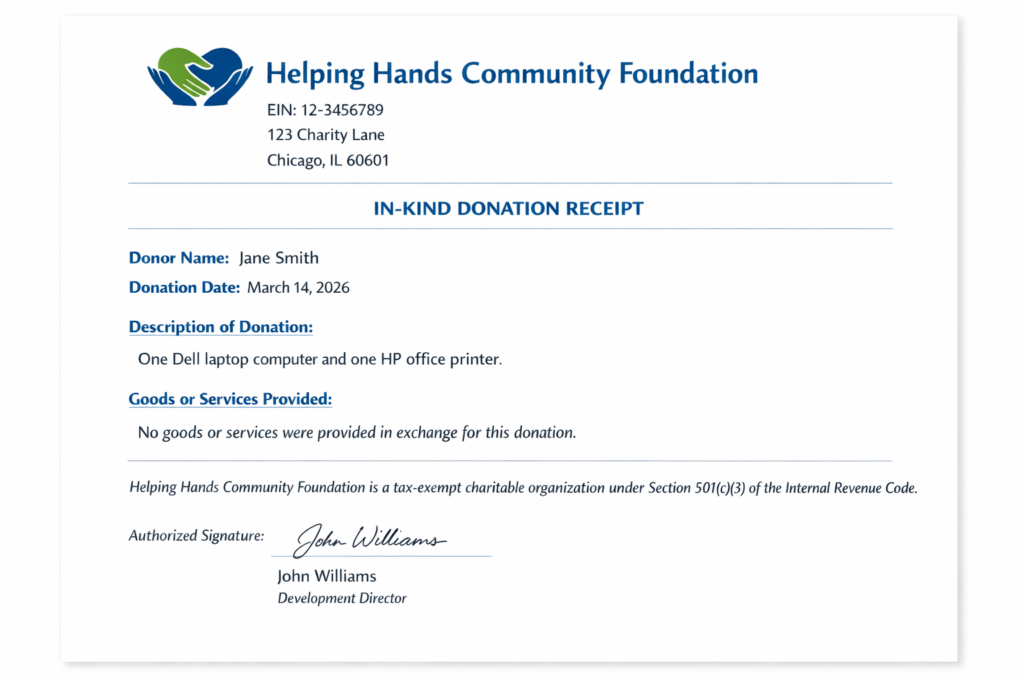
(This is a dummy receipt shown for illustration purposes only. All names and details are fictitious.)
Valuation Rules (What NOT to Include)
This is where many nonprofits make mistakes.
Never Include These in Non-Cash Receipts
Estimated dollar value
Fair market value
Replacement cost
Online resale value
Appraisal references
Why Valuation Is the Donor’s Responsibility
IRS rules clearly state that donors determine value, not charities. When nonprofits assign values, they risk penalties and donor disputes.
If a donor asks for a value, you should politely explain that IRS rules prevent the organization from assigning one.
Common Mistakes Nonprofits Make
Even experienced nonprofits make errors with in-kind donation receipts.
Frequent Compliance Errors
Assigning estimated values
Using vague item descriptions
Forgetting the “no goods or services” statement
Issuing receipts late
Using outdated receipt templates
Missing EIN or organization status
Each of these mistakes can trigger donor complaints or IRS scrutiny.
IRS Forms & Thresholds ($250, $500, $5,000 Rules)
Non-cash donations trigger different IRS forms based on value.
$250 Rule
Written acknowledgment required
Receipt must include all required elements
$500 Rule
Donor must file Form 8283 (Section A)
Nonprofit does not complete the form
$5,000 Rule
Donor must file Form 8283 (Section B)
Qualified appraisal required
Nonprofit signs the form acknowledging receipt
Special Rules for Vehicles
Vehicle donations require Form 1098-C and additional disclosures.
How Donation Receipt Software Helps
Manual receipt creation increases risk. Donation receipt software automates compliance and saves staff time.
Benefits of Automated Receipt Software
Pre-built IRS-compliant templates
Automatic required disclosures
Accurate item descriptions
Secure donor records
Easy retrieval during audits
Faster receipt delivery
Automation ensures consistency across every donation.
Why DonorKite Is the Best Solution
DonorKite is built specifically for nonprofits that want to eliminate compliance stress and simplify donation documentation. It supports organizations of all sizes by ensuring every receipt meets IRS requirements—without manual effort or guesswork.
Whether your nonprofit receives cash gifts, non-cash donations, stock contributions, or other forms of support, DonorKite helps you manage everything accurately and efficiently from one place.
What Makes DonorKite Different
Built for U.S. IRS regulations: DonorKite is designed around current IRS rules for 501(c)(3) organizations. Every receipt includes required disclosures, language, and formatting to support donor tax deductions and audit readiness.
Handles all types of donations correctly: DonorKite supports cash donations, non-cash gifts, property contributions, stock donations, and other donation types. Each receipt is generated based on the correct IRS requirements for that specific contribution.
Prevents valuation mistakes automatically: For non-cash donations, DonorKite ensures receipts include clear item descriptions without assigning dollar values. This protects nonprofits from common compliance errors and prevents donor confusion.
Generates professional receipts instantly: Receipts are created automatically and delivered quickly, improving donor experience while reducing administrative workload for nonprofit staff.
Stores audit-ready records securely: All donation data and receipts are stored in a secure system, making it easy to retrieve documentation during audits, donor inquiries, or annual reporting.
By automating donation receipts and compliance checks, DonorKite allows nonprofits to spend less time on paperwork and more time advancing their mission, building donor trust, and increasing long-term support.
Final Compliance Checklist
Before issuing any non-cash donation receipt, confirm the following:
Description is detailed but unvalued
Receipt includes EIN and organization name
Proper disclosure statement is included
Donation date is accurate
Receipt issued within IRS time limits
Copy stored securely
If all boxes are checked, your receipt meets IRS standards.
Conclusion
Non-cash gifts play an important role in helping nonprofits operate, grow, and extend their impact. However, these donations also come with specific IRS requirements that organizations cannot afford to overlook. Issuing accurate, compliant receipts ensures that donors can claim their tax deductions with confidence while protecting your organization from avoidable compliance issues.
By understanding IRS rules, using clear item descriptions, and avoiding valuation errors, nonprofits can handle in-kind donations correctly and consistently. Reliable donation receipt software further simplifies this process by reducing manual work, preventing mistakes, and keeping records organized for future audits.
A well-prepared non-cash donation receipt is more than a formality—it reflects transparency, accountability, and professionalism. When donors see that their contributions are handled carefully and in line with IRS guidelines, trust grows. That trust leads to stronger donor relationships, repeat giving, and long-term support for your mission.