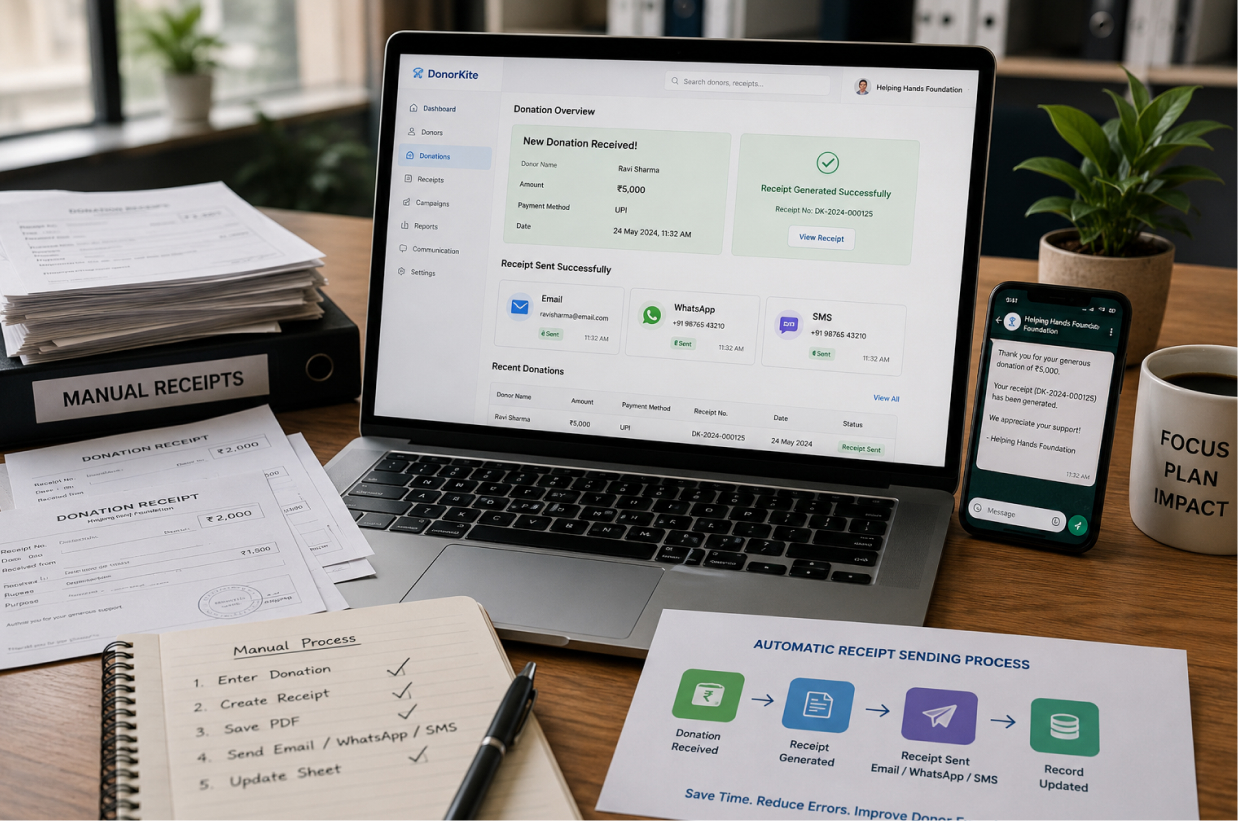
Every donation deserves a timely acknowledgment. Whether a donor contributes online, through a fundraising event, via bank transfer, or through a community campaign, receiving a donation receipt confirms that their contribution has been received and recorded correctly.
However, many nonprofits, NGOs, charitable trusts, religious organizations, foundations, and fundraising groups still rely on manual methods to create and share donation receipts. Staff members often spend hours updating spreadsheets, generating receipts individually, sending emails, and maintaining donor records. While this process may seem manageable initially, it quickly becomes inefficient as donation volumes increase.
Manual receipt management not only consumes valuable administrative time but also increases the risk of delays, errors, and inconsistent donor communication. In an era where donors expect quick responses and professional interactions, these challenges can affect donor trust and overall fundraising effectiveness.
This is where Donation Receipt Software becomes a game-changer.
Modern donation receipt solutions automate the entire receipt process, helping organizations generate, manage, and deliver receipts instantly through email, WhatsApp, and SMS. Instead of spending hours on repetitive administrative work, teams can focus on donor engagement, fundraising growth, and mission-driven activities.
In this guide, we’ll explore why organizations are moving away from manual receipt sharing, how donation receipt software works, the features to look for, and how automation can improve both donor relationships and operational efficiency.
Why Donation Receipts Matter More Than Ever
Many organizations view donation receipts as a simple administrative requirement. In reality, they play a critical role in donor communication, transparency, and long-term fundraising success.
A donation receipt serves several important purposes:
- Confirms that a donation was received successfully
- Provides documentation for donors
- Builds trust and credibility
- Improves transparency
- Supports record keeping and audits
- Creates a professional donor experience
For donors, a receipt is often the first direct communication they receive after making a contribution. A prompt and accurate acknowledgment reassures them that their donation has reached the intended organization.
The Link Between Timely Receipts and Donor Trust
Imagine making a donation and not hearing back from the organization for several days.
Questions naturally arise:
- Was my donation received?
- Did the payment go through successfully?
- Was the amount recorded correctly?
- Will I receive documentation for my records?
An instant receipt eliminates these concerns immediately.
When organizations send receipts promptly, donors feel valued and appreciated. This simple interaction helps establish trust and creates a stronger foundation for future engagement.
Why Modern Donors Expect Faster Communication
Today’s donors are accustomed to instant confirmations from online purchases, banking transactions, and digital services.
The same expectations now apply to charitable giving.
Donors increasingly expect:
- Immediate confirmation
- Professional communication
- Easy access to records
- Transparent donation tracking
Organizations that continue relying on manual processes often struggle to meet these expectations consistently.
The Hidden Costs of Manual Receipt Sharing
Many organizations underestimate how much time and effort manual receipt management actually requires.
While creating a single receipt may take only a few minutes, the workload increases significantly as donations grow.
Administrative Time Adds Up Quickly
A typical manual workflow often involves:
- Collecting donation information
- Verifying donor details
- Creating receipt documents
- Assigning receipt numbers
- Sending receipts individually
- Updating donor databases
- Maintaining records for future reference
For organizations processing dozens or hundreds of donations each month, these tasks can consume a substantial portion of staff time.
Instead of focusing on fundraising initiatives, donor engagement, or program delivery, teams become occupied with repetitive administrative work.
Increased Risk of Human Errors
Manual processes naturally create opportunities for mistakes.
Common issues include:
- Incorrect donor names
- Wrong donation amounts
- Missing receipt numbers
- Duplicate receipts
- Incomplete records
- Incorrect contact information
Even small errors can create confusion and require additional follow-up communication.
Delayed Receipt Delivery
Many organizations batch receipt creation weekly or monthly because of workload constraints.
This can result in donors waiting days—or even weeks—to receive acknowledgment of their contribution.
Delayed communication can negatively affect donor satisfaction and create unnecessary uncertainty.
Difficulty Managing Growing Donor Databases
As organizations expand, donor information becomes more complex.
Managing hundreds or thousands of donor records through spreadsheets often leads to:
- Duplicate entries
- Missing information
- Inconsistent data
- Reporting challenges
- Limited visibility into donor history
Without a centralized system, maintaining accurate records becomes increasingly difficult.
Manual Receipt Sharing vs Donation Receipt Software
The differences between manual processes and automated systems become more apparent as fundraising activities grow.
| Feature | Manual Receipt Sharing | Donation Receipt Software |
| Receipt Creation | Manual | Automated |
| Time Required | High | Minimal |
| Error Risk | High | Low |
| Delivery Speed | Slow | Instant |
| Donor Experience | Inconsistent | Professional |
| Record Keeping | Manual | Centralized |
| Scalability | Limited | Excellent |
| Reporting | Time-Consuming | Automated |
| Team Productivity | Lower | Higher |
Organizations that adopt donation receipt software often experience immediate improvements in efficiency, accuracy, and donor communication.
When Manual Processes Stop Working
Many organizations begin with spreadsheets and basic document templates.
This approach may work when handling a small number of donations each month.
However, challenges typically emerge when:
- Donation volumes increase
- Multiple fundraising campaigns are running simultaneously
- Teams need better visibility into donor activity
- Compliance requirements become more demanding
- Donors expect faster communication
At this stage, automation becomes less of a convenience and more of a necessity.
How Organizations Are Automating Donation Receipts Today
One of the most common questions fundraising teams ask is:
How do you send donation receipts automatically?
The answer lies in modern donation receipt software.
Instead of manually preparing and sending receipts, organizations can automate the entire workflow.
Step 1: Capture Donation Information
The system records:
- Donor name
- Donation amount
- Date of donation
- Payment method
- Email address
- Mobile number
- Campaign details
This information may come from:
- Online donation forms
- Fundraising events
- Direct donations
- Bank transfers
- Offline donation entries
Step 2: Generate the Receipt Automatically
Once a donation is recorded, the software automatically generates a receipt using predefined templates.
This eliminates the need to create receipts manually for every transaction.
Step 3: Deliver the Receipt Instantly
Modern solutions can send receipts through multiple channels, including:
- SMS
This ensures donors receive acknowledgment through their preferred communication method.
Step 4: Store and Track Records
Every receipt is automatically stored and linked to the donor’s profile.
Organizations can easily access:
- Donation history
- Receipt records
- Communication logs
- Campaign performance data
Step 5: Maintain Accurate Donor Records
Automated systems keep donor information organized and up to date, making future communication and reporting significantly easier.
What Is Donation Receipt Software?
Donation Receipt Software is a specialized solution designed to automate the creation, management, and delivery of donation receipts while maintaining accurate donor and donation records.
Instead of relying on spreadsheets, document templates, and manual communication, organizations can use a centralized system that automatically generates receipts whenever a donation is recorded.
Modern fundraising organizations need more than basic receipt generation. They need a solution that helps them:
- Manage donors effectively
- Track donations in real time
- Generate receipts instantly
- Communicate through multiple channels
- Maintain organized records
- Improve operational efficiency
As fundraising activities become increasingly digital, Donation Receipt Software has become an essential tool for nonprofits, NGOs, charitable trusts, foundations, educational institutions, and religious organizations.
Why Organizations Are Adopting Donation Receipt Software
The fundraising landscape has changed significantly in recent years.
Organizations now receive donations through:
- Online donation forms
- UPI payments
- Payment gateways
- Bank transfers
- Fundraising campaigns
- Events and community drives
Managing these contributions manually can quickly become overwhelming.
Donation Receipt Software helps organizations:
- Save administrative time
- Improve donor communication
- Reduce human errors
- Maintain organized records
- Support fundraising growth
- Deliver a professional donor experience
The result is a more efficient organization that can spend less time on administrative tasks and more time advancing its mission.
Essential Features of Modern Donation Receipt Software
Not all solutions offer the same capabilities.
When evaluating Donation Receipt Software, organizations should focus on features that improve efficiency, donor management, and communication.
Automatic Receipt Generation
One of the most important features is the ability to generate receipts automatically.
When a donation is recorded, the software instantly creates a professional receipt using predefined templates.
This eliminates the need for:
- Manual document creation
- Repetitive data entry
- Individual receipt preparation
Automated receipt generation ensures consistency and significantly reduces administrative workload.
Donor Management
Effective fundraising depends on strong donor relationships.
Modern software should include a centralized donor database that allows organizations to:
- Store donor information
- Track donation history
- Monitor recurring contributions
- Segment supporters
- Maintain communication records
Having all donor data in one place helps organizations build stronger relationships and make more informed fundraising decisions.
Donation Tracking
Organizations need visibility into their fundraising performance.
Donation tracking features help teams monitor:
- Total donations received
- Campaign performance
- Donation trends
- Donor activity
- Contribution history
This information is valuable for planning future fundraising initiatives and measuring impact.
Multi-Channel Receipt Delivery
Today’s donors use different communication channels.
Some prefer email, while others are more responsive on WhatsApp or mobile messaging.
The best Donation Receipt Software allows organizations to send receipts through multiple channels to improve visibility and engagement.
Automatic Donation Receipt Software: Why Automation Matters
Many organizations begin with manual processes because they appear simple and affordable.
However, automation becomes increasingly valuable as fundraising activities grow.
Faster Operations
Instead of spending hours preparing receipts, organizations can generate and send acknowledgments within seconds.
Better Accuracy
Automated systems reduce the risk of:
- Typographical errors
- Incorrect donation amounts
- Duplicate receipts
- Missing records
Improved Donor Experience
Donors appreciate receiving immediate confirmation that their contribution has been received.
Scalability
Whether an organization processes ten donations per month or ten thousand, automation helps maintain efficiency and consistency.
Reduced Administrative Burden
Teams spend less time managing receipts and more time focusing on fundraising, outreach, and donor engagement.
Email Donation Receipts Software: The Foundation of Donor Communication
Email continues to be one of the most effective channels for donor acknowledgment.
An Email Donation Receipts Software solution allows organizations to automatically deliver detailed receipts directly to a donor’s inbox.
Benefits of Email Donation Receipts
Professional Communication: Email receipts create a professional experience while providing donors with complete documentation.
Easy Record Keeping: Donors can store, organize, and access receipts whenever needed.
Personalization: Organizations can customize messages using donor information, campaign details, and branding elements.
Instant Delivery: Receipts can be sent immediately after a donation is received.
What to Look for in Email Donation Receipts Software
An effective solution should support:
- Automated delivery
- Custom receipt templates
- Personalized messaging
- Delivery tracking
- Donor database integration
These capabilities help organizations streamline communication while maintaining a professional image.
WhatsApp Donation Receipt Software: Meeting Donors Where They Are
Communication preferences are changing.
Many donors check WhatsApp more frequently than email, making it an increasingly valuable channel for receipt delivery.
WhatsApp Donation Receipt Software enables organizations to send donation confirmations directly through WhatsApp, ensuring faster visibility and engagement.
Advantages of WhatsApp Receipt Delivery
Immediate Visibility: Messages often receive attention quickly because donors regularly check WhatsApp throughout the day.
Improved Engagement: WhatsApp creates a more direct and conversational communication experience.
Faster Acknowledgment: Receipts can be delivered instantly after donations are recorded.
Better Accessibility: Donors can easily access receipts from their mobile devices without searching through email inboxes.
As mobile communication continues to grow, WhatsApp is becoming an important part of modern donor engagement strategies.
SMS Donation Receipt Software: Fast, Reliable, and Accessible
SMS remains one of the most universally accessible communication channels.
Unlike email or app-based messaging, SMS works on virtually every mobile device.
Benefits of SMS Donation Receipt Software
Immediate Delivery: Receipts reach donors within seconds.
Broad Reach: SMS can reach supporters regardless of device type or internet availability.
High Visibility: Text messages are often viewed quickly after delivery.
Simple Communication: SMS provides a straightforward method for confirming donations and sharing receipt information.
Many organizations use SMS alongside email and WhatsApp to ensure donors receive timely acknowledgments through multiple channels.
Donation Receipt Format: What Information Should Be Included?
One of the most common questions organizations ask is:
What should a donation receipt include?
A properly structured receipt helps maintain transparency, improve record keeping, and provide donors with accurate documentation.
While requirements may vary depending on organizational and regional regulations, most donation receipts should include the following information.
Organization Information
Include:
- Organization name
- Address
- Contact details
- Registration information (if applicable)
This helps donors identify the issuing organization.
Receipt Number
Each receipt should have a unique reference number.
Receipt numbers help with:
- Tracking
- Auditing
- Record management
- Future reference
Donor Information
Include:
- Donor name
- Contact information
Accurate donor details reduce confusion and improve record keeping.
Donation Information
Clearly specify:
- Donation amount
- Donation date
- Payment method
- Campaign or purpose (if applicable)
This ensures transparency and accuracy.
Acknowledgment Message
A simple thank-you message reinforces donor appreciation and strengthens relationships.
Example:
“Thank you for your generous contribution. Your support helps us continue our mission and create meaningful impact.”
Authorized Signature or Approval
Many organizations include a digital signature or authorized approval to enhance professionalism and authenticity.
Donation Receipt Template Example
Below is a simple donation receipt template that organizations can use as a reference.
Donation Receipt
Receipt Number: DR-2026-00125
Organization Name: ABC Foundation
Organization Address: 123 Community Street
Donor Name: John Smith
Donation Amount: ₹5,000
Donation Date: June 15, 2026
Payment Method: Online Transfer
Purpose: General Fund Donation
Acknowledgment
Thank you for your generous contribution. Your support helps us continue serving our community and advancing our mission.
Authorized Representative
ABC Foundation
While templates are useful, manually creating receipts using templates can become time-consuming as donation volumes grow. Donation Receipt Software automates this process, ensuring every donor receives a professional and accurate receipt without additional administrative effort.
Common Donation Receipt Mistakes Organizations Make
Even organizations with the best intentions can encounter challenges when managing donation receipts manually. As donation volumes increase, small mistakes can quickly turn into larger administrative problems.
Understanding these common issues can help organizations improve their processes and provide a better donor experience.
Delayed Receipt Delivery
One of the most common mistakes is waiting too long to acknowledge donations.
Many organizations create receipts weekly or monthly to save time. While this may seem efficient internally, donors often expect confirmation much sooner.
Delayed receipts can create uncertainty and leave donors wondering whether their contribution was received successfully.
Automated receipt systems solve this problem by delivering acknowledgments immediately after a donation is recorded.
Incorrect Donation Amounts
Manual data entry increases the risk of recording incorrect donation values.
Even minor mistakes can create confusion and require additional follow-up communication to resolve.
Accurate donation records are essential for maintaining donor trust and organizational credibility.
Missing Donor Information
Incomplete donor records often lead to communication challenges.
Missing details such as email addresses, phone numbers, or donor names can make it difficult to send receipts and maintain accurate records.
A centralized donor management system helps ensure information remains complete and organized.
Duplicate Receipts
Without proper tracking mechanisms, organizations may accidentally issue duplicate receipts.
This can create confusion for both donors and internal teams.
Automated systems assign unique receipt numbers and maintain detailed records to prevent duplication.
Inconsistent Record Keeping
When donation information is stored across multiple spreadsheets, email threads, and documents, maintaining consistency becomes difficult.
Over time, this can result in:
- Duplicate donor records
- Missing transaction history
- Reporting inaccuracies
- Compliance challenges
A centralized system helps eliminate these issues and provides a single source of truth for donor and donation information.
Email vs WhatsApp vs SMS Receipts: Which Channel Is Best?
Modern donors communicate in different ways.
Some prefer email, while others are more responsive to mobile messaging platforms such as WhatsApp and SMS.
The most effective approach often involves using multiple channels to ensure receipts are received and viewed promptly.
| Feature | SMS | ||
| Delivery Speed | Fast | Instant | Instant |
| Accessibility | High | Very High | Very High |
| Detailed Information | Excellent | Good | Limited |
| Donor Engagement | Good | Excellent | Good |
| Record Keeping | Excellent | Good | Limited |
| Mobile Visibility | Moderate | High | High |
| Personalization | Excellent | Good | Moderate |
When Email Works Best
Email is ideal for:
- Detailed receipts
- Long-form donor communication
- Record retention
- Professional documentation
Most organizations continue to use email as their primary receipt delivery channel.
When WhatsApp Works Best
WhatsApp is effective when organizations want:
- Faster visibility
- Higher engagement
- Convenient mobile access
- Direct donor communication
Because many people check WhatsApp frequently throughout the day, receipts delivered through this channel are often seen quickly.
When SMS Works Best
SMS remains valuable for:
- Immediate notifications
- Broad accessibility
- Simple confirmations
- Reaching donors without internet access
Many organizations combine email, WhatsApp, and SMS to create a more reliable donor communication strategy.
How Automated Receipts Improve Donor Retention
Donor retention is one of the most important factors in long-term fundraising success.
While attracting new supporters is important, retaining existing donors is often more cost-effective and sustainable.
Donation receipts play a larger role in donor retention than many organizations realize.
Immediate Acknowledgment Creates Positive Experiences
When donors receive instant confirmation, they know their contribution has been received successfully.
This creates confidence and reinforces trust in the organization.
Professional Communication Strengthens Credibility
Automated systems ensure every donor receives a consistent and professional acknowledgment.
This helps organizations present themselves as organized, transparent, and accountable.
Better Communication Builds Stronger Relationships
Effective donor communication goes beyond fundraising campaigns.
Timely receipts demonstrate appreciation and help create positive donor experiences that encourage future engagement.
Organized Data Supports Personalized Outreach
When donor records are centralized, organizations can better understand donor behavior and tailor future communication accordingly.
This can lead to stronger relationships and improved fundraising outcomes over time.
Why Growing Organizations Need More Than Spreadsheets
Spreadsheets are often the starting point for donor management.
They are simple, familiar, and easy to access.
However, as organizations grow, spreadsheets begin to reveal significant limitations.
Difficulty Managing Large Donor Databases
As donor numbers increase, spreadsheets become harder to maintain accurately.
Common issues include:
- Duplicate records
- Data inconsistencies
- Missing information
- Version control challenges
Limited Reporting Capabilities
Fundraising teams often need insights into:
- Donation trends
- Campaign performance
- Donor activity
- Contribution history
Generating these reports manually can be time-consuming and prone to errors.
Communication Challenges
Spreadsheets are not designed for donor communication.
Teams must often switch between multiple tools to:
- Send receipts
- Track communications
- Maintain records
- Monitor engagement
This fragmented approach reduces efficiency and increases administrative complexity.
Lack of Automation
Perhaps the biggest limitation is the inability to automate repetitive tasks.
As donation volumes increase, manual processes consume more time and resources.
Organizations eventually reach a point where spreadsheets can no longer support their operational needs effectively.
How DonorKite Simplifies Donation Receipt Management
Managing donations and donor communications should not require hours of manual effort.
DonorKite is designed to help nonprofits, NGOs, trusts, foundations, religious organizations, and fundraising teams streamline donation management and receipt delivery.
Instead of juggling spreadsheets, templates, and multiple communication tools, organizations can manage everything from a single platform.
With DonorKite, organizations can:
Manage Donors and Donations
Track who donated, when they donated, and how much they contributed.
A centralized database makes it easy to maintain organized donor records and access donation history whenever needed.
Generate Donation Receipts Automatically
DonorKite eliminates the need for manual receipt creation.
Receipts are generated automatically, helping organizations save time and reduce administrative workload.
Send Receipts Through Multiple Channels
Organizations can instantly deliver receipts through:
- SMS
This helps ensure donors receive acknowledgments quickly and through their preferred communication method.
Maintain Accurate Records
All donor and donation information is stored in one place, improving visibility and simplifying reporting.
Improve Operational Efficiency
By automating repetitive tasks, teams can spend more time on fundraising, donor engagement, and mission-focused activities.
Whether an organization processes a handful of donations each month or manages large-scale fundraising campaigns, DonorKite helps simplify operations and create a more professional donor experience.
Conclusion
As fundraising activities continue to grow, manual receipt management becomes increasingly difficult to sustain. Creating receipts individually, maintaining spreadsheets, and sending acknowledgments manually can consume valuable time while increasing the risk of errors and delays.
Donation Receipt Software offers a smarter alternative.
By automating receipt generation, maintaining organized donor records, and enabling instant delivery through Email, WhatsApp, and SMS, organizations can improve efficiency while providing a better donor experience.
Beyond saving time, automation helps strengthen donor trust, improve communication, and create the operational foundation needed for long-term fundraising success.
For nonprofits, NGOs, charitable trusts, foundations, religious organizations, and fundraising teams looking to modernize their operations, investing in Donation Receipt Software is no longer just a convenience—it is becoming an essential part of effective donor management.
Solutions like DonorKite make it easier to manage donors and donations, generate receipts automatically, and deliver acknowledgments instantly, helping organizations focus less on administrative work and more on creating meaningful impact.
Frequently Asked Questions (FAQs)
Why is Donation Receipt Software important?
It helps organizations save time, reduce errors, improve donor communication, and maintain accurate records for reporting and compliance purposes.
How do I send donation receipts automatically?
Organizations can use Donation Receipt Software to automatically generate and deliver receipts through email, WhatsApp, or SMS whenever a donation is recorded.
Can donation receipts be sent through WhatsApp?
Yes. Many modern solutions allow organizations to send donation receipts directly through WhatsApp for faster communication and improved visibility.
What information should be included in a donation receipt?
A donation receipt should typically include:
- Organization name
- Receipt number
- Donor name
- Donation amount
- Donation date
- Payment method
- Acknowledgment message
What is Automatic Donation Receipt Software?
Automatic Donation Receipt Software generates and sends receipts without requiring manual intervention, improving efficiency and accuracy.
What are the benefits of Email Donation Receipts Software?
Email receipt software helps organizations provide professional documentation, improve record keeping, and deliver receipts instantly.
Why use WhatsApp Donation Receipt Software?
WhatsApp receipt delivery provides faster visibility, improved engagement, and convenient access to donation acknowledgments.
What are the advantages of SMS Donation Receipt Software?
SMS offers immediate delivery, broad accessibility, and reliable communication across virtually all mobile devices.
Can Donation Receipt Software help with donor management?
Yes. Many platforms include donor databases, donation tracking, communication records, and reporting features that help organizations manage donor relationships effectively.
Is Donation Receipt Software suitable for small NGOs?
Absolutely. Organizations of all sizes can benefit from automation, improved communication, and more efficient donor management.
How does automation improve fundraising operations?
Automation reduces administrative work, improves accuracy, speeds up communication, and allows teams to focus on fundraising and donor engagement.