
While digital fundraising grabs the headlines with crowdfunding campaigns and QR codes, the reality for most non-governmental organizations (NGOs) in Germany is quite different. A significant portion of charitable giving still happens offline. Whether it represents cash collected at a local Sommerfest, direct bank transfers (Überweisungen) from loyal monthly supporters, or checks received via mail, offline donations remain the financial backbone of the nonprofit sector.
However, managing these funds presents a unique operational challenge. Unlike online payments that are automatically recorded and receipted, offline donations require manual intervention. For many organizations, this leads to a chaotic mix of spreadsheets, paper receipts, and fragmented data. This disconnect doesn't just waste valuable administrative time; it creates compliance risks regarding German tax laws and can damage donor relationships if acknowledgments are missed.
To bridge this gap, organizations must adopt the right Software to Manage Offline Donations in Germany. Transitioning from manual spreadsheets to a dedicated system isn't just about modernization; it is about ensuring every Euro donated is accounted for, compliant, and used to further your mission. This guide explores the landscape of offline donation management and identifies the best tools to streamline your operations.
Understanding the Landscape of Offline Donations in Germany
The German donation culture is distinct. While younger generations are moving toward digital wallets, older demographics—who often make up the core of major donors—still prefer traditional methods. Bank transfers, standing orders (Daueraufträge), and cash donations at events are prevalent.
The Bureaucratic Challenge
Managing these funds is not merely a matter of bookkeeping; it is a matter of strict legal compliance. German tax law is rigorous regarding charitable donations. To allow donors to claim tax deductions, NGOs must issue valid donation receipts (Zuwendungsbestätigungen). If these receipts contain errors or lack specific required information, the Finanzamt (tax office) may reject them, leading to frustrated donors and potential audits for the organization.
This is where a robust offline donation management software in Germany becomes essential. The software must do more than just record a number; it needs to capture the donor's full details, the date of receipt, the purpose of the donation, and generate a receipt that meets current regulatory standards.
Furthermore, data privacy is non-negotiable. With the GDPR (DSGVO) in full effect, keeping donor lists on unsecured Excel sheets on a local laptop is a significant liability. An offline donor management system in Germany ensures that sensitive financial data is encrypted, access-controlled, and stored in compliance with data protection laws.
Key Features to Look for in Donation Management Software
When evaluating software, you need a solution that specifically addresses the friction points of non-digital giving. A tool designed purely for online credit card processing will fail to meet your needs. Here are the non-negotiable features you should prioritize.
1. Robust Offline Donation Tracking
You need a centralized system that treats offline giving with the same fidelity as online giving. The best offline donation receipt software in Germany allows for easy manual entry of cash and check donations. Crucially, it should support bulk imports. If you receive a monthly bank statement with 500 bank transfers, you shouldn't have to type them in one by one. The software should allow you to upload bank files (like CSV or CAMT formats) and automatically map them to existing donor profiles.
2. Automated Receipt Generation
This is often the biggest time-saver. Generating end-of-year cumulative tax receipts (Sammelbestätigungen) manually is a massive administrative burden. A capable tax donation receipt software in Germany will automate this entirely. It should generate PDF receipts that are legally compliant, customized with your NGO’s branding, and ready to be emailed or printed for postage immediately after a donation is logged or at the end of the fiscal year.
3. Comprehensive Donor Management
An isolated donation is less valuable than a relationship. A charity donation management software in Germany should function as a CRM (Customer Relationship Management) tool. When you view a donor's profile, you should see a holistic view: their online gifts, their offline bank transfers, their volunteer history, and communication logs. This 360-degree view allows for better stewardship and segmentation.
4. Integration Capabilities
Your donation software cannot exist in a vacuum. It needs to "talk" to your accounting software (like DATEV) and your email marketing tools. A donation receipt tracking system in Germany that integrates with your financial systems ensures that the numbers your fundraising team sees match the numbers your accountant sees.
5. Specialized Tracking Needs
Different organizations have different revenue streams. For example, religious institutions often deal with specific trust funds or tithes. Using specialized trust donation management software in Germany or religious organization donation software in Germany ensures that funds restricted for specific purposes are tracked separately and used correctly, maintaining transparency and trust.
Top Software Options for Managing Offline Donations in Germany
Selecting the right tool can be daunting given the variety of options. Below are some of the top contenders that excel in the German market, starting with our top recommendation.
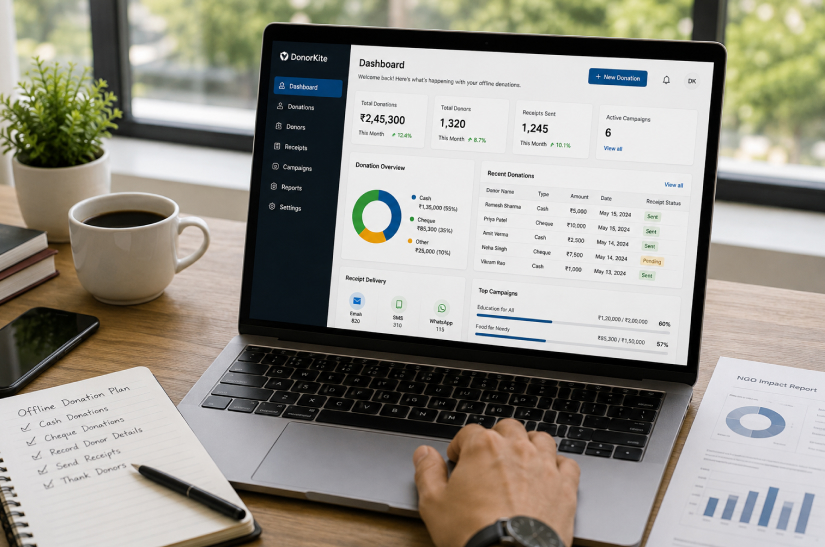
1. DonorKite
For NGOs seeking a balance of powerful features and ease of use, DonorKite stands out as a premier choice. It is highly adaptable to the specific needs of organizations operating within the German regulatory framework.
DonorKite excels as a donation receipt software for ngos in Germany because it streamlines the reconciliation of offline data. Its strength lies in its ability to integrate with legacy systems while providing a modern interface for tracking cash, checks, and bank transfers.
- Key Features: It offers robust donor profile management, enabling you to segment donors based on their giving history (online and offline). Its receipt generation engine is designed to handle the specific requirements of tax-compliant receipts, reducing the workload during tax season.
- Why it works for Germany: DonorKite understands the nuances of non-digital giving. It offers dedicated features that serve as cheque donation tracking software in Germany, ensuring that even the less common payment methods are accurately recorded and acknowledged.
2. FundraisingBox
A well-known player in the DACH region, FundraisingBox is a comprehensive CRM designed specifically for charities.
- Key Features: It offers a strong "Donation Management" module that handles SEPA direct debits and bank transfer reconciliation. It automates the Zuwendungsbestätigung process effectively.
- Pros: Locally hosted data (servers in Germany) ensures high GDPR compliance.
- Cons: It can be on the pricier side for smaller associations, and the feature set might be overwhelming if you only need basic tracking.
3. CiviCRM
For organizations that prefer open-source solutions, CiviCRM is a powerful contender. It is highly customizable and free to download, though hosting and maintenance cost money.
- Key Features: Because it is open-source, the community has built specific extensions for German tax receipts and banking standards. It is a flexible donation acknowledgment software in Germany.
- Pros: No licensing fees and complete ownership of your data.
- Cons: It requires significant technical expertise to set up and maintain. If you don't have an IT team, the complexity can become a hurdle.
4. Salesforce Nonprofit Cloud
For large international NGOs with a branch in Germany, Salesforce is the industry standard for scalability.
- Key Features: Unmatched customization. You can build virtually any workflow, including complex offline donor management system in Germany processes that trigger tasks for major gift officers.
- Pros: It grows with you effectively forever.
- Cons: High implementation costs and a steep learning curve. It often requires hiring a specialized consultant to configure it for German-specific banking and tax needs.
How to Choose the Right Software for Your NGO
Finding the perfect Software to Manage Offline Donations in Germany depends on your organization's size, budget, and technical capacity.
Assess Your Volume:
If you process five checks a month, a simple spreadsheet might still suffice (provided it is secure). If you process 500 bank transfers a month, you need automation. Look for donation receipt software for ngos in Germany that offers batch processing to handle high volumes without manual data entry errors.
Check the "German Fit":
Many US-based software platforms claim to be global, but fail when asked to generate a German tax receipt or handle a SEPA file. Always ask specifically to see the German receipt template and how the system handles German banking formats.
Consider Scalability:
Will the software grow with you? A system that works for 1,000 donors might crash under the weight of 50,000. Ensure the trust donation management software in Germany you choose handles complex fund accounting as your revenue streams diversify.
Evaluate Support:
When you are trying to print tax receipts in January and the system jams, you need help immediately. Test the vendor's customer support. Do they have support staff available during European business hours?
Best Practices for Implementing and Using Donation Management Software
Buying the software is only the first step. Implementation is where success happens.
Data Migration and Cleanup
Before moving to a new offline donation management software in Germany, clean your data. Remove duplicate profiles, update addresses, and standardize how you record names. Importing "dirty" data into a new system will only lead to sophisticated confusion.
Rigorous Training
Your staff and volunteers need to know exactly how to enter offline gifts. Create a standard operating procedure (SOP). For example, establish a rule for how to record a check from a joint bank account—does the credit go to the husband, the wife, or both? Consistency is key for the donation receipt tracking system in Germany to work correctly.
Workflow Optimization
Use the software to trigger automatic "Thank You" tasks. When a check is logged in the cheque donation tracking software in Germany, the system should alert a staff member to write a handwritten note, or automatically send a digital acknowledgment if an email address is on file. Speed of acknowledgment is directly tied to donor retention.
Regular Audits
Even with the best donation acknowledgment software in Germany, human error happens. Schedule quarterly audits where you compare the total donations in your software against your actual bank deposits. This reconciliation ensures financial integrity and prepares you for end-of-year reporting without panic.
Empowering Your Mission Through Better Management
Managing offline donations in Germany comes with a unique set of administrative and regulatory hurdles. However, viewing these offline donors as a burden is a mistake; they are often your most loyal and generous supporters. They deserve a management system that handles their contributions with care and professionalism.
By implementing specialized Software to Manage Offline Donations in Germany, such as DonorKite, organizations can move away from the risks of manual data entry and toward a future of efficiency. Whether you are a small local club or a large religious organization donation software in Germany user, the right tools will free up your time. Instead of wrestling with receipts and spreadsheets, your team can focus on what matters most: building relationships with donors and driving impact for your cause.
Take the time to review your current processes today. If you are spending more time managing the administration of donations than the donations themselves, it is time for an upgrade.