

Charities and non-governmental organisations (NGOs) play a vital role in New Zealand’s social, cultural, and humanitarian landscape. Whether supporting health initiatives, education, environmental causes, or community welfare, these organisations rely heavily on public trust and donor confidence. One of the most important administrative responsibilities that supports this trust is the correct handling of donation receipts.
In New Zealand, donation receipts are directly linked to the country’s donation tax credit system. Donors can claim a tax credit for eligible charitable donations, but only if they have valid receipts that meet the standards set by the Inland Revenue Department (IRD). For charities and NGOs, understanding IRD donation receipt requirements is essential—not only to support donors, but also to demonstrate sound governance and compliance.
This guide provides a comprehensive explanation of IRD donation receipt requirements, when receipts must be issued, what information they must contain, common compliance risks, and best practices for managing donation documentation in New Zealand.
The Legal Context: Why Donation Receipts Matter in New Zealand
New Zealand’s tax system allows individuals to claim a donation tax credit of up to 33.33% of eligible donations made to approved donee organisations. This tax credit is claimed directly from IRD, and donation receipts serve as the primary evidence supporting the claim.
Unlike some jurisdictions where donation receipts are optional or purely informational, in New Zealand they are a compliance document. Without a valid receipt, a donor cannot successfully claim a donation tax credit, regardless of whether the donation itself was genuine.
From IRD’s perspective, donation receipts are part of the broader framework that ensures:
- Donations are genuine gifts
- Donee organisations are eligible
- Tax credits are claimed accurately
- Public funds are protected from misuse
For charities and NGOs, issuing correct receipts is therefore not just administrative—it is part of maintaining integrity in the charitable system.
Who Must Follow IRD Donation Receipt Requirements?
IRD donation receipt requirements apply only to specific types of organisations that are legally authorised to receive tax-deductible donations in New Zealand. These rules exist to protect donors, ensure tax credits are claimed correctly, and maintain trust in the charitable sector. Not every nonprofit or community organisation is permitted to issue donation receipts for tax purposes, and issuing them without the correct approval can result in serious compliance issues.
Registered Charities
Registered charities are required to follow IRD donation receipt requirements when issuing receipts to donors who may claim donation tax credits. These organisations must be formally registered and maintain their charitable status in good standing. Donation receipts issued by registered charities must contain accurate information and clearly reflect genuine gifts, as they form part of the donor’s tax credit claim with IRD.
Approved Donee Organisations
Approved donee organisations are specifically recognised by IRD as eligible to receive tax-deductible donations. These organisations may include charities, trusts, or other entities that meet IRD’s criteria. Donation receipts issued by approved donee organisations must comply fully with IRD requirements, as donors rely on these receipts to support their claims for donation tax credits.
NGOs Authorised to Receive Tax-Deductible Donations
Certain NGOs that are not traditional charities may still be authorised to receive tax-deductible donations. These organisations must have explicit approval to issue donation receipts for tax purposes. When authorised, NGOs are expected to follow the same standards of accuracy, transparency, and record-keeping as registered charities when issuing donation receipts.
Organisations that are not approved donee organisations must not issue donation receipts intended for donation tax credit claims, even if they operate on a nonprofit or community-focused basis. Issuing receipts without the appropriate status can create significant compliance risks for both the organisation and the donor.
Charities and NGOs should periodically confirm their donee status with IRD and ensure that donation receipts are issued only in circumstances where they are legally permitted. Regular reviews of organisational status help prevent errors and protect long-term compliance.
When Is a Charity Required to Issue a Donation Receipt?
In New Zealand, charities and NGOs are generally expected to issue donation receipts in situations where a donation meets IRD’s criteria for tax credit eligibility. While IRD does not mandate receipts for every payment in every circumstance, donation receipts play a practical and compliance-focused role in supporting both donors and organisations.
Charities and NGOs are typically expected to issue donation receipts when:
- A donor makes a voluntary payment: The donation must be given freely, without obligation or pressure, and should reflect the donor’s intention to support the organisation’s charitable purpose rather than to receive something in return.
- The payment qualifies as a genuine gift: A genuine gift is one where the donor does not receive a material benefit in exchange for the payment. This distinction is important, as payments tied to goods, services, or commercial value generally do not qualify as donations for tax credit purposes.
- The donor may reasonably expect to claim a tax credit: If a donor intends to use the payment to claim a donation tax credit, a compliant donation receipt becomes essential evidence for submission to IRD.
While IRD does not explicitly require charities to issue receipts for every transaction, issuing donation receipts has become standard practice across New Zealand. Donors commonly rely on receipts when submitting their annual donation tax credit claims, and consistent receipt issuance helps charities demonstrate financial transparency, accountability, and good governance.
What Qualifies as a “Gift” for Donation Receipt Purposes?
A key concept in IRD donation receipt requirements is the definition of a gift. For a donation to qualify:
- The payment must be voluntary
- The donor must not receive material benefit in return
- The donation must be made to an approved donee organisation
If a donor receives goods or services in return—such as merchandise, event tickets, or advertising benefits—the payment may not qualify as a gift in full or at all. In such cases, issuing a donation receipt can be inappropriate or misleading.
Charities must carefully assess fundraising activities to determine whether receipts should be issued.
Information That Must Appear on an IRD-Compliant Donation Receipt
IRD expects donation receipts to contain enough information to clearly establish the legitimacy of the donation. While IRD guidance allows some flexibility, a compliant donation receipt should include the following core details:
Required Information
- Full legal name of the charity or NGO
- IRD number of the organisation
- Date the donation was received
- Amount of the donation
- A clear statement confirming the donation is a gift
Strongly Recommended Information
- Name of the donor
- A unique receipt or reference number
- Contact details of the organisation
Including complete and consistent information reduces the likelihood of donor claims being delayed or questioned by IRD.
Example of an IRD-Compliant Donation Receipt
Below is an example of a donation receipt that meets the Inland Revenue Department (IRD) requirements in New Zealand. This sample illustrates the key information charities and NGOs should include when issuing receipts to donors for donation tax credit purposes.
Helping Hands Trust
Charity Registration Number: CC12345
IRD Number: 98-765-432
456 Kindness Avenue
Wellington 6011
New Zealand
DONATION RECEIPT
Donor Name: John Smith
Donation Date: 15 March 2024
Donation Amount: NZD $250.00
Gift Declaration:
This donation is a voluntary gift made to Helping Hands Trust, a registered charity in New Zealand.
Receipt Number: DR-2024-00491
This receipt has been issued in accordance with IRD donation receipt requirements and may be used by the donor to support a donation tax credit claim, subject to IRD eligibility rules.
Sample Donation Receipt Image for Reference
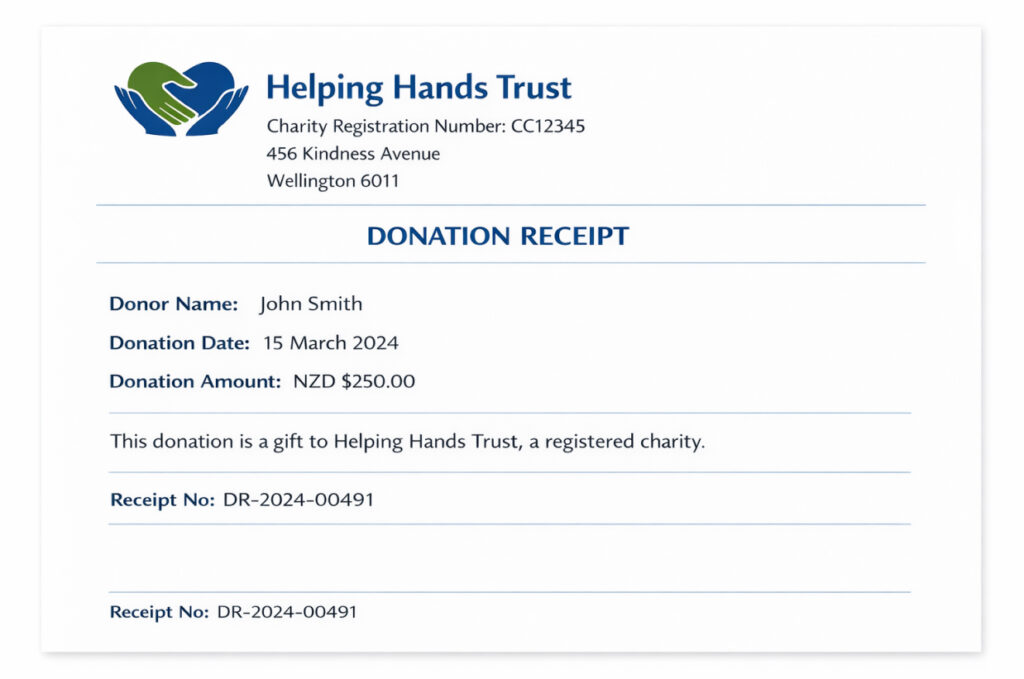
(This is a dummy receipt shown for illustration purposes only. All names and details are fictitious.)
Digital vs Paper Donation Receipts
The Inland Revenue Department (IRD) accepts both paper and digital donation receipts, provided they contain the required information and accurately reflect the donation. From a compliance perspective, both formats are treated equally under IRD rules.
In practice, however, charities and NGOs increasingly rely on digitally generated donation receipts, especially as donation volumes grow and donors submit tax credit claims online. Software-generated receipts offer greater consistency, accuracy, and long-term record availability compared to manual paper-based processes.
Digital Donation Receipts Generated Through Software
Donation receipts generated using dedicated software help charities meet IRD requirements in a structured and repeatable way. Receipt-generating software ensures that each receipt follows a standard format and contains all required details, reducing the risk of errors or omissions.
Key benefits of software-generated donation receipts include:
- Consistency – every receipt follows the same IRD-compliant structure
- Accuracy – automated data handling reduces manual mistakes
- Retrievability – receipts can be easily accessed during IRD reviews
- Record integrity – receipts are linked to donation records and reports
Using receipt-generating software allows charities to issue compliant digital donation receipts efficiently while maintaining clear, organised records that support both donors and regulatory requirements.
Record-Keeping Obligations Beyond Issuing Receipts
Issuing a receipt is only one part of the compliance picture. Charities and NGOs must also maintain proper records to support their donation activity.
These records typically include:
- Copies of all donation receipts issued
- Donation transaction records
- Bank statements showing receipt of funds
- Accounting records that reconcile donation income
- Internal reports used for financial oversight
IRD may request access to these records during audits or reviews, and organisations are expected to provide them promptly.
Retention Period for Donation Records
Charities are required to retain donation-related records for the period specified under New Zealand tax law. This requirement allows the Inland Revenue Department (IRD) to verify historical donation tax credit claims when necessary and ensures that charities can support the accuracy of receipts they have issued.
Records should be:
- Stored securely: Donation records must be protected against unauthorised access, accidental deletion, or data breaches to safeguard both organisational and donor information.
- Easily retrievable: Charities should be able to locate and produce donation records promptly if requested by IRD, without relying on time-consuming manual searches.
- Protected from loss or unauthorised alteration: Records should be maintained in a way that prevents tampering or unintended changes, ensuring the integrity of historical donation data.
Poor record retention is a common source of compliance risk, particularly for organisations that rely on manual, paper-based, or fragmented systems. Inconsistent or incomplete records can make it difficult to respond to IRD reviews and may undermine donor confidence.
Common Compliance Mistakes Charities Make
Even well-intentioned organisations can encounter issues with donation receipts. Common mistakes include:
- Issuing receipts for payments that are not genuine gifts
- Omitting required receipt information
- Issuing duplicate receipts for the same donation
- Incorrect donation amounts or dates
- Inconsistent records between receipts and accounting systems
- Difficulty producing historical receipts during IRD reviews
Over time, these issues can erode donor confidence and increase regulatory scrutiny.
Donation Receipts and Annual Tax Credit Claims
Many donors submit donation tax credit claims annually, often uploading multiple receipts at once. This makes accuracy and consistency particularly important.
Charities that issue annual consolidated receipts must ensure that:
- All donations included qualify as gifts
- Totals are accurate
- Records support the consolidated figures
Errors in consolidated receipts can affect multiple donor claims at once, increasing risk.
Best Practices for Managing Donation Receipts
To meet IRD donation receipt requirements effectively, charities and NGOs should adopt best practices such as:
- Using standardised receipt templates
- Ensuring receipt data aligns with accounting records
- Assigning clear responsibility for receipt issuance
- Conducting periodic internal reviews of donation documentation
- Maintaining a clear audit trail from donation to receipt to financial record
Strong processes reduce errors and demonstrate professionalism to donors and regulators alike.
The Role of Technology in Supporting Compliance
As charities grow, manual receipt processes often become inefficient, inconsistent, and more prone to errors. Managing donation receipts through spreadsheets, emails, or paper files can increase compliance risk, especially when donation volumes rise or multiple team members are involved. Technology plays an important role in supporting compliance by helping organisations manage donation documentation in a structured and reliable way.
Tools like DonorKite are designed to support charities by standardising how donation receipts and records are created, stored, and retrieved. Instead of relying on fragmented systems, charities can manage donation documentation from a single, organised platform.
Such tools typically support charities by:
- Generating structured donation receipts: Receipts are created in a consistent format that includes all required IRD information, reducing the risk of missing or incorrect details.
- Maintaining organised donation records: Donation data and receipts are stored together, making record management more systematic and less dependent on manual filing.
- Linking receipts with underlying donation data: Each receipt is connected to the original donation record, helping ensure accuracy and supporting internal reviews or external checks.
- Making it easier to retrieve documentation when required: Receipts and records can be accessed quickly if requested during IRD reviews or internal audits.
While the use of donation receipt software does not replace a charity’s legal responsibility to comply with IRD requirements, it helps organisations apply their policies more consistently. By reducing manual handling and improving record structure, such tools can lower administrative burden and support long-term compliance as charities scale their operations.
Final Thoughts
Donation receipts play a central role in how charities and NGOs operate in New Zealand. Because they directly support donation tax credit claims, receipts must meet Inland Revenue Department (IRD) standards and be backed by accurate, well-maintained records.
When organisations clearly understand IRD donation receipt requirements, apply consistent receipt processes, and maintain reliable documentation, they protect both their donors and themselves. Strong receipt practices reduce compliance risk, support smooth tax credit claims, and reinforce confidence in how donations are managed.
Ultimately, this goes beyond meeting regulatory obligations. Clear, compliant donation receipts contribute to stronger governance, greater transparency, and long-term sustainability—helping charities and NGOs maintain public trust while continuing to focus on their mission.