
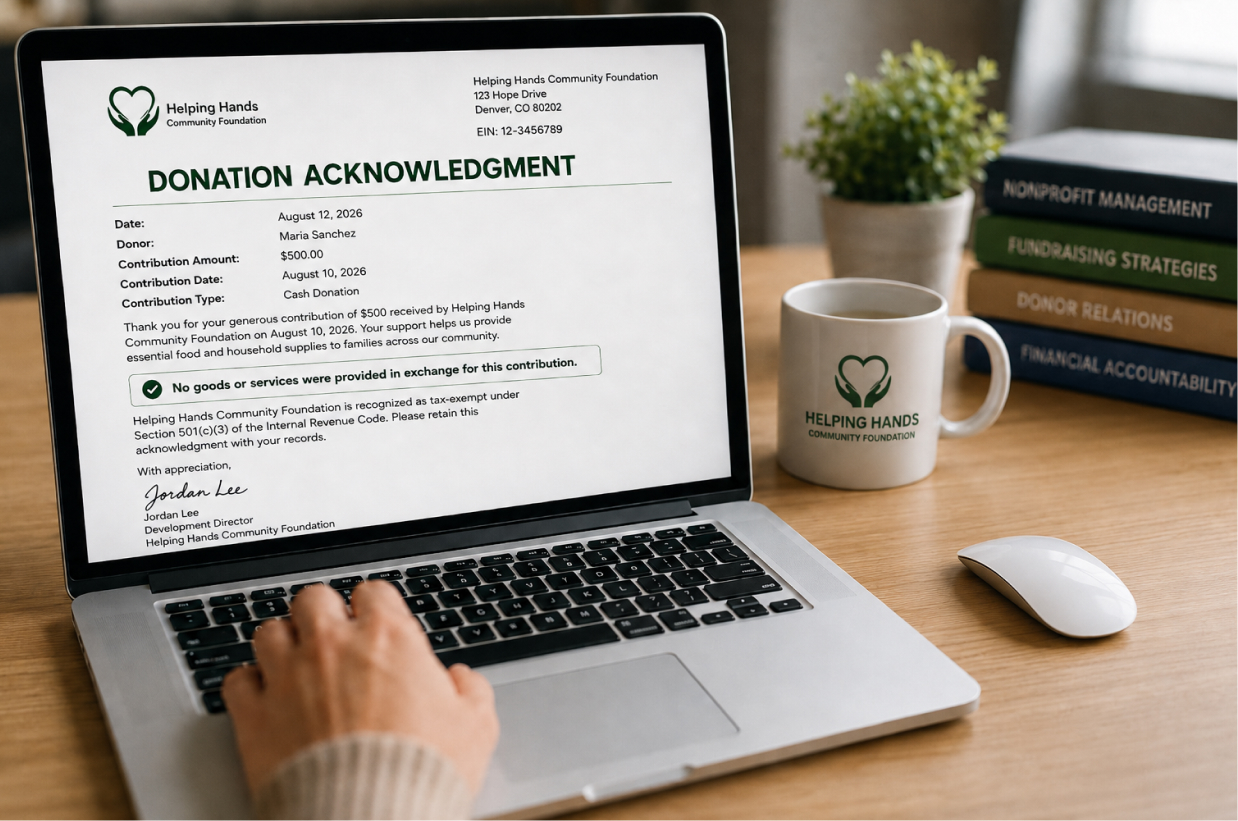
A donation acknowledgment letter does more than thank a supporter. It confirms that a contribution was received, gives the donor important information for their records and, when required, helps substantiate a charitable tax deduction. For nonprofit teams, however, producing these letters manually can involve repeatedly checking donor names, contribution dates, amounts, gift types and the correct Internal Revenue Service wording.
That process may be manageable when an organization receives only a few gifts. As donation volume grows, the same work becomes repetitive and small mistakes can appear even after careful review. A misspelled donor name, an incorrect date, missing goods-or-services wording or a receipt saved in the wrong folder can lead to corrections and unnecessary follow-up.
This guide explains how to write a clear donation acknowledgment letter, what the IRS expects for contributions of $250 or more, and how wording changes for cash, non-cash and quid pro quo contributions. Nonprofits that want to move beyond manual documents can also use DonorKite to organize donor records, record offline contributions, generate donation receipts and send them through email, SMS or WhatsApp.
What Is a Donation Acknowledgment Letter?
A donation acknowledgment letter is a written communication from a nonprofit confirming that it received a donor’s contribution. It normally combines appreciation with the details needed to identify the gift, such as the contribution date, amount or property description, and whether the donor received anything in return.
The acknowledgment can be delivered as a printed letter, an email, a PDF or another written format. The IRS does not prescribe a single layout. What matters is that the document contains enough information to substantiate the contribution when the applicable rules require it.
A strong acknowledgment serves three practical purposes:
It reassures the donor that the contribution was received and recorded correctly.
It documents the gift for the donor’s tax and personal records.
It gives the nonprofit a consistent record of donor communication and contribution history.
Donation Acknowledgment Letter vs Donation Receipt
Purpose of a Donation Acknowledgment Letter
An acknowledgment letter is relationship-focused. It recognizes the donor’s support, confirms the contribution and can explain how the gift supports the organization’s mission. Its tone is usually warm and appreciative.
Purpose of a Donation Receipt
A donation receipt is more transaction-focused. It normally presents the donor and contribution details in a structured format and may include a receipt number, payment method, fund or campaign, issue date and required tax statements.
Can One Document Serve Both Purposes?
Yes. A nonprofit can create one document that thanks the donor while also including the information needed for a compliant written acknowledgment. This avoids sending a separate thank-you letter and receipt when one properly structured communication can do both.
When Is a Written Donation Acknowledgment Required?
Contributions of $250 or More
For a donor to claim a deduction for a single charitable contribution of $250 or more, the donor must obtain a contemporaneous written acknowledgment from the qualified organization. Separate contributions are generally evaluated separately rather than automatically combined to reach the $250 threshold.
The donor must receive the acknowledgment by the earlier of the date the donor files the original return for the contribution year or the return’s due date, including extensions. Although obtaining the acknowledgment is the donor’s responsibility, issuing it promptly is a good nonprofit practice.
Donations Where Goods or Services Were Provided
When a donor makes a payment partly as a contribution and partly in exchange for goods or services, the acknowledgment should describe what the donor received and include a good-faith estimate of its value. A charitable organization must provide a written disclosure for a quid pro quo contribution exceeding $75.
Non-Cash and In-Kind Donations
For a non-cash contribution, the acknowledgment should describe the donated property but should not state its value. Valuation is generally the donor’s responsibility. Additional donor filing and appraisal requirements may apply based on the amount claimed and the type of property.
Smaller Contributions
Even when a contribution is below $250, donors need reliable records for monetary gifts. Sending an acknowledgment for every recorded contribution creates a consistent donor experience, reduces confusion and makes year-end recordkeeping easier.
For a detailed breakdown of U.S. thresholds and required receipt information, see DonorKite’s IRS donation receipt requirements guide and its focused explanation of the IRS $250 donation rule.
What Should a Donation Acknowledgment Letter Include?
The exact presentation can vary, but the following information creates a clear and useful acknowledgment.
Nonprofit’s legal name
Use the organization’s official legal name so the donor can identify the qualified recipient of the contribution.
Donor’s name
Address the letter to the correct individual, household or business. Check spelling and donor preferences before sending.
Contribution date
State the date the organization received the contribution. The date should match the nonprofit’s donation record.
Cash contribution amount
For a monetary gift, state the exact amount received. Avoid vague wording such as “your generous donation” without identifying the contribution.
Description of non-cash property
Describe donated property clearly but do not assign a dollar value. For example, use “two laptop computers and one printer” rather than “office equipment worth $2,000.”
Goods-or-services statement
State whether the nonprofit provided any goods or services in return for the contribution. When something was provided, describe it and give a good-faith estimate of its value.
Organization contact details
Include an address, email or phone number so the donor can request a correction or replacement document.
EIN and tax-exempt information
Many nonprofits include their Employer Identification Number and a statement about their tax-exempt status for clarity, even though the IRS core acknowledgment list focuses on the organization name and contribution information.
Receipt or acknowledgment number
A unique reference is not the central IRS requirement, but it helps the organization retrieve, correct and reissue documents efficiently.
Authorized sign-off
Close with the name or role of an authorized representative, especially when the acknowledgment is presented as a formal letter.
IRS Wording for Donation Acknowledgment Letters
The wording should reflect what actually happened. Do not use the “no goods or services” statement when the donor received a meaningful benefit in return.
When No Goods or Services Were Provided
No goods or services were provided in exchange for this contribution.
This language clearly states that the donor received no return benefit from the organization. It is commonly used for straightforward cash gifts and qualifying non-cash contributions where nothing was provided in exchange.
When Goods or Services Were Provided
In exchange for your contribution of $[amount], you received [description of goods or services] with a good-faith estimated value of $[value].
The acknowledgment should make clear that the potentially deductible portion is generally limited to the amount paid above the value of the benefit. The organization should use a reasonable good-faith estimate rather than an arbitrary figure.
When Only Intangible Religious Benefits Were Provided
The only goods or services provided in exchange for this contribution consisted of intangible religious benefits.
This wording applies in the limited circumstances recognized by the IRS for intangible religious benefits. Organizations should use it only when it accurately describes the benefit provided.
Wording for Non-Cash Contributions
Thank you for your contribution of [clear description of property], received on [date]. No goods or services were provided in exchange for this contribution. The organization has not assigned a monetary value to the donated property.
The property description should be specific enough to identify what was received. The donor, not the nonprofit, is generally responsible for determining the value used for tax purposes.
How to Write a Donation Acknowledgment Letter Step by Step
Confirm the donor and contribution details
Check the donor’s name, contact information, contribution date, amount, gift type, payment method and any fund or campaign designation.
Determine whether the donor received anything in return
Identify event admission, merchandise, meals, memberships or other benefits connected with the payment.
Begin with a personal thank-you
Open with a concise expression of appreciation. Use the donor’s name and acknowledge the specific gift rather than sending a generic message.
State the contribution clearly
For money, include the exact amount and date received. For property, provide a clear description without assigning value.
Add the appropriate IRS wording
Use the no-goods-or-services statement, the quid pro quo disclosure or the intangible religious benefit statement as applicable.
Explain the contribution’s impact
Add one or two sentences describing how the gift supports the nonprofit’s work. Keep the impact statement accurate and relevant.
Include the organization’s details
Add the nonprofit’s legal name and contact information. Include the EIN and tax-exempt status statement when appropriate for the organization’s standard format.
Review, send and retain the acknowledgment
Verify all details, deliver the document promptly and save a copy with the corresponding donor and contribution record.
The challenge at scale: These steps are straightforward for one gift, but repeating them for dozens or hundreds of offline contributions consumes staff time. Manual copying also increases the risk that a donor name, amount, date or disclosure statement will be entered incorrectly.
Donation Acknowledgment Letter Sample for a Cash Donation
Below is a sample acknowledgment letter for a cash contribution where the donor did not receive any goods or services in return.
August 12, 2026 |
This sample combines a personal thank-you with the contribution amount, contribution date, organization identity and goods-or-services statement. The nonprofit should replace every sample field with accurate information from its own donor and donation records.
Sample Letter for a Donation of $250 or More
For an individual contribution of $250 or more, the donor generally needs a written acknowledgment from the nonprofit to support a charitable deduction.
September 4, 2026 |
For a contribution of $250 or more, the acknowledgment should clearly state the cash amount or describe the donated property. It should also confirm whether the organization provided any goods or services in exchange for the contribution.
The nonprofit should send the acknowledgment early enough for the donor to receive it within the applicable IRS timing requirements.
Sample Acknowledgment Letter for a Non-Cash Donation
A nonprofit acknowledgment for a non-cash contribution should describe the donated property but should not normally assign a monetary value to it.
October 8, 2026 |
For more detail on property descriptions, valuation and donor documentation, see DonorKite’s guide to non-cash donation receipts under IRS rules.
Sample Letter When the Donor Received Goods or Services
When a donor receives something in exchange for a payment, the acknowledgment should describe the benefit and provide a good-faith estimate of its value.
November 18, 2026 |
Because the donor received a benefit, the acknowledgment should not state that no goods or services were provided. The description and estimated value help the donor understand the portion of the payment that may qualify as a charitable contribution.
Donation Acknowledgment Email Example
A nonprofit may send a donation acknowledgment electronically, provided the message or attached document contains accurate contribution details and the appropriate acknowledgment wording.
Subject: Thank You for Your Contribution to Community Care Alliance |
The acknowledgment may appear directly in the email, in an attached PDF or in both places. The delivery channel does not replace the need for accurate donor information, contribution details and appropriate wording.
Year-End Donation Acknowledgment Letter Example
A year-end acknowledgment can summarize multiple contributions made by the same donor during the calendar year.
January 15, 2027 |
A year-end acknowledgment can list several contributions, but the nonprofit’s records should preserve the individual date and amount of each gift. Providing only a combined annual total can make corrections, reconciliation and donor record verification more difficult.
Common Donation Acknowledgment Letter Mistakes
Using the wrong donor name: A nickname, business contact or misspelled surname may not match the donor’s records.
Recording the wrong contribution date: The acknowledgment should reflect when the organization received the gift, based on its records.
Omitting the goods-or-services statement: A thank-you message alone may not provide the information required to substantiate a contribution of $250 or more.
Valuing non-cash property: The nonprofit should describe contributed property but generally should not assign its tax value.
Using “no goods or services” when a benefit was provided: Event admission, meals, merchandise and similar benefits require different disclosure wording.
Combining records inaccurately: Year-end summaries should be generated from verified individual contribution records.
Sending acknowledgments too late: Late delivery can create problems for donors preparing their tax returns.
Failing to retain a copy: Without an organized history, correcting or reissuing an acknowledgment becomes unnecessarily difficult.
Keeping donor, donation and receipt information in separate places: Disconnected spreadsheets, folders and email accounts create repeated work and inconsistent records.
Can Donation Acknowledgments Be Sent by Email, SMS or WhatsApp?
Written acknowledgments can be delivered electronically. The most suitable channel depends on the document length, the donor’s preference and how the nonprofit stores proof of delivery.
Email works well for detailed acknowledgments and PDF receipts. It gives the donor an easy-to-store record and provides room for a personal message, contribution details and contact information.
SMS
SMS is useful for immediate confirmation and short notifications. For formal tax documentation, the message can direct the donor to a secure receipt or confirm that the receipt has been sent through another channel.
WhatsApp can provide direct receipt delivery for donors who prefer messaging. As with email, the attached or linked document should contain the necessary contribution details and disclosure language.
Manual Donation Acknowledgment Letters vs Automated Software
Manual process | Structured software process |
Search spreadsheets for donor information | Use centralized donor records |
Copy contribution details into a template | Generate the receipt from recorded contribution information |
Choose wording manually for each document | Use a consistent, controlled receipt process |
Create and name files one by one | Maintain organized receipt references and history |
Send individual emails or messages | Deliver receipts through supported communication channels |
Store copies in separate folders | Keep donor, donation and receipt information connected |
Search manually for previous documents | Retrieve contribution and receipt history more easily |
Repeat the process for every gift | Reduce repetitive administration as donation volume grows |
Manual templates are not inherently wrong. They can work for a small number of contributions. The problem appears when the organization must repeatedly find donor details, enter contribution information, select wording, send the document and store a copy. Even careful teams can make mistakes when the same process is repeated at scale.
When Should a Nonprofit Automate Donation Acknowledgments?
A nonprofit should consider a more structured process when:
Staff repeatedly copy donor and contribution details into Word or PDF files.
Donation volumes are increasing and acknowledgments are delayed.
Donors frequently request corrected or duplicate receipts.
Different team members use different formats or wording.
Receipt numbers and document versions are difficult to control.
Donation records and receipt files are stored separately.
Year-end contribution summaries take significant time to prepare.
Previous receipts are difficult to locate during donor inquiries or reviews.
When these issues become routine, creating another template usually does not solve the underlying recordkeeping problem. The organization needs a process that connects donor information, contribution records, receipt generation and delivery.
Generate and Send Donation Receipts With DonorKite
Writing a donation acknowledgment letter manually requires staff to verify donor information, enter contribution details, select the correct wording, send the document and retain a copy. Completing every step carefully still does not eliminate the possibility of incorrect names, dates, amounts or disconnected receipt records.
DonorKite provides a more organized way to manage this work. It is built specifically for organizations that need to manage offline donations and donation receipts rather than accept online payments. Nonprofits can maintain donor profiles, record contributions, generate donation receipts and send them through email, SMS or WhatsApp while keeping donation and receipt information connected to the donor’s history.
With DonorKite, nonprofits can:
Maintain centralized donor details and contribution history.
Record cash, cheque, bank transfer and other offline contributions.
Generate accurate donation receipts from organized records.
Use a more consistent receipt process across the organization.
Send receipts through email, SMS or WhatsApp.
Locate previous contribution and receipt information more easily.
Reduce reliance on disconnected spreadsheets, templates and folders.
Organizations comparing receipt automation options can also review the DonorKite donation receipt software buyer’s guide for the features and evaluation criteria that matter as donation volume grows.
Ready to simplify offline donation and receipt management? |
Conclusion
A well-written donation acknowledgment letter should thank the donor, identify the contribution accurately and include the wording appropriate to the gift. For contributions of $250 or more, the acknowledgment must provide the information the donor needs to substantiate the contribution. Non-cash gifts and payments involving goods or services require additional care.
Templates can help organizations understand the format, but every letter still depends on accurate donor and contribution records. As donation volume grows, repeatedly checking, creating, sending and storing acknowledgments can consume staff time and create avoidable errors. DonorKite helps nonprofits bring donor records, offline contribution tracking, receipt generation and multichannel delivery into a more structured process.