
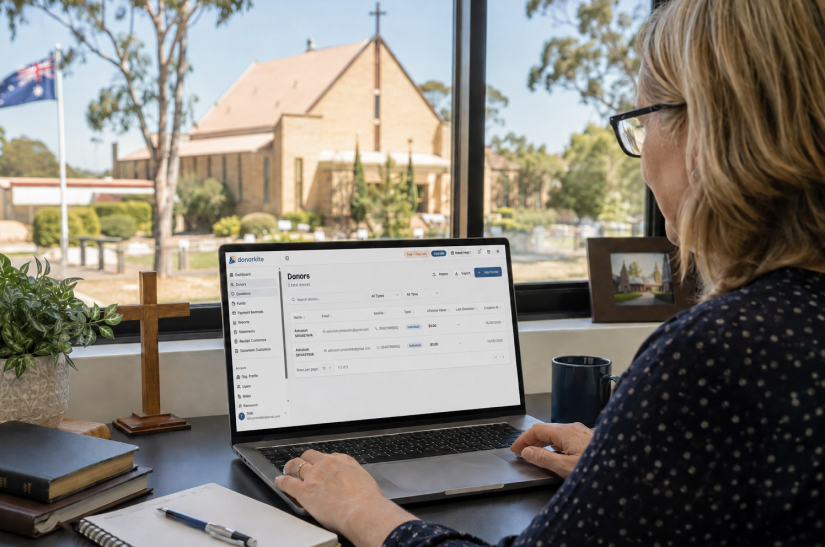
Churches across Australia manage much more than weekly services. Behind every congregation is administrative work involving donations, offerings, donor information, church funds, giving records, receipts and reporting.
For many churches, these records begin with spreadsheets. Cash offerings may be recorded in one file, bank transfers in another, donor information somewhere else, while receipts are created manually and emailed separately.
That approach can work when donation activity is limited. As giving grows, however, church administrators and volunteers often spend more time checking spreadsheets, correcting duplicate records, finding earlier contributions and recreating receipts.
This is why more organisations are evaluating church management software in Australia to simplify the administrative side of giving.
Church management software can cover membership, attendance, volunteers, events and other areas. But not every church needs a large system that manages every activity. If the main challenge is donations, giving records and receipts, focused church donation management software may provide a simpler solution.
For churches specifically looking for donation management software for Australian churches, DonorKite provides a structured way to maintain donor records, record offline contributions, organise funds, review giving histories, generate donation reports and create receipts that can be sent by email.
Instead of managing one contribution across several different files, Australian churches can record the donation once and maintain the related donor, fund and receipt information together.
What Is Church Management Software?
Church management software is a digital system used to organise different areas of church administration.
Depending on the product, a church management system may support:
membership records
attendance
events
volunteer coordination
communications
giving and donations
funds and campaigns
reporting
However, organisations searching for church management software Australia often have very different requirements.
A large congregation may need a complete church management platform covering numerous operational areas.
A smaller church may simply be trying to solve a recurring problem:
How can we manage our church donations more effectively?
For churches receiving regular contributions, the donation-management workflow can quickly become one of the most repetitive administrative responsibilities.
Staff may need to know:
Who made the donation?
How much was received?
When was it received?
Was it cash, cheque or bank transfer?
Which church fund did it support?
Was a receipt generated?
Was the receipt sent by email?
These questions explain why donation administration should be a major consideration when comparing church management software for Australian churches.
If giving administration is the main challenge, dedicated church donation management software can provide a more focused way to manage the process.
Why Australian Churches Need Better Donation Management
Church giving can come through many different channels.
Australian churches may receive Sunday offerings, regular member giving, cash donations, cheques, bank transfers, building-fund contributions, mission donations, ministry support and contributions towards special appeals.
Each contribution creates information that may need to be accessed again.
The challenge begins when that information is scattered across multiple systems.
An administrator might record a bank transfer in Excel, update a separate giving-history spreadsheet, create a receipt in a document template and then email that receipt separately.
If the donor later asks for another copy, someone needs to locate the contribution, confirm its details and find the correct receipt.
Multiply that workflow across hundreds of donations and manual administration becomes difficult to maintain.
This is one of the strongest reasons churches begin searching for donation management software for Australian churches.
A structured system keeps the donor, donation, fund and receipt connected.
Rather than asking:
"Which spreadsheet contains this donation?"
church staff can work from a single organised donation record.
How to Manage Church Donations in Australia
One of the most common questions churches face is how to manage church donations in Australia without creating unnecessary administrative work.
A good process starts with consistency.
Every identifiable donation should follow a similar workflow:
Donation received → donor identified → contribution recorded → fund selected → giving history updated → receipt created when appropriate → receipt emailed → record retained
The exact steps may vary between churches, but the underlying principle remains the same.
Donation information should be recorded once and reused throughout the workflow.
When churches understand how to manage church donations in Australia through a structured system, they can significantly reduce duplicate data entry.
For example, when a bank transfer arrives from an existing donor, authorised staff can select the donor, record the contribution, assign the appropriate fund and maintain the donation within that person's giving history.
If a receipt is required, it can then be generated from the recorded donation details and sent by email.
That is considerably simpler than maintaining separate records for the same contribution.
Easy Ways to Manage Church Donations
Church administrators often look for easy ways to manage church donations because the biggest problem is not always the number of donations. It is the amount of repetitive work attached to each one.
One of the easiest improvements is to stop entering the same information multiple times.
If donor information already exists, staff should not need to re-enter it every time the person gives.
If the contribution has already been recorded, staff should not need to manually copy the same amount and date into a receipt template.
If the donation supports a particular church fund, that relationship should remain attached to the donation record.
This is why church giving software can be valuable.
The objective is not merely to digitise existing paperwork.
The objective is to make church giving administration easier.
For churches exploring easy ways to manage church donations, centralising the donation workflow is usually more useful than adding another spreadsheet.
Church Donation Management Software vs Spreadsheets
Many Australian churches begin donation tracking with Excel or Google Sheets.
A basic spreadsheet might contain:
donor name, date, donation amount, payment method, fund and notes.
Initially, this may be sufficient.
As the number of donations increases, problems begin to appear.
A donor might be entered under slightly different names.
A donation might be associated with the wrong person.
Several staff members may maintain different spreadsheet versions.
A formula can be accidentally overwritten.
Receipt records may become separated from the original contribution.
A church donation spreadsheet is essentially a list of transactions.
A proper church donation management system creates relationships between those transactions.
The donor has a profile.
Each donation is connected to that donor.
Each contribution becomes part of the giving history.
Funds remain connected with donations.
Receipts remain connected with the donation record.
For churches that have outgrown a church donation spreadsheet, moving to donor database software provides a more reliable way to maintain donor and donation information together.
This becomes increasingly important as the church grows.
Church Giving Software for Maintaining Giving Records
Church giving records remain useful long after the contribution is received.
A church member may ask:
"Can you confirm the donations I made last year?"
An administrator may need to check:
"Which contributions did this donor make to the building fund?"
Church leadership may want to understand giving related to a particular campaign.
When church giving records are maintained properly, these questions become easier to answer.
A structured church giving software system connects each contributor with their donation history.
Authorised staff can review relevant information including:
donor details
donation dates
donation amounts
payment methods
funds or campaigns
receipt information
previous giving activity
Without a central system, church giving records may be spread across several files.
DonorKite keeps donor records and donation history together so churches do not have to maintain completely separate databases for donors, donations and receipts.
Church Donation Tracking Software for Offline Giving
Churches frequently receive contributions outside an online payment platform.
Cash remains common.
Churches may also receive cheques and direct bank transfers.
These contributions still need to become digital records.
This is where church donation tracking software becomes particularly useful.
A cash offering does not automatically create a donor record.
A cheque does not automatically update the church's giving history.
A bank transfer may need to be identified and matched with the correct donor.
Someone must record the contribution.
Using church donation tracking software gives staff a consistent way to manage these transactions.
Rather than keeping different records for cash, cheque and bank-transfer giving, churches can maintain all identifiable contributions through one donation-management workflow.
Offline Donation Management Software for Australian Churches
Offline giving is especially important when choosing church management software in Australia.
Many churches already have established ways of receiving contributions.
Their problem is not necessarily collecting the money.
Their problem is managing what happens afterwards.
This is where offline donation management software for Australia becomes relevant.
DonorKite helps churches record donations after they have already been received.
For example, an organisation can record a cash contribution, cheque or bank transfer and connect it with the appropriate donor, fund or campaign.
For Australian churches, offline donation management can reduce the need to maintain completely separate systems for different payment methods.
How to Track Cash Donations at a Church
Cash requires careful record keeping because the donation does not automatically arrive with a digital transaction record.
Where a contributor can be identified, the church may need to record:
the donor, amount, date and relevant fund.
Using cash donation tracking software allows these contributions to become part of the church's main donation history.
The church does not need to maintain a separate cash-only spreadsheet.
This creates a more consistent approach to church donation record keeping.
For churches searching for an easier way to maintain cash contributions, church donation tracking software can help ensure that offline giving remains part of the same organised system as other donations.
Tracking Cheque and Bank-Transfer Donations
Cheque and bank-transfer contributions create similar record-keeping requirements.
The payment has already happened, but the church still needs a reliable internal record.
With church donation software, authorised staff can record the contribution and connect it with the appropriate donor.
This allows churches to use one consistent workflow across:
cash, cheque and bank transfer donations.
Instead of maintaining separate systems for every payment method, donation information remains centralised.
This is particularly helpful when preparing reports or reviewing historical giving activity.
Church Donor Management Software and Giving History
Church donor management should involve more than storing names and email addresses.
The real value comes from connecting a donor with their contribution history.
A church donor management software system can help staff understand what each donor has contributed and when.
For example, authorised users may need to review:
previous donations
donation dates
contribution amounts
supported funds
associated receipts
Without organised church donor records, these questions often require manually filtering spreadsheets.
DonorKite maintains donor information and donation history together.
This gives churches a clearer picture of giving without turning the donor database into another disconnected address book.
Organisations looking for broader donor-management functionality can also review DonorKite's donor management software.
Managing Church Funds and Campaign Donations
Churches often receive contributions for more than one purpose.
Examples may include:
building projects, missions, community programmes, outreach work, ministry activities and special appeals.
A church therefore needs more than a total donation amount.
It may also need to know which fund or campaign the donor intended to support.
Church donation management software can help organise donations according to funds or campaigns.
This reduces the need to create separate spreadsheets for every church initiative.
It also makes reporting more meaningful because church staff can review donations in the context of the purpose they supported.
Church Donation Receipts in Australia
Receipt administration is another important part of church management software for Australia.
However, Australian churches should be careful not to assume every contribution automatically qualifies as a tax-deductible gift.
Tax deductibility depends on the relevant Australian rules, the nature of the contribution and whether the recipient has appropriate Deductible Gift Recipient status where required.
This distinction matters when churches issue ATO donation receipts.
Software can support the receipt workflow, but the church remains responsible for understanding which receipts should be treated as tax-deductible documentation.
A reliable donation system should therefore help maintain accurate underlying records.
The donation, donor, fund and receipt should remain connected.
Understanding ATO Receipts
Australian organisations often search for ATO receipts when trying to understand how donation documentation should be managed.
An ATO donation receipt should not simply be treated as a generic acknowledgement document.
For an eligible deductible gift, appropriate information needs to be maintained according to the relevant circumstances.
This makes ATO receipt requirements an important consideration when Australian churches configure their receipt workflow.
The organisation should ensure that the information used within the receipt reflects the appropriate entity, fund and donation details.
Rather than repeatedly typing this information into standalone documents, donation software can use the existing donation record as the basis for generating the receipt.
This can make ATO receipts easier to manage and retrieve.
ATO Donation Receipt Requirements
Searches for ATO donation receipt requirements are particularly relevant to Australian churches that manage potentially deductible gifts.
The receipt process should be supported by an accurate donation record.
Important information may include the relevant organisation or fund details, donation information and other details required for the church's circumstances.
The point is not simply to create a visually professional receipt.
The church should be able to trace that receipt back to the actual donation.
This is where ATO donation receipt software can help simplify administration.
Church staff can work from structured donation records instead of manually recreating the same information every time a receipt is needed.
ATO-Compliant Donation Receipt Software
The phrase ATO-compliant donation receipt software is commonly used by organisations looking for an easier way to manage tax-related receipts.
However, software itself cannot automatically make an organisation or donation compliant.
Eligibility still depends on the church's circumstances and applicable Australian requirements.
What ATO-compliant donation receipt software can support is a more structured administrative process.
That can include:
maintaining organisation information
recording donor information
recording donation details
generating receipts from recorded data
maintaining receipt history
retrieving previous donation records
For Australian churches, this is considerably more reliable than creating every receipt manually.
ATO-Compliant Tax Receipt Software for Churches
Churches searching specifically for ATO-compliant tax receipt software are usually trying to reduce manual receipt administration while maintaining more dependable records.
The software should help the church keep the donation and receipt connected.
That way, if a donor asks for another copy later, staff can locate the donation record rather than searching through folders of unrelated PDF files.
An ATO-compliant tax receipt software workflow should therefore support the organisation's administrative process without suggesting that every donation automatically qualifies for a deduction.
For Australian churches, accuracy and consistency are more valuable than simply generating documents quickly.
DGR Donation Receipts
Deductible Gift Recipient status is particularly important when discussing tax-deductible church donations.
A DGR donation receipt should not be confused with a standard acknowledgement provided for every contribution.
Where the relevant organisation, fund, authority or institution has the appropriate status and the gift meets applicable requirements, the church may need to maintain suitable documentation.
This makes DGR donation receipts part of the broader donation-management process.
The underlying donation should remain connected to the donor and relevant fund.
The receipt should also remain associated with that contribution.
A DGR donation receipt is much easier to manage when the church is not relying on disconnected spreadsheets and document folders.
Church Donation Receipt Software
Churches often focus on the document itself when considering church donation receipt software.
But the receipt is only one part of the process.
Before the receipt can be created, the organisation needs accurate donation information.
That includes the donor, amount, date and relevant fund or campaign.
A useful church donation receipt software workflow therefore begins with structured donation management.
DonorKite allows churches to generate receipts from recorded donation information instead of rebuilding the contribution details manually.
This can significantly reduce repetitive administrative work.
Sending Church Donation Receipts by Email
Generating the receipt is only half of the process.
The church also needs to deliver it to the donor.
Email provides a straightforward way to send donation receipts digitally.
With a manual process, an administrator may need to:
create the receipt, save the file, locate the donor's email address, open an email account, attach the receipt and send the message.
When donation receipt administration is connected with donor records, this workflow becomes easier.
DonorKite supports sending donation receipts by email after the relevant donation information has been recorded.
This gives churches a simpler workflow:
record donation → create receipt → send receipt by email → retain the donation record
Churches that specifically want to improve receipt delivery can learn more about DonorKite's email donation receipt software.
Why Email Donation Receipts Simplify Administration
Email donation receipts also make it easier for both the church and the donor to retain the document.
The donor receives a digital copy.
The church maintains the underlying donation record.
If the donor later needs the receipt again, authorised staff can locate the relevant contribution and manage the request from the recorded information.
This is much more reliable than creating receipts that become detached from the original donation.
For churches processing frequent contributions, email-based receipt administration can remove a considerable amount of repetitive work.
How to Keep Church Donation Records Organised
Good church donation record keeping depends on consistency.
Donor names should be maintained consistently.
Payment methods should use standard categories.
Funds should have clear names.
Donation dates and amounts should be recorded accurately.
Receipt information should remain associated with the contribution.
This is difficult to maintain when different staff members use separate spreadsheets.
A structured church donation database gives the church one system for maintaining this information.
It also helps authorised team members continue the process even when staff or volunteers change.
Church Giving Records and Member Donation History
Maintaining accurate church giving records can also improve everyday donor administration.
Instead of treating every donation independently, churches can build a complete giving history for each donor.
This makes it easier to answer questions such as:
How much has this member contributed?
Which funds have they supported?
When was their last donation?
Which receipt relates to a particular contribution?
A connected system gives authorised staff access to the history without manually combining spreadsheet rows.
For churches looking to improve church giving records, this is one of the strongest reasons to move towards structured donation software.
Church Donation Reports
Accurate donation records should also support useful reporting.
Church administrators may need to review:
donations received during a particular period, contributions to a specific fund, giving associated with a campaign or the history of a particular donor.
When donation data is organised properly, these reports become easier to produce.
When information is scattered across multiple spreadsheets, reporting becomes a separate manual exercise.
This is another practical advantage of church donation management software.
The same information entered during normal donation administration can later support reporting.
What Should Australian Churches Look for in Church Management Software?
The best church management software in Australia depends on what the church is trying to improve.
A church requiring attendance tracking, worship planning, volunteer rosters and event management may need a broad church management system.
A church whose main problem is donation administration should evaluate the giving workflow more closely.
When comparing church management software for Australian churches, ask whether the system can support:
donor records
offline donations
church giving histories
cash donations
cheque donations
bank transfers
funds and campaigns
donation receipts
email receipt delivery
donation reports
These are the capabilities that matter when the church's main administrative challenge is giving.
Church Management Software for Small Churches
Smaller congregations sometimes assume software is only worthwhile for large churches.
That is not necessarily the case.
A small organisation can still receive frequent cash, cheque and bank-transfer contributions.
It may also have fewer staff members available to manage those donations.
This can make administrative efficiency even more important.
Church management software for small churches should therefore be simple rather than overloaded with unnecessary functionality.
If the church mainly needs to maintain donations and giving histories, specialised donation software may be more appropriate than a complex all-in-one platform.
When Should Churches Move Away From Donation Spreadsheets?
There is no fixed number of contributions at which a church must stop using spreadsheets.
The better indicator is the amount of friction they create.
Consider moving away from a church donation spreadsheet when:
donor information is duplicated, staff struggle to locate past donations, several spreadsheet versions exist, receipt records are difficult to find, giving histories require manual calculation or reporting takes too long.
At this point, adding more spreadsheet tabs usually does not solve the underlying problem.
The organisation needs a structured donation-management process.
Why DonorKite Works for Australian Church Donation Management
DonorKite is designed specifically around donation and donor administration.
For Australian churches, that means the platform can help organise:
donor records
cash donations
cheque donations
bank-transfer donations
donation histories
funds and campaigns
receipts
email receipt delivery
donation reporting
This makes DonorKite particularly relevant for churches searching for donation management software for Australian churches.
DonorKite is not positioned as software for worship planning, volunteer scheduling or attendance management.
Instead, it focuses on the giving side of church administration.
For churches whose primary challenge is maintaining donation records, this focused approach can be considerably easier to adopt.
A Church Donation Workflow With DonorKite
Consider an Australian church receiving a bank transfer from a regular contributor.
With a spreadsheet-based process, the administrator might:
open the donation spreadsheet, find the donor, enter the transaction, update another giving file, create a receipt manually and send the receipt through email.
With DonorKite, the workflow can be more organised.
The donor is selected.
The contribution is recorded.
The appropriate fund or campaign is assigned.
The donation becomes part of the donor's history.
Where a receipt is appropriate, it can be generated from the recorded information and sent by email.
The donation remains available for future reporting and reference.
This is the type of workflow churches should expect when evaluating church donation management software.
Church Management Software Should Reduce Administrative Work
Technology should simplify church administration.
A church should not need several spreadsheets and document folders to answer:
Who donated, how much did they give, where was the donation allocated and was a receipt sent?
These should be basic questions.
Modern church management software in Australia should make donation information easier to manage when giving administration is part of the church's requirements.
For churches receiving offline contributions, DonorKite provides a focused way to maintain accurate records without changing how the original donation was collected.
One System for Church Donations, Donors and Giving Records
Church donor management, donation tracking, giving records, funds, receipts and reporting are all closely connected.
Treating them as completely separate processes creates unnecessary work.
When the church maintains one structured donation record, that information can support multiple administrative needs.
The donor history becomes more reliable.
Receipt requests become easier to handle.
Donation reporting becomes easier.
Staff do not have to reconstruct giving information later.
This is ultimately what church donation management software should achieve.
A Simpler Way to Manage Church Donations in Australia
If your church is struggling with spreadsheets, disconnected donor records or manual receipt administration, moving to organised donation software can remove a significant amount of repetitive work.
For organisations researching how to manage church donations in Australia, the answer is not necessarily to purchase the largest church management platform available.
The better approach is to identify the process causing the most administrative difficulty and choose software that solves it.
For donation-focused administration, DonorKite brings donor records, church donations, giving histories, funds, receipts and reports together.
Australian churches can record offline contributions, maintain donor histories, generate appropriate receipts and send those receipts by email.
This gives organisations a practical alternative to maintaining increasingly complicated donation spreadsheets.
Try DonorKite for Your Australian Church
If your church wants an easier way to manage donations, donor records, giving histories and receipts, you can try DonorKite and see how the workflow fits your organisation.
DonorKite is particularly suited to churches that receive offline contributions and want a structured alternative to spreadsheets and manual receipt administration.
Record church donations.
Maintain donor giving histories.
Organise funds and campaigns.
Track cash, cheque and bank-transfer contributions.
Generate donation reports.
Create donation receipts.
Send receipts by email.
Keep the complete donation history organised.
Register your church and try DonorKite for free to start managing donations and giving records in one place.