
Managing donations involves more than acknowledging the generosity of supporters. Australian nonprofits must also maintain accurate donation details, organise donor information and provide clear receipts when required. A reliable receipt generator can simplify this work by creating consistent, professional receipts without requiring staff to prepare every document manually.
For a nonprofit receiving only a few donations, creating receipts with a basic document or spreadsheet may appear manageable. However, as donation activity increases, staff must repeatedly enter donor names, donation amounts, dates, receipt numbers and organisation details. This can lead to errors, duplicate receipt numbers and inconsistent record keeping.
A receipt generator provides a more structured way to create receipts for donations. It can help Australian charities, Deductible Gift Recipients, community organisations and not-for-profit teams produce clear documentation while reducing repetitive administrative work.
This guide explains how a receipt generator works, what Australian nonprofits should consider when issuing tax-deductible donation receipts and when an organisation may need more than a basic tax receipt template.
What Is a Receipt Generator?
A receipt generator is a tool that creates a formatted receipt using information entered by an organisation. Instead of designing a new document for each donation, authorised staff can add the relevant donor and donation details to produce a consistent receipt.
A receipt may contain information such as:
- The name of the organisation or eligible fund
- The organisation’s Australian Business Number, where applicable
- The donor’s name
- The donation date
- The donated amount
- A unique receipt number
- A description of the contribution
- A statement confirming that the receipt relates to a gift
- Relevant contact information
For Australian nonprofits, a receipt generator can be particularly helpful when the organisation receives offline donations through cash, cheque, bank transfer or other directly recorded methods.
The purpose of a receipt generator is not limited to making a receipt look professional. It can also help standardise the receipt creation process, reduce manual formatting and make it easier to maintain clear donation records.
Why Australian Nonprofits Need a Receipt Generator
Australian nonprofits often operate with limited administrative resources. Employees and volunteers may be responsible for donor communication, fundraising administration, reporting, event coordination and receipt generation at the same time.
Creating receipts manually can become a significant burden when an organisation receives donations regularly. Each receipt may require staff to locate donor information, verify the donation, enter the correct amount, assign a receipt number, export the document and send it to the donor.
A receipt generator can make this process more efficient by providing a standard structure for every receipt. It can also help organisations maintain consistent branding and avoid accidentally leaving important information out of a receipt.
Australian nonprofits may use a receipt generator to:
- Create receipts for individual donations
- Maintain consistent receipt formatting
- Reduce repeated data entry
- Assign or record receipt numbers
- Correct receipt errors
- Reissue missing receipts
- Provide donors with professional documentation
- Maintain organised donation records
- Reduce dependence on separate Word and Excel files
For organisations managing a growing number of supporters, a receipt generator can also become an important part of their wider donation management software.
Understanding Tax-Deductible Donations in Australia
Not every donation made to a charity or nonprofit is automatically tax deductible in Australia. Generally, an organisation must have Deductible Gift Recipient status to receive gifts that donors may be able to claim as tax deductions.
A Deductible Gift Recipient, commonly known as a DGR, is an organisation or fund entitled to receive tax-deductible gifts under Australian tax law. Some charities are registered as DGRs, but not every registered charity has DGR status.
A donor may generally be able to claim a deduction when:
- The gift is made to an eligible DGR
- The contribution qualifies as a genuine gift
- The donation meets the applicable value requirement
- The donor has not received a material benefit in return
- Appropriate evidence or records are available
For example, a person making a genuine monetary gift to an eligible DGR may be able to claim a deduction. However, a payment for raffle tickets, fundraising merchandise, event entry or membership may not be treated in the same way because the payer receives something in return.
Nonprofits should avoid describing every contribution as tax deductible. Before issuing a tax deductible receipt, the organisation should confirm its DGR status and determine whether the particular contribution qualifies as a gift.
The Australian Taxation Office states that only gifts or donations made to organisations with DGR status can qualify for a deduction, subject to the relevant conditions. Not all charities are DGRs. Organisations and donors should consult current ATO guidance on gifts and donations when determining eligibility.
Does an Australian DGR Have to Issue a Receipt?
An Australian DGR is generally not required to issue a receipt for every tax-deductible gift. However, when a DGR chooses to issue a receipt, the document must contain specific information.
According to the Australian Taxation Office, a receipt issued for a deductible gift should state:
- The name of the fund, authority or institution receiving the gift
- The Australian Business Number of the DGR, if it has one
- The fact that the receipt relates to a gift
Although additional information may not always be legally required, including the donor’s name, date, amount and receipt number can support clearer records for both the organisation and the donor.
Receipt requirements may vary for specific types of contributions, including political donations, workplace giving arrangements and gifts of property. Australian nonprofits should review current ATO guidance or seek professional advice when they are uncertain about a receipt.
What Should an Australian Donation Receipt Include?
An effective receipt should clearly identify the receiving organisation, the contribution and the purpose of the document. It should be easy for the donor to understand and useful for the organisation’s internal records.
An Australian donation receipt may include the following details.
Organisation Information
The receipt should display the legal name of the fund, authority or institution that received the gift. If the eligible fund operates under a larger organisation, staff should ensure that the correct DGR entity is identified.
The organisation’s ABN should also be included when applicable. Contact details, a logo and a registered address may be added to make the receipt easier to recognise.
Donor Information
The donor’s full name can be included to connect the receipt with the individual or organisation that made the gift. Contact information may also be recorded internally to support future communication and donor history management.
Staff should verify names carefully before generating receipts. Incorrect donor names are a common reason receipts need to be corrected and reissued.
Donation Information
The receipt should clearly show the donation date and monetary amount. For a non-cash gift, the organisation may need to describe the donated property rather than independently assigning a value.
Where relevant, staff can also record the donation method, campaign, appeal, fund or purpose. These details may support internal reporting, even if every field does not need to appear on the donor’s receipt.
Receipt Number
A unique receipt number can help an organisation locate the corresponding donation record. It also makes it easier to manage corrections, cancellations and reissued receipts.
Receipt numbers should follow a consistent structure. Using unrelated spreadsheets or manually selecting numbers can create duplication and make older receipts difficult to trace.
Gift Statement
A receipt issued for a deductible gift should clearly state that it is a receipt for a gift. Organisations should use wording appropriate to their status and the nature of the contribution.
A receipt generator can help ensure that approved wording appears consistently across receipts.
Example Tax Receipt Template for an Australian Nonprofit
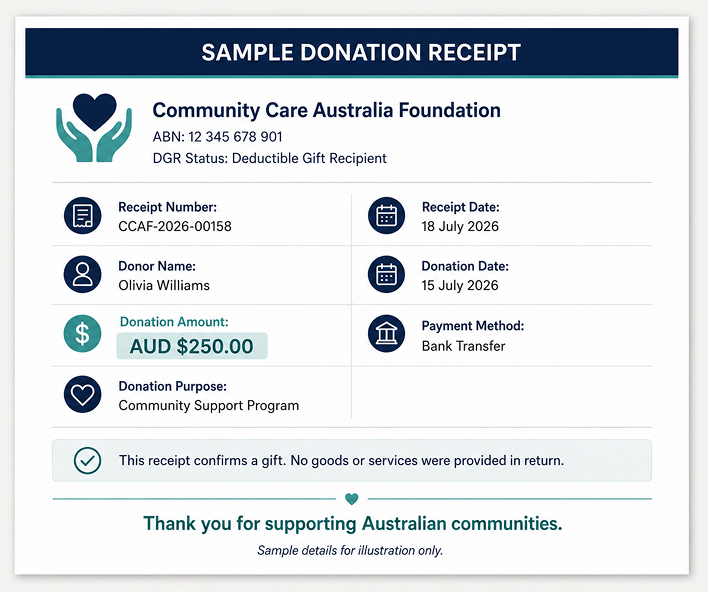
The following example provides a basic structure that an Australian nonprofit could consider when preparing a donation receipt.
Donation Receipt
Organisation or Fund Name: Helping Communities Fund
ABN: 12 345 678 901
Receipt Number: HCF-2026-00124
Donor Name: Jordan Smith
Donation Date: 15 July 2026
Donation Amount: AUD $100.00
Description: Monetary gift supporting community programs
Gift statement: This receipt acknowledges a gift made to Helping Communities Fund.
Organisation Contact: accounts@example.org.au
Authorised By: Donations Administration Team
This is only a general example. An organisation should adapt its tax receipt template to its legal structure, DGR endorsement and the nature of the contribution. Professional tax or legal guidance may be necessary for particular circumstances.
How Does a Receipt Generator Work?
A receipt generator usually follows a straightforward process.
Enter Organisation Details
The organisation adds its name, ABN, address, contact information and approved receipt wording. These details can then be used consistently across future receipts.
Add Donor Information
Staff enter or select the donor’s name and relevant contact details. A receipt generator connected with donor records can reduce the need to re-enter the same information for every contribution.
Record the Donation
The donation date, amount, method and other relevant details are added. Organisations may also record the related campaign, appeal, branch or fund.
Generate the Receipt
The receipt generator places the information into a standard format. Staff can review the receipt and verify the details before it is issued.
Send and Retain the Receipt
The completed receipt is sent to the donor, while a record is retained by the organisation. Maintaining both the receipt and its associated donation record can help with reporting, corrections and future enquiries.
Receipt Generator vs Tax Receipt Template
A receipt generator and a tax receipt template can both be used to create donation receipts, but they are not the same.
A tax receipt template is usually a Word, Excel, PDF or design file containing a reusable layout. Staff must copy the file and manually replace the details for every donation. This may be suitable for an organisation that issues only a small number of receipts.
A receipt generator provides a more structured process. The user enters the relevant details, and the system creates the receipt using a standard format. This can reduce formatting errors and improve consistency.
| Solution | Suitable for | Primary limitation |
| Tax receipt template | Occasional receipt creation | Requires manual entry and document management |
| Basic receipt generator | Generating individual receipts consistently | May not maintain complete donor records |
| Donor management software | Managing donors, donations and receipts together | Requires proper setup and user access |
| Nonprofit software | Supporting broader nonprofit administration | Features vary considerably between platforms |
A template may help an organisation create a document, but it does not necessarily help staff maintain donor histories, track corrections, manage communication or report on donation activity.
Common Problems With Manual Receipt Generation
Manual receipt preparation may work initially, but the process becomes increasingly difficult as donation activity grows.
Repeated Data Entry
Staff may enter the same organisation and donor information into multiple documents. This consumes time and increases the likelihood of spelling mistakes or inconsistent details.
Duplicate Receipt Numbers
When receipt numbers are maintained manually, two staff members may accidentally assign the same number. Duplicate numbering can make it difficult to identify the correct donation.
Inconsistent Receipt Formats
Different employees or volunteers may use different templates. As a result, some receipts may contain missing fields, outdated branding or inconsistent wording.
Incorrect Donor Details
A receipt containing an incorrect name, amount or date may need to be cancelled and reissued. Without organised records, staff may struggle to connect the corrected receipt with the original donation.
Scattered Donation Records
Donor details may be stored in one spreadsheet, donation amounts in another and receipts in separate folders. This fragmentation makes reporting and donor enquiries more difficult.
Delayed Receipt Delivery
Preparing and sending every receipt individually can cause delays, particularly following a fundraising campaign or a period of high donation activity.
Difficulty Finding Old Receipts
When a donor requests another copy, staff may need to search through emails, folders and spreadsheets. A central receipt history makes it easier to locate and reissue the document.
When Is a Basic Receipt Generator No Longer Enough?
A basic receipt generator focuses on producing the receipt itself. However, nonprofits must often complete several related tasks before and after generating it.
Staff may need to:
- Confirm the donation has been received
- Match the donation with the correct donor
- Update the donor’s history
- Allocate the donation to a campaign or fund
- Generate and verify the receipt
- Send it through the donor’s preferred channel
- Retain a record of the receipt
- Correct or reissue the receipt when necessary
- Include the donation in internal reports
When these activities are managed separately, a receipt generator alone may not provide enough support. This is where donor management software becomes valuable.
Donor management software connects donor profiles with their donation and communication histories. It can reduce the need to maintain separate spreadsheets and help authorised team members access consistent information.
Similarly, donation management software can help organisations record contributions, categorise donations, generate receipts and prepare reports from a more centralised system.
How Nonprofit Software Improves Receipt Management
Appropriate nonprofit software can support the complete administrative process surrounding a donation receipt. Instead of treating every receipt as an isolated document, the receipt can remain connected with the relevant donor and donation record.
This may help Australian nonprofits:
- Maintain complete donor profiles
- Review previous donation activity
- Categorise donations by campaign or purpose
- Generate receipts using approved templates
- Maintain consistent receipt numbers
- Record when receipts were created and sent
- Correct and reissue receipts
- Control which staff members can access donor information
- Prepare reports based on recorded donations
- Maintain clearer audit histories
The right solution depends on the organisation’s size, donation volume, internal processes and reporting requirements. A small community group may only need a simple template, while a larger nonprofit may benefit from a dedicated donation and donor management system.
Choosing a Receipt Generator for an Australian Nonprofit
Before selecting a receipt generator, an organisation should consider how receipts fit into its wider donation administration process.
Australian Receipt Requirements
The tool should allow the organisation to include its correct legal or fund name, ABN and an appropriate gift statement. It should not force users to rely on receipt language designed exclusively for another country.
Customisable Receipt Templates
Organisations should be able to maintain a consistent receipt layout with their logo, contact information and approved wording.
Donor Record Management
If staff frequently re-enter the same donor details, a receipt generator connected with donor profiles may save considerable time.
Receipt Correction and Reissue
The system should provide a controlled way to correct receipt errors and reissue documents while maintaining a record of what changed.
Multiple Delivery Channels
Australian nonprofits should consider how their donors prefer to receive receipts. Email may be suitable for many donors, while WhatsApp and SMS can offer additional ways to deliver receipt information or links efficiently.
User Permissions
Not every employee or volunteer should necessarily have the same access. Role-based permissions can help an organisation control who can view donor information, record donations and generate receipts.
Reporting and Record Keeping
A receipt generator is more valuable when receipt details remain connected with donation records. Reporting features can help teams understand donation activity without manually combining multiple spreadsheets.
Receipt Generator Checklist for Australian Organisations
Before generating and issuing a donation receipt, check the following:
- Has the correct recipient organisation or fund been selected?
- Does that entity hold the relevant DGR status?
- Does the contribution qualify as a genuine gift?
- Are the donor’s details accurate?
- Is the donation date correct?
- Has the correct amount been recorded?
- Does the receipt include the organisation’s ABN, where applicable?
- Does it state that the receipt relates to a gift?
- Has a unique receipt number been assigned?
- Has the receipt been reviewed before sending?
- Will a copy remain connected with the donation record?
- Can the receipt be located and reissued later?
This process can help reduce avoidable errors and create a more dependable experience for donors.
Simplify Receipt Generation and Offline Donation Management With DonorKite
Generating a receipt is only one part of donation administration. Australian nonprofits may also need to record offline donations, maintain donor information, organise donation histories, manage receipt templates, send receipts, correct errors and prepare reports.
Completing these tasks through separate spreadsheets, document templates and communication platforms can create a considerable administrative burden.
DonorKite brings these activities into one organised system. It is designed to help nonprofits manage offline donations and the records associated with them. DonorKite does not collect or process online donations.
With DonorKite, organisations can:
- Record and organise offline donations
- Create centralised donor profiles
- Review donor and donation histories
- Generate professional donation receipts
- Use consistent receipt templates
- Send receipts through WhatsApp, SMS and email
- Correct and reissue receipts
- Import multiple donation records
- Apply role-based user permissions
- Maintain audit logs
- Generate donation reports
The ability to send receipts through WhatsApp, SMS and email gives organisations greater flexibility when communicating with donors. Instead of manually exporting a receipt, locating the donor’s contact details and switching between different systems, staff can manage receipt delivery through a more structured process.
Move Beyond Manual Receipt Creation
A basic receipt generator can help create an individual receipt. However, growing nonprofits need a reliable way to manage everything connected with that receipt.
DonorKite helps bring donor information, offline donation records, receipt generation, receipt delivery and reporting together. This reduces repeated administrative work and gives nonprofit teams more time to focus on supporters, programs and their broader mission.
If your organisation is spending too much time managing spreadsheets, preparing individual receipts and searching for donor records, DonorKite can provide a more organised approach.
Contact DonorKite to learn how your Australian nonprofit can simplify offline donation management and send professional receipts through WhatsApp, SMS and email.
Frequently Asked Questions (FAQs)
Can Australian nonprofits use a receipt generator?
Yes. Charities, DGRs, community groups and other not-for-profit organisations can use a receipt generator to create professional donation receipts. The organisation remains responsible for using accurate information and appropriate wording.
Are all donations tax deductible in Australia?
No. Generally, a donation must be made to an eligible Deductible Gift Recipient and satisfy the relevant conditions before a donor can claim a tax deduction. Not every charity has DGR status, and not every payment to a nonprofit qualifies as a gift.
What should a tax-deductible receipt include?
When a DGR issues a receipt for a deductible gift, it should state the name of the receiving fund, authority or institution, its ABN if applicable and the fact that the receipt relates to a gift. Organisations commonly include additional details such as the donor’s name, date, amount and receipt number.
Is a receipt generator better than a tax receipt template?
A template may be sufficient for occasional receipts. A receipt generator provides a more consistent creation process, while donation management software is better suited to organisations that also need to maintain donor histories, manage receipt delivery and prepare reports.
Can donation receipts be sent digitally?
Yes. Digital receipt delivery can reduce printing and help donors receive their documents more quickly. DonorKite allows nonprofits to generate receipts and send them through WhatsApp, SMS and email.
Does DonorKite process online donations?
No. DonorKite does not collect or process online donations. It helps nonprofits record and manage offline donations, organise donor information, generate receipts and maintain related records.
Can DonorKite reissue a donation receipt?
Yes. DonorKite helps authorised users manage receipt records and reissue receipts when a document is lost or requires correction.
What is the difference between donor management software and donation management software?
Donor management software focuses primarily on donor profiles, relationships, communication and giving histories. Donation management software focuses on recording, categorising, receipting and reporting donations. DonorKite supports both donor and offline donation administration.
Why send donation receipts through WhatsApp or SMS?
WhatsApp and SMS can provide convenient additional delivery channels when donors prefer mobile communication. Along with email, these options help nonprofits deliver receipts using the contact channels available for each donor.