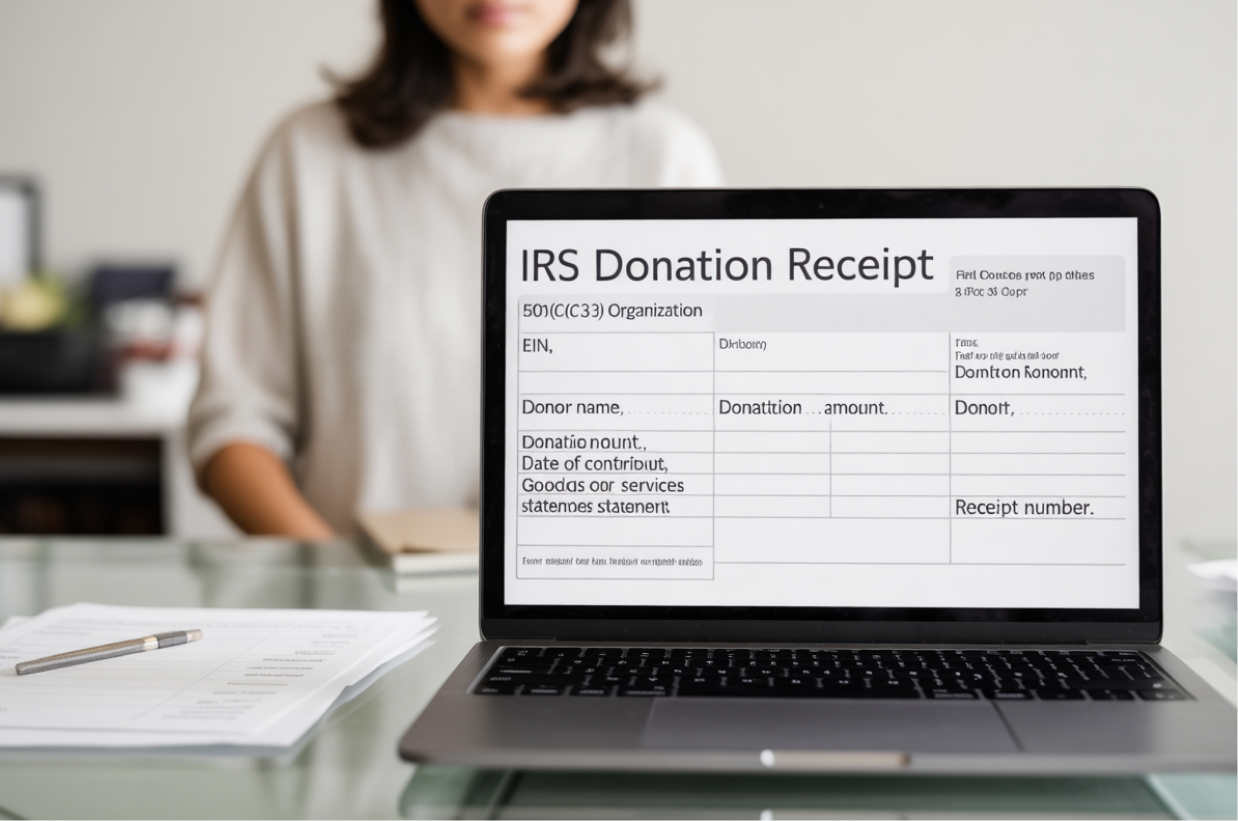
Donation receipts are not just “thank-you notes.”
In the United States, they are legal tax documents governed by the Internal Revenue Service (IRS).
If a donation receipt is missing required information, written incorrectly, or issued at the wrong time, a donor may lose their tax deduction, and the nonprofit may face compliance risk during audits or reviews.
This guide explains IRS donation receipt requirements in the simplest possible way. It covers:
- What a donation receipt really is
- When receipts are legally required
- What must be included on a receipt
- How different donation types are handled
- Real examples of correct receipts
- Common mistakes nonprofits make
No legal jargon. No fundraising buzzwords. Just clear rules.
What is an IRS Donation Receipt?
An IRS donation receipt (also called a written acknowledgment) is a document that proves a donor gave money or property to a qualified nonprofit.
It allows the donor to:
- Claim a charitable tax deduction
- Show proof if the IRS asks
It allows the nonprofit to:
- Show compliance with IRS rules
- Avoid disputes and audit problems
A payment confirmation, bank statement, or “thank you” email is not always enough.
Which Organizations Can Issue Tax-Deductible Donation Receipts?
Only qualified charitable organizations can issue IRS-valid donation receipts.
This usually includes:
- 501(c)(3) nonprofits
- Churches and religious organizations
- Public charities and foundations
If an organization is not IRS-qualified, donations to it are not tax-deductible, even if a receipt is issued.
When Does the IRS Require a Donation Receipt?
The IRS $250 Rule (Very Important)
If a donor gives $250 or more in a single donation, the IRS requires a written donation receipt.
Without it:
- The donor cannot legally claim the deduction
- A bank or credit card statement alone is not enough
This rule applies:
- Even if the donation was made online
- Even if the donor paid by credit card
- Even if the donor has a payment confirmation email
Donations Under $250
For donations under $250:
- A receipt is still recommended
- Bank records may be sufficient
- Best practice is to issue receipts for all donations
This avoids confusion at tax time.
What Must Be Included in an IRS-Compliant Donation Receipt?
Every compliant receipt must include specific information.
Required Information
An IRS-compliant donation receipt must clearly show:
- Legal name of the nonprofit
- Organization address
- Employer Identification Number (EIN)
- Donation date
- Donation amount or description of donated property
- Statement about goods or services
If the donor received nothing in return, the receipt must say:
“No goods or services were provided in exchange for this contribution.”
This sentence is mandatory.
Cash Donations (Most Common Case)
What is a Cash Donation?
A cash donation means the donor gives:
- Money online
- A check
- Cash
- Bank transfer
And receives nothing in return.
Example: Simple Cash Donation
Donor gives $500 online.
They receive nothing.
IRS-Compliant Donation Receipt Example (Cash Donation)
Helping Hands Foundation
890 Charity Lane
Austin, TX 73301
EIN: 12-3456789
Donation Receipt Details
| Field | Information |
| Receipt Number | DK-2026-000321 |
| Receipt Issue Date | February 20, 2026 |
| Donation Date | February 20, 2026 |
| Donor Name | John Smith |
| Donation Type | Cash Donation |
| Donation Amount | $300.00 |
| Payment Method | Cash |
| Fund / Campaign | General Fund |
Official Acknowledgment Statement
Thank you for your generous contribution of $300.00 received on February 20, 2026.
No goods or services were provided in exchange for this contribution.
This receipt may be used for U.S. federal income tax purposes in accordance with Internal Revenue Service (IRS) regulations.
Authorized Signature
Helping Hands Foundation
Authorized Representative
Common Mistakes to Avoid
- Missing EIN
- Missing donation date
- Forgetting the “no goods or services” sentence
- Editing the amount after the receipt is sent
Event and Benefit Donations (Quid Pro Quo Donations)
What is an Event or Benefit Donation?
This happens when a donor:
- Gives money
- And receives something of value
Examples:
- Gala dinner ticket
- Fundraising event entry
- Golf tournament registration
- Merchandise
- Membership benefits
In these cases, the donor is not donating the full amount.
The Basic IRS Rule
Only the amount above the value received is tax-deductible.
Formula:
Deductible Amount = Total Paid − Fair Market Value (FMV)
Example
Donor pays: $250
Dinner value: $50
Deductible amount: $200
Correct Receipt Example (Event Donation)
Helping Hands Foundation
890 Charity Lane, Austin, TX 73301
EIN: 12-3456789
Donation Receipt
| Field | Information |
| Receipt Number | DK-2026-000410 |
| Receipt Issue Date | February 20, 2026 |
| Donation Date | February 20, 2026 |
| Donor Name | Sarah Lee |
| Donation Type | Event / Benefit |
| Total Amount Paid | $300.00 |
| Benefit Description | Annual Charity Gala Dinner |
| Fair Market Value (FMV) | $60.00 |
| Deductible Amount | $240.00 |
| Payment Method | Credit Card |
IRS Required Statement
Thank you for your contribution of $300.00.
In exchange for your contribution, you received Annual Charity Gala Dinner.
The fair market value of the goods or services provided was $60.00.
The amount of your contribution that is deductible for federal income tax purposes is $240.00.
Important IRS Thresholds
- Over $75 → Disclosure required
- $250 or more → Written acknowledgment required
In-Kind Donations (Non-Cash Donations)
What is an In-Kind Donation?
An in-kind donation is a gift of goods or property, not money.
Examples:
- Laptops
- Furniture
- Food supplies
- Vehicles
- Clothing
Very Important IRS Rule
The nonprofit must not assign a dollar value to in-kind donations on the receipt.
The donor determines the value for tax purposes.
Correct Receipt Example (In-Kind Donation)
Helping Hands Foundation
890 Charity Lane, Austin, TX 73301
EIN: 12-3456789
Donation Receipt
| Field | Information |
| Receipt Number | DK-2026-000422 |
| Receipt Issue Date | February 20, 2026 |
| Donation Date | February 20, 2026 |
| Donor Name | ABC Technologies |
| Donation Type | In-Kind |
| Description of Property | 3 Dell Latitude Laptops |
IRS Required Statements
No goods or services were provided in exchange for this contribution.
In accordance with IRS regulations, no value has been assigned to the donated property.
Please consult your tax advisor regarding valuation.
What Must NOT Be Done
- Do not assign a dollar value
- Do not calculate deductible amount
- Do not skip compliance wording
Pledge Donations
What is a Pledge?
A pledge is a promise to donate in the future.
Example:
- Donor pledges $5,000
- Pays $1,000 per month for 5 months
A pledge is not money.
Critical IRS Rule
You cannot issue a receipt for a pledge until money is actually received.
Receipts are issued:
- Per payment
- For the amount paid only
Correct Receipt Example (Pledge Payment)
Helping Hands Foundation
890 Charity Lane, Austin, TX 73301
EIN: 12-3456789
Donation Receipt
| Field | Information |
| Receipt Number | DK-2026-000455 |
| Receipt Issue Date | February 20, 2026 |
| Donation Date | February 20, 2026 |
| Donor Name | John Smith |
| Donation Type | Pledge Payment |
| Installment Amount Paid | $1,000.00 |
| Total Pledge Amount | $5,000.00 |
| Amount Paid to Date | $1,000.00 |
| Remaining Balance | $4,000.00 |
| Payment Method | Bank Transfer |
IRS Required Statement
Thank you for your pledge installment payment of $1,000.00.
No goods or services were provided in exchange for this contribution.
Why Most Nonprofits Get This Wrong
Many organizations:
- Use simple thank-you emails
- Forget required wording
- Overstate deductible amounts
- Issue receipts for pledges
- Miss event donation rules
These mistakes often surface during audits or year-end tax filing.
How DonorKite Helps Nonprofits Stay IRS-Compliant
DonorKite is built specifically to enforce IRS donation receipt rules automatically.
It ensures:
- Correct receipt wording
- Proper handling of $250 rule
- Accurate event donation calculations
- No valuation errors for in-kind gifts
- Receipts only for money received
- Locked records after receipt generation
This removes manual guesswork and reduces compliance risk.
Conclusion
IRS donation receipt requirements define what charities and nonprofits in the United States must include on a receipt and when a receipt can legally be issued. These rules change based on the type of donation—cash, in-kind gifts, or pledge payments—and each has its own compliance standards.
By understanding these requirements, nonprofits can issue receipts that accurately reflect what was received, avoid common IRS mistakes, and ensure donors have proper documentation for tax purposes. Following IRS rules is not about paperwork—it is about issuing correct, compliant, and defensible donation receipts every time.