

Small nonprofits searching for DonorPerfect alternatives in 2026 are often looking for a donor management system that makes everyday fundraising administration easier rather than adding more complexity.
Raising a donation is only one part of the process. Once a contribution is received, the organization still needs to maintain the donor's information, record the donation accurately, associate it with the correct fund or campaign, identify the payment method, prepare the appropriate donation receipt, email that receipt to the donor, preserve the giving history, and make the same information available when statements or reports are needed later.
For a small nonprofit with a limited administrative team, these responsibilities can become difficult when donor information is spread across Excel files, receipt folders, email accounts, bank records, and different systems.
DonorPerfect is an established nonprofit CRM and fundraising platform with a broad range of donor management, fundraising, communication, campaign, automation, and reporting capabilities. Organizations looking for a wider nonprofit fundraising ecosystem may find that level of functionality useful.
However, nonprofits comparing DonorPerfect alternatives do not necessarily need another platform with exactly the same scope. Some already have established ways to conduct fundraising and receive contributions. Their larger challenge is keeping the donors, donations, funds, receipts, giving histories, and reports created by those fundraising activities properly organized.
That is where DonorKite is worth considering.
DonorKite is donor and donation management software built for nonprofits, charities, churches, foundations, trusts, associations, educational organizations, and community organizations that need a structured way to manage donor records and contributions.
Its focus is on managing donations that have already been received rather than acting as the payment gateway through which every gift must be collected. An organization can continue using the fundraising methods that work for it while DonorKite helps manage the administrative work behind those contributions.
For organizations in the United States, Canada, United Kingdom, Australia, and New Zealand, DonorKite can also help maintain donor, donation, and receipt information relevant to country-specific tax and charitable contribution workflows.
Organizations can try DonorKite for free for 7 days before deciding whether the platform fits their donor management and fundraising administration requirements.
DonorKite as a DonorPerfect Alternative for Small Nonprofits
The right DonorPerfect alternative should not be chosen simply by comparing which system has the longest feature list. A more useful evaluation starts with the work the organization needs to complete every day.
DonorPerfect has a broad nonprofit fundraising and CRM focus. DonorKite is more concentrated on managing donor records and the administrative work connected with donations after they have been received.
Consider a small charity that has just completed a fundraising campaign. Supporters may have contributed through cash, checks, cheques, bank transfers, or another method the organization already uses. The campaign may have been successful, but the administrative work is only beginning.
Staff now need to make sure each donation belongs to the correct donor, enter the amount and date accurately, associate the gift with the appropriate fund or campaign, record the payment method, maintain relevant tax information, generate the appropriate donation receipt, and email the documentation to the donor. The same contribution may later need to appear in the donor's giving history, a year-end statement, or a donation report.
DonorKite is designed around this practical side of nonprofit donor management.
For organizations researching donor management software for small nonprofits, this focused approach can be easier to align with the day-to-day work of a smaller administrative team.
How Donor Management Supports Better Fundraising
Fundraising and donor management are closely connected.
A successful fundraising campaign brings contributions into an organization, but good donor management preserves the information and relationships created by those contributions.
Suppose a nonprofit runs an education fundraising campaign. One supporter contributes $150 for the first time. Another gives $500 after supporting the same program for three consecutive years. A third supporter usually contributes to emergency relief instead.
Looking only at the current transactions provides limited context. A structured donor database tells a much more useful story.
Nonprofit donor management software can help staff understand whether a supporter is new or returning, how much they have contributed previously, which funds or campaigns they have supported, and what receipt or statement information already exists.
This information can support future fundraising and donor stewardship. Staff have better context when answering contribution-related questions, reviewing historical support, communicating with repeat donors, or considering how different fundraising campaigns have performed.
DonorKite does not replace the human relationships behind successful fundraising. Instead, it provides more organized information to support those relationships.
That distinction is important when organizations compare nonprofit fundraising software. Some nonprofits need a broad platform that manages multiple parts of the fundraising process. Others already have established fundraising methods and primarily need fundraising donor management software that keeps supporters, donations, funds, campaigns, receipts, and giving histories organized.
DonorKite is focused on that second requirement.
Centralize Donor Records and Giving History
A dependable donor database becomes increasingly important as fundraising activity grows.
Many small nonprofits begin with one Excel workbook. Over time, another spreadsheet is created for annual donations, another for a fundraising campaign, another for funds, and another for receipt numbers. Historical receipt PDFs may be stored in folders, while updated donor contact information exists somewhere else.
Eventually, staff no longer have one place they can trust as the complete donor record.
DonorKite gives organizations a centralized place to maintain supporter information and connect donations with the people who made them.
Organizations moving away from fragmented records can use donor database software to maintain donor profiles, offline donations, contribution histories, funds, and receipt information within a more structured system.
Maintain Detailed Donor Profiles
A useful donor profile should contain more than a name and email address.
Organizations may need to maintain address information, phone details, country information, tax-related information, and other administrative data relevant to their workflow.
The value becomes clearer when that donor contributes again.
Instead of creating another disconnected spreadsheet row, the new contribution can become part of the same donor record. If someone has supported the organization for several years, staff can review one giving history instead of searching multiple annual files.
For fundraising teams, this means a donor becomes more than an individual transaction. Staff can understand more of the person's historical relationship with the organization.
Preserve Complete Donor Giving History
Donor giving history provides important context.
Imagine a supporter gives $200 in January, $100 during a spring campaign, $300 to an emergency appeal, and another $500 at year end.
These are four separate contributions, but they represent one donor relationship.
Keeping the contributions connected with the same supporter allows staff to understand the full giving history instead of treating every donation independently.
This can help when a donor asks about an earlier contribution, when staff need to retrieve a previous receipt, when fundraising teams review historical support, or when a year-end statement needs to be prepared.
Complete donor giving history can also strengthen donor stewardship because staff can work from accurate historical records instead of relying on memory.
Reduce Duplicate Donor Records
Duplicate donor records can create problems across fundraising, receipt administration, statements, and reporting.
For example, an organization may already have a donor profile for Jennifer Thompson. Later, another staff member creates Jenny Thompson using a different email address.
If these profiles belong to the same person, contributions may become divided across two records.
One profile may contain donations to an annual campaign while another contains contributions to an education fund. The organization may incorrectly treat them as two supporters, and neither profile provides the complete giving history.
This can become particularly problematic when annual statements are prepared or fundraising results are reviewed.
A centralized donor management system gives organizations a stronger foundation for maintaining cleaner donor records and reducing fragmented histories.
Move Donor and Fundraising Records from Excel
Excel is often the first donor management tool used by a small nonprofit because it is familiar, flexible, and easy to start with.
The limitations usually appear gradually.
One workbook becomes several. Different years have different donation files. Fundraising campaigns are tracked separately. Receipt numbers exist in another sheet. Staff begin adding columns every time a new administrative requirement appears.
Eventually, the organization spends significant time reconciling files instead of using the information.
Moving to donor management software gives nonprofits an opportunity to build a more structured record system.
DonorKite supports importing and exporting donor information, which can reduce the need to recreate every supporter profile manually.
Before migration, organizations should review their existing data carefully. Duplicate donors, inconsistent spellings, outdated email addresses, incomplete contact information, inconsistent date formats, and fragmented historical donation records should be cleaned where possible.
The objective should not simply be moving an Excel spreadsheet into another application. It should be creating a dependable donor database that supports fundraising records, future donations, receipts, statements, and reporting.
Manage Offline Donations Generated Through Fundraising
Fundraising does not only happen through online checkout forms.
Many small nonprofits continue to receive significant contributions through offline donation methods. A supporter may send a check after receiving a fundraising appeal. Someone may hand cash to an organization at a community event. A charity may receive a cheque through the post. A long-standing donor may make a bank transfer after speaking with the organization directly.
These are still fundraising results.
They simply require a different administrative process afterwards.
DonorKite helps organizations manage offline donations after they have been received. Staff can record the donor, contribution amount, date, relevant fund or campaign, payment method, and other important details.
The contribution then becomes part of the organization's donor and donation records rather than remaining only on a bank statement or in a spreadsheet.
For organizations comparing fundraising software for small nonprofits, this distinction matters.
DonorKite is not positioned as an online fundraising payment gateway. Its role is to help organizations manage the donor and donation records generated by their fundraising activities.
Record Cash, Checks, Cheques, and Bank Transfers
Different nonprofits receive contributions in different ways.
A U.S. nonprofit may regularly receive checks, while charities in Canada, the UK, Australia, and New Zealand may commonly use the spelling cheques. Cash and bank transfers may also represent important offline donation methods.
DonorKite allows these contributions to be maintained within the same donation management software.
Instead of knowing only that $500 appeared in the organization's account, staff can maintain information about who contributed it, when it was received, how it was received, and what fund or campaign it supported.
This creates a much more useful historical record.
Organize Fundraising Contributions with Funds and Campaigns
Fundraising information becomes more valuable when the organization knows what each donation supported.
A nonprofit may maintain several fundraising priorities during the year. A community charity might operate a general fund alongside education, emergency support, and annual campaign funds. A church may maintain general giving, missions, building, and community outreach funds. A foundation may organize contributions across several charitable programs.
DonorKite includes funds and campaigns so organizations can associate donations with the purposes they support.
When a contribution is recorded, staff can select the relevant fund or campaign instead of trying to reconstruct that information months later from notes or spreadsheets.
This supports clearer fundraising administration because campaign information remains connected with the actual donations generated through that activity.
Fund and campaign records can also improve fundraising reporting. Instead of seeing only the total amount received, staff can better understand which areas received support.
Configure Payment Methods Around your Organization
Payment methods add important context to donation records.
Different organizations may receive different combinations of cash, checks, cheques, bank transfers, or other offline payment methods.
DonorKite allows organizations to configure payment methods around the way they actually operate.
Recording the payment method can also support internal reconciliation. When staff look at a historical donation, they can see not only the amount but how the contribution was received and which fund or campaign it supported.
For small nonprofits handling multiple offline donation methods, this can provide much clearer records than relying on a spreadsheet amount alone.
Use Giving Records to Strengthen Donor Stewardship
Donor stewardship is an important part of long-term fundraising.
Organizations are better positioned to maintain supporter relationships when they can respond accurately to questions and understand historical giving.
A donor should not need to explain their previous contribution history every time they contact the nonprofit.
Staff should be able to review the organization's own records and understand previous donations, supported funds, campaigns, and receipt information.
This is one way donor management software can support fundraising without becoming the fundraising platform itself.
A fundraiser speaking with a long-standing supporter can have more context when previous contributions are visible. Administrative staff can respond more quickly when a donor requests another receipt. Management can review which fundraising campaigns a supporter has historically backed.
Better records do not replace personal communication, but they provide a stronger foundation for donor engagement and donor stewardship.
Generate Professional Donation Receipts from Recorded Contributions
Donation receipts are an important part of the post-fundraising workflow.
When receipts are handled manually, the same information may need to be entered several times. Staff record the donation in Excel, open a receipt template, enter the donor information again, type the amount and date, add organization information, export the document as a PDF, open an email application, attach the file, and then maintain another record showing whether it was sent.
For a fundraising campaign that generates many donations, this can quickly become a significant administrative burden.
DonorKite reduces this repetition by allowing receipts to be generated from donor and donation information already maintained in the system.
Organizations wanting to improve this process can explore donation receipts for nonprofits and how structured receipt management can reduce repeated administrative work.
Once a contribution is recorded, a professional PDF donation receipt can be generated from the existing information and remain associated with the appropriate donor and donation.
This connection becomes especially useful when historical documentation is needed.
If a supporter contacts the organization several months later asking for another copy, staff can begin with the underlying donation record rather than searching through unrelated PDF folders.
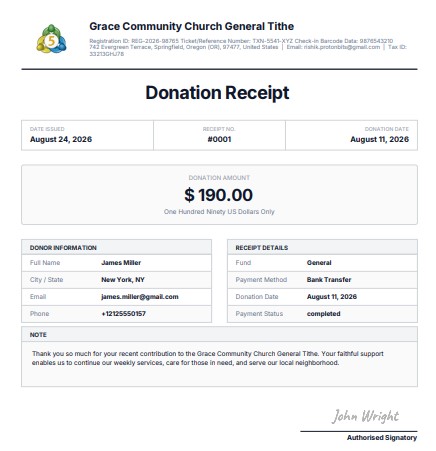
The anonymized DonorKite-generated donation receipt sample should be placed directly after this section in the published blog.
It gives readers a real product example and demonstrates what the receipt-generation feature produces instead of relying only on written descriptions.
Suggested image caption:
Sample Donation Receipt Generated with DonorKite
Suggested ALT text:
Donation receipt generated using DonorKite donation receipt software
Keep Donation Receipt Numbers Organized
Structured receipt numbering becomes increasingly important as donation volume grows.
When different staff members manually create receipt numbers, inconsistencies can make historical records harder to maintain.
DonorKite supports organized receipt numbering and allows organizations to configure the starting receipt number according to their existing administrative process.
For example, an organization moving from another system may already have issued receipts through #00019. It may want the new sequence to continue appropriately rather than beginning again at #00001.
Receipt numbering can also be maintained around financial-year workflows.
Consistent receipt numbers give administrators another reliable way to identify and locate historical donation documentation.
Customize Donation Receipts for your Organization
A donation receipt should reflect the organization issuing it.
DonorKite provides receipt customization capabilities so nonprofits are not restricted to one generic document.
Organizations can configure receipt elements such as their logo, organization information, authorized signature, fonts, labels, tax-related information, and relevant receipt terminology.
This can be particularly valuable for nonprofits that previously maintained their own Word or PDF receipt templates.
Instead of manually modifying every receipt, the organization can establish a more consistent format within its donation management workflow.
Customization is also important for organizations in different countries because charitable contribution terminology and tax receipt requirements are not identical in every jurisdiction.
Manage Country-Specific Donation Receipt Records
The United States, Canada, United Kingdom, Australia, and New Zealand do not use identical charitable contribution documentation.
Organizations operating in these countries need to maintain information relevant to their local rules rather than assuming one universal receipt format is appropriate everywhere.
DonorKite helps organizations maintain the underlying donor, contribution, and receipt information used within these processes.
Nonprofits can review Charitable Contributions Receipt Requirements to understand differences between IRS, CRA, Gift Aid, ATO/DGR, and IRD-related donation records.
DonorKite supports the administrative and recordkeeping workflow, but the nonprofit or charity remains responsible for determining whether a contribution qualifies for the relevant tax treatment and whether its documentation satisfies applicable requirements.
United States: IRS Donation Receipts and Fundraising Records
U.S. nonprofits need reliable contribution records because IRS acknowledgement requirements can differ depending on the amount and nature of a donation.
Maintaining accurate donor information, contribution dates, monetary amounts, and appropriate acknowledgement information makes receipt administration easier after fundraising activities.
The same principle applies whether the donation came from a year-end appeal, community fundraiser, church contribution, direct-mail campaign, or another fundraising initiative.
Rather than reconstructing this information later, staff can maintain it when the donation is first recorded.
Organizations can review DonorKite's IRS donation receipt requirements for more information about charitable contribution acknowledgement records.
For U.S. nonprofits, connecting fundraising records with donor history and receipt information can reduce a significant amount of repetitive administration.
Canada: CRA Donation Receipts and Donor Records
Canadian registered charities work within a more prescriptive official donation receipt framework.
Depending on the circumstances, an official donation receipt may require information about the registered charity, donor, donation amount, relevant dates, registration information, unique receipt number, and eligible amount.
Fundraising campaigns can generate many of these records within a short period.
If donor addresses exist in one spreadsheet, contribution information in another, and receipt numbering somewhere else, the process becomes unnecessarily difficult.
DonorKite helps centralize the underlying donor and donation information.
Canadian charities can review CRA donation receipt software to understand how centralized donor records and structured receipt administration can simplify the process.
Once the relevant donation is recorded, the organization can generate the receipt and deliver it by email while keeping the documentation connected with the donor's giving history.
United Kingdom: Fundraising, Gift Aid, and Giving History
UK charities operate within a different charitable tax framework.
Gift Aid should not simply be described as another form of tax donation receipt. It has separate declaration and recordkeeping requirements.
However, accurate donor information remains fundamental.
When a fundraising campaign generates multiple contributions from a returning supporter, those donations need to remain connected with the correct donor record.
Duplicate profiles or fragmented histories can make it more difficult to review giving records connected with Gift Aid administration.
DonorKite helps UK charities maintain structured donor and donation histories.
Organizations can explore charity CRM software for UK charities for more information about managing donor records, offline donations, and giving history.
The charity remains responsible for its Gift Aid declarations, claims, and relevant HMRC requirements. DonorKite helps maintain the underlying donor and donation information needed to support those processes.
Australia: ATO, DGR, and Fundraising Donation Records
Australian charities also need accurate underlying donor and donation information.
Fundraising activities may generate contributions for general purposes, specific programs, community initiatives, or designated funds. Maintaining the donor, amount, date, fund, and relevant receipt information from the beginning reduces the need to recreate those records later.
Australian organizations must also consider whether the recipient organization or relevant fund has Deductible Gift Recipient status and whether a particular contribution qualifies for the relevant treatment.
DonorKite can help maintain donation records and provide an email-based donation receipt workflow.
Organizations can review ATO donation receipt software for more information about structuring Australian donor and receipt records.
The organization remains responsible for determining the correct tax treatment. DonorKite helps organize the donor, donation, and documentation workflow behind that determination.
New Zealand: IRD Donation Receipts and Donor Giving Records
New Zealand charities and approved donee organizations operate under their own donation receipt and donation tax credit framework.
A fundraising campaign may result in many individual contributions, but each eligible donation still requires accurate underlying information.
The organization may need to maintain donor details, contribution amount, date, organization information, and appropriate receipt records.
DonorKite helps keep those contributions connected with the correct supporter instead of treating them as disconnected transactions.
New Zealand organizations can review IRD donation receipt requirements for more information about the relevant donation documentation framework.
Accurate historical records can also make it easier to respond when donors request replacement receipts or information about previous contributions.
Send Donation Receipts Directly by Email
Creating a receipt is only part of the process.
The documentation still needs to reach the donor.
DonorKite supports email donation receipt delivery, helping organizations move from recorded contribution to receipt delivery without creating another disconnected administrative workflow.
This becomes particularly useful after fundraising campaigns.
Processing a few manually created receipts may be manageable. Processing dozens or hundreds with separate spreadsheets, document templates, PDF folders, and email accounts can quickly become inefficient.
Keeping receipt delivery connected with donation administration helps reduce repetitive work and makes historical documentation easier to retrieve.
For the DonorKite workflow discussed in this article, receipt delivery is focused on email.
Generate Donor Statements from Giving History
Individual donation receipts relate to individual contributions.
Donor statements provide a broader view of giving over a defined period.
This can be particularly useful for repeat supporters.
Suppose a donor contributes every month and also supports two fundraising campaigns during the year. By year end, the organization may have fourteen separate contributions associated with that supporter.
If those donations have been recorded consistently throughout the year, the giving history already exists.
DonorKite allows organizations to generate donor statements from maintained contribution records rather than manually filtering and calculating multiple spreadsheet rows.
This can reduce administrative pressure at year end when several donors may request contribution summaries at the same time.
Statements can also support donor stewardship by giving supporters a clearer record of their historical giving.
Use Fundraising and Donation Reports More Effectively
Reporting is another area where fundraising and donor management overlap.
A small nonprofit may want to understand how much was contributed during a particular period, which fundraising campaign received recorded donations, which funds attracted support, or how contributions were received.
DonorKite includes donation reporting as well as funds and campaign management.
The advantage is that reporting can use information staff already maintain as part of everyday donation administration.
When a donation is recorded, the organization captures information such as the donor, amount, date, fund or campaign, and payment method. Those records can later be used to review fundraising activity without requiring another spreadsheet that must be updated separately.
For organizations without a dedicated database administrator or analyst, this can make fundraising reporting much easier to maintain.
Customize DonorKite Around your Organization's Requirements
Every nonprofit has its own internal processes.
One organization may require a particular receipt format. Another may use unique terminology for its funds or campaigns. A church may organize donations differently from a foundation. A Canadian charity may maintain different receipt information from a U.S. nonprofit.
DonorKite already provides configurable options across donor information, funds, campaigns, payment methods, receipt settings, and organization details.
If the standard configuration does not fully match the organization's requirements, the nonprofit can discuss those requirements directly with DonorKite.
This could involve a specific receipt format, terminology, record field, fund structure, report, or another donation-management workflow.
Organizations should not assume every custom request will automatically be developed. Instead, the requirement can be discussed with the DonorKite team to determine what can be configured or customized.
Organizations with specific requirements can contact DonorKite and explain the workflow they need.
DonorKite vs DonorPerfect for Small Nonprofits
DonorKite and DonorPerfect overlap in donor management, but their overall scope is different.
DonorPerfect is a broader nonprofit fundraising and CRM platform. DonorKite is more focused on maintaining donor records and managing the administrative work connected with contributions that have already been received.
Comparison Area | DonorKite | DonorPerfect |
Primary focus | Donor and donation administration | Broader nonprofit fundraising and CRM |
Donor database | Yes | Yes |
Donor giving history | Yes | Yes |
Offline donation management | Core workflow | Yes |
Funds and campaigns | Yes | Yes |
Fundraising support | Donor, fund, campaign, receipt, statement, and reporting administration | Broader fundraising ecosystem |
Donation receipt generation | Core workflow | Available |
Receipt customization | Yes | Available within broader platform |
Email receipt delivery | Yes | Available |
Donor statements | Yes | Broader donor and reporting capabilities |
Donation reporting | Yes | Extensive fundraising and CRM reporting |
Custom requirements | Contact DonorKite to discuss | Broader configurable CRM |
Current starting price | $49/month | Starts at $99/month |
Best suited for | Organizations wanting focused donor and donation administration | Organizations needing a broader fundraising technology ecosystem |
Price should not be the only factor when comparing donor management software.
An organization that needs extensive online fundraising capabilities, integrated payment processing, marketing automation, and a broad nonprofit CRM environment may prefer the wider scope available through DonorPerfect.
A small nonprofit whose main challenges involve donor records, offline fundraising contributions, funds, campaigns, donation receipts, giving histories, statements, and donation reports may find DonorKite's more focused approach easier to match with its everyday work.
That distinction is more useful than simply asking which platform contains more features.
Who Should Consider DonorKite?
DonorKite can be particularly relevant to small nonprofits, registered charities, churches, faith-based organizations, foundations, trusts, associations, educational organizations, and community organizations where fundraising generates substantial administrative work.
It can be especially useful for organizations that already have established ways to raise and receive donations but struggle with what happens afterwards.
That may include maintaining donor information in Excel, recording offline donations manually, managing several fundraising campaigns or funds, preparing receipts individually, reconstructing donor giving histories, producing statements, or maintaining donation reports through separate spreadsheets.
For these organizations, DonorKite provides a focused donor management layer behind their fundraising activities.
Try DonorKite Before Switching
Choosing donor management software should involve more than reading a comparison table.
The people responsible for administration should be able to test the actual workflow.
DonorKite currently provides a 7-day free trial, giving organizations an opportunity to explore donor records, offline donation entry, funds, campaigns, payment methods, receipt customization, PDF receipt generation, email receipt delivery, donor statements, and donation reports.
This provides a practical way to determine whether the system addresses the problems that led the organization to search for DonorPerfect alternatives.
Organizations can try DonorKite for free before subscribing.
DonorKite Pricing for Small Nonprofits
DonorKite currently lists its standard plan at $49 per month.
The plan includes unlimited donors and donations, donor management, email donation receipts, one-click donation statements, funds and campaigns, donation reports, cloud-based access, and email support.
For smaller organizations, straightforward pricing can make budgeting easier because the core donor management cost is clear without requiring staff to compare several complicated tiers.
Organizations with custom requirements should discuss those requirements directly with DonorKite so the team can determine what configuration or customization may be needed.
Why DonorKite is Worth Considering as a DonorPerfect Alternative
A DonorPerfect alternative does not need to reproduce every part of DonorPerfect to be useful.
What matters is whether the software solves the problems the nonprofit is actually trying to address.
DonorKite can help organizations centralize donor information, preserve complete giving histories, move away from fragmented spreadsheets, record offline fundraising contributions, organize funds and campaigns, configure payment methods, maintain relevant tax information, generate professional donation receipts, maintain structured receipt numbering, customize receipt presentation, send receipts by email, create donor statements, and review donation reports.
These capabilities also support the administrative side of fundraising.
A fundraising campaign becomes easier to review when contributions are associated with the right fund or campaign. Donor stewardship becomes more informed when complete donor histories are available. Receipt administration becomes easier when documentation uses information already maintained in the donor database. Year-end statements become less time-consuming when contributions have been recorded consistently throughout the year.
DonorKite does not need to replace every fundraising activity the organization performs. Its role is to provide organized donor and donation records behind those fundraising efforts.
For a small administrative team, that focus can mean less time rebuilding information and more time available for fundraising, donor relationships, programs, and mission-related work.
Is DonorKite the Right DonorPerfect Alternative for your Small Nonprofit?
The right donor management software depends on what your organization actually needs.
If your nonprofit wants a broad fundraising CRM that combines extensive fundraising functionality, online giving, payment processing, marketing capabilities, automation, and constituent management, DonorPerfect's broader ecosystem may remain appropriate.
If the main requirement is a simpler way to maintain donor records, manage offline contributions, organize fundraising funds and campaigns, preserve donor giving history, create country-relevant donation receipts, send receipts by email, prepare donor statements, and review donation reports, DonorKite deserves serious consideration.
Its main advantage is that these responsibilities remain connected instead of becoming separate administrative processes.
A donor's information can be maintained once. Future donations can build onto the same history. Funds and campaigns can be selected when contributions are recorded. Receipt documentation can use information already maintained in the system. Statements can work from historical contributions, and reports can use the same underlying donation data.
Organizations can start a free DonorKite trial and evaluate the software using their own donor and fundraising workflows.
If your organization has a specific receipt format, donor field, fund structure, reporting need, or other administrative requirement, contact DonorKite to discuss what can be configured or customized.
Frequently asked questions
Is DonorKite a Good DonorPerfect Alternative for Small Nonprofits?
DonorKite is worth considering for small nonprofits that primarily need donor management, offline donation tracking, fundraising fund and campaign records, donation receipts, giving histories, statements, and reports. DonorPerfect provides a broader nonprofit fundraising and CRM environment, while DonorKite focuses more closely on donor and donation administration.
Can DonorKite Support Nonprofit Fundraising?
DonorKite supports the administrative side of fundraising. Organizations can use it to maintain donor records, record donations generated by fundraising activity, associate contributions with funds and campaigns, preserve giving histories, create donation receipts, generate statements, and review donation reports. It is not positioned as an online fundraising payment gateway.
What is Fundraising Donor Management Software?
Fundraising donor management software helps nonprofits maintain supporter information and connect donors with contributions, giving histories, funds, campaigns, receipts, statements, and reporting. It gives organizations a structured view of the people supporting their fundraising activities.
Can DonorKite Manage Offline Donations?
Yes. DonorKite is designed to help organizations record donations they have already received through methods such as cash, checks, cheques, bank transfers, and other configured payment methods.
Can DonorKite Manage Funds and Campaigns?
Yes. DonorKite allows organizations to maintain funds and campaigns and associate donations with the appropriate fundraising purpose when the contribution is recorded.
Does DonorKite Generate Donation Receipts?
Yes. DonorKite can generate donation receipts using donor and contribution information already recorded in the system, reducing the need to recreate the same information manually in separate templates.
Can DonorKite Customize Donation Receipts?
Yes. Organizations can configure receipt-related information including their logo, organization details, authorized signature, fonts, labels, relevant tax information, and receipt terminology.
Can DonorKite Send Donation Receipts by Email?
Yes. Email donation receipt delivery is part of DonorKite's donor and donation management workflow.
Does DonorKite Support Country-Specific Donation Receipt Records?
DonorKite can help organizations maintain donor, contribution, and receipt information relevant to workflows in the United States, Canada, United Kingdom, Australia, and New Zealand. Organizations remain responsible for ensuring that their documentation meets the rules applicable to each donation.
Can Donor Records be Imported from Excel?
DonorKite supports data import and export, helping organizations move existing donor records into a centralized donor database instead of manually recreating every supporter.
Can DonorKite Generate Donor Statements?
Yes. DonorKite includes donation statements that allow organizations to work from the giving history already maintained within the system.
Can DonorKite Help with Fundraising Reports?
DonorKite includes donation reporting and allows contributions to be associated with funds and campaigns. This provides more structured information for reviewing fundraising and donation activity.
Can DonorKite be Customized for our Organization?
Organizations with specific receipt formats, reporting requirements, fund structures, donor fields, terminology, or other donation-management requirements can contact DonorKite to discuss what can be configured or customized.
How Much Does DonorKite Cost?
DonorKite currently lists its standard plan at $49 per month. The plan includes unlimited donors and donations, donor management, email donation receipts, donation statements, funds and campaigns, donation reports, cloud-based access, and email support.
Does DonorKite Offer a Free Trial?
Yes. DonorKite currently offers a 7-day free trial so organizations can evaluate donor records, offline donations, fundraising administration, receipts, statements, funds, campaigns, and reporting before subscribing.
Organizations can try DonorKite for free.