
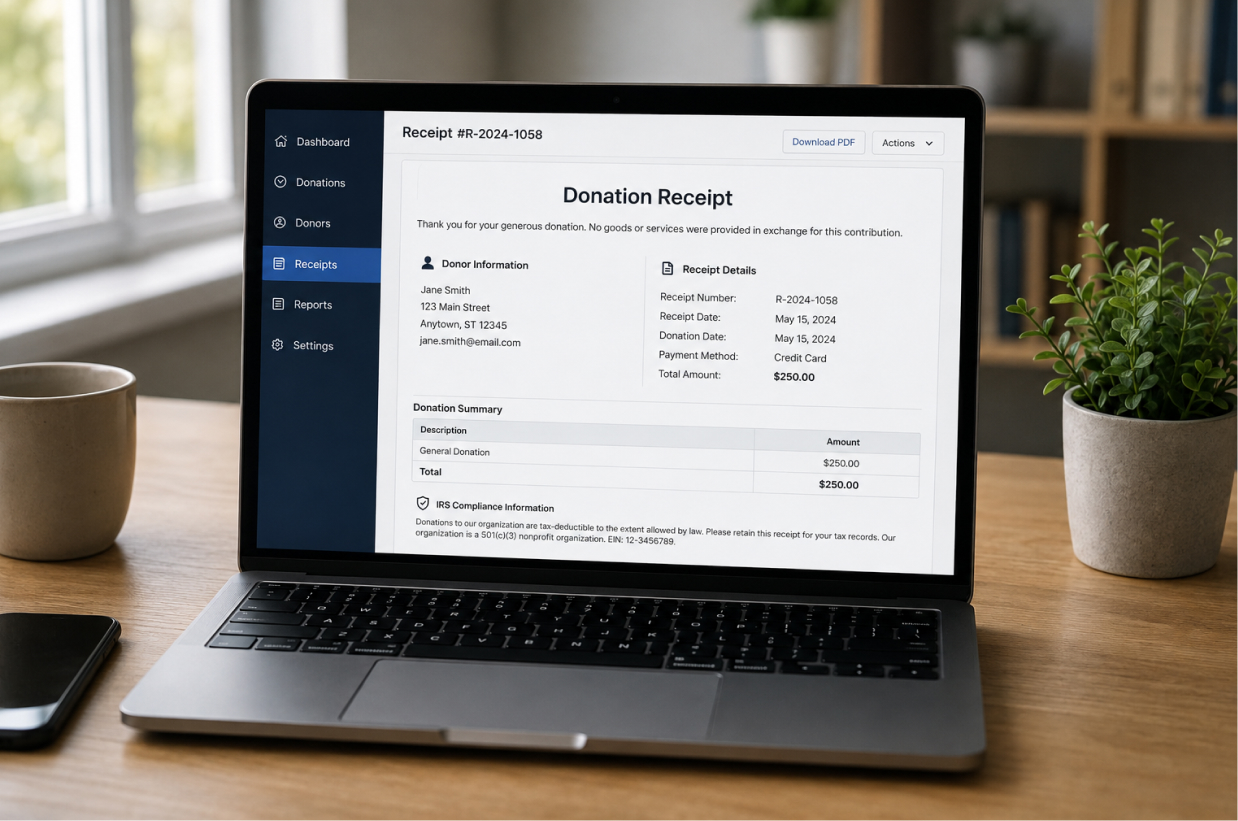
Every contribution begins with a donor choosing to support a cause. What happens after the gift arrives is just as important. The nonprofit must record the donation accurately, connect it with the correct donor, and provide documentation that contains the appropriate contribution details.
Creating donation receipts for nonprofits involves more than typing a donor name and amount into a document. The receipt may need to identify the organization, describe the contribution, state whether the donor received anything in return, and use wording appropriate to the type of donation received.
The receipt must also be delivered and retained so staff can find it if the donor requests a correction, replacement, or year-end summary. A nonprofit may manage this manually when it receives only a few contributions. As donation activity grows, however, repeated data entry, disconnected spreadsheets, and separately stored receipt files can create delays and mistakes.
DonorKite gives nonprofits a more organized way to maintain donor information, record offline donations, generate receipts, and send them through email, SMS, or WhatsApp.
Start With the Type of Donation You Received
Before creating a receipt, identify the type of contribution received. The donation type affects what information should be recorded and how the contribution should be described.
Cash Donations
For a cash contribution, record the exact amount and the date received. The nonprofit should also connect the donation with the correct donor, campaign or fund, and internal payment reference where applicable.
Check Donations
A check donation should be recorded for the amount received and matched with the correct donor. Sensitive banking information does not need to appear on the donor-facing receipt, although an internal check number can support reconciliation.
Bank Transfer Donations
For a bank transfer, record the donor name, amount, date received, bank or transaction reference, designated purpose, and receipt number. Keeping the transaction reference in the internal record makes corrections and donor questions easier to resolve.
Non-Cash Donations
A non-cash or in-kind contribution may include furniture, computers, equipment, clothing, artwork, inventory, or other property. The nonprofit should describe the property clearly but should generally not assign it a monetary value. The donor is responsible for determining the value used for tax purposes.
For additional guidance, read DonorKite’s guide to non-cash donation receipts.
Event and Quid Pro Quo Payments
A donor may make a payment and receive something in return, such as dinner at a charity gala, event admission, merchandise, a membership benefit, or an auction item. In this situation, the receipt should not state that no goods or services were provided.
For a quid pro quo contribution exceeding $75, a charitable organization generally must provide a written disclosure explaining that the deductible amount is limited to the payment exceeding the fair market value of the benefit and giving a good-faith estimate of that benefit.
Multiple Contributions From the Same Donor
When a donor contributes several times during the year, the nonprofit may issue a separate receipt for each contribution or a detailed year-end acknowledgment. The organization should preserve the date and amount of every individual gift instead of retaining only one combined total.
The information included in donation receipts for nonprofits changes depending on whether the organization received cash, a check, a bank transfer, donated property, or a payment involving goods or services.
Does This Contribution Need a Written Receipt?
Federal tax rules distinguish between donor substantiation requirements and disclosure obligations placed on charitable organizations. The practical approach is to issue accurate documentation consistently, while applying the correct wording to the contribution received.
| Contribution situation | Recommended receipt or acknowledgment approach |
| Monetary contribution below $250 | Provide a written receipt or acknowledgment as a consistent administrative practice. |
| Individual contribution of $250 or more | The donor needs a contemporaneous written acknowledgment to substantiate the deduction. |
| Quid pro quo payment exceeding $75 | The nonprofit generally has a written disclosure obligation. |
| Non-cash contribution | Describe the property without assigning its value. |
| Several gifts during the year | Use separate receipts or a detailed annual acknowledgment listing individual gifts. |
| Unpaid pledge | Do not issue a donation receipt until payment is received. |
Contributions of $250 or More
A donor claiming a deduction for an individual charitable contribution of $250 or more must obtain a contemporaneous written acknowledgment from the qualified organization. Separate contributions are not combined simply to reach the $250 threshold.
For deeper coverage, see IRS donation receipt requirements and the dedicated IRS $250 donation rule guide.
Contributions Below $250
For cash, check, electronic transfer, and other monetary gifts, donors still need written records showing the organization name, contribution date, and amount. Providing a receipt for smaller donations helps the nonprofit maintain a consistent donor experience and reliable internal records.
Quid Pro Quo Contributions
A quid pro quo contribution occurs when a donor makes a payment partly as a contribution and partly in exchange for goods or services. The written disclosure should explain the potential deductible portion and provide a good-faith estimate of the benefit received.
Pledges and Pledge Payments
A pledge is a promise to contribute in the future. A donation receipt should be generated for the amount actually received, not merely for the amount promised. When a pledge is paid in installments, each payment should be recorded accurately.
What Should Donation Receipts for Nonprofits Include?
Well-prepared donation receipts for nonprofits should bring organization details, donor information, contribution records, IRS acknowledgment wording, and internal receipt references together in one clear document.
1. Organization Information
- Legal organization name
- Organization address
- Employer Identification Number, where appropriate
- Contact information
- Tax-exempt status statement, where appropriate
2. Donor Information
- Correct donor name
- Mailing address or email where appropriate
- Internal donor identification number
- Preferred delivery channel
The receipt should use information from a verified donor record rather than relying on repeated manual typing.
3. Contribution Information
- Contribution date
- Cash amount or property description
- Donation type
- Payment method where useful
- Campaign, fund, or designated purpose
- Receipt issue date
4. IRS Acknowledgment Statement
For an individual contribution of $250 or more, the written acknowledgment should state whether the organization provided goods or services. If it did, the acknowledgment should include a description and good-faith estimate of their value. For a non-cash gift, include a description but not the value of the property.
5. Recordkeeping Information
- Unique receipt number
- Internal donation reference
- Name or role of the authorized representative
- Delivery date and channel
- Correction or cancellation reference, when applicable
Choose the Correct IRS Statement
The wording on a receipt should reflect what actually happened in exchange for the contribution.
When No Goods or Services Were Provided
| No goods or services were provided in exchange for this contribution. |
When Goods or Services Were Provided
| In exchange for your contribution, you received goods or services with a good-faith estimated value of $[amount]. |
The disclosure should also explain that the deductible portion is limited to the payment exceeding the fair market value of the benefit received.
When Only Intangible Religious Benefits Were Provided
A qualifying religious organization may state that the goods or services provided consisted entirely of intangible religious benefits. The organization should use wording appropriate to its specific circumstances.
For Non-Cash Contributions
| Two laptop computers, one wireless printer, and three computer monitors were received on August 10, 2026. No monetary value has been assigned to the donated property by the organization. |
See How a Complete Donation Receipt Comes Together
The following example shows how donation receipts for nonprofits can present contribution information clearly while including an appropriate goods-or-services statement.
| HELPING HANDS COMMUNITY FOUNDATION 125 Community Avenue, Boston, MA 02110 EIN: 12-3456789 DONATION RECEIPT Receipt Number: HHCF-2026-00815 Receipt Issue Date: August 12, 2026 Donor Name: Maria Johnson Contribution Date: August 10, 2026 Contribution Amount: $500 Payment Method: Check Designated Fund: Community Support Fund Dear Maria, Thank you for your generous contribution of $500, received by Helping Hands Community Foundation on August 10, 2026. Your support helps us provide essential food and household supplies to families across our community. No goods or services were provided in exchange for this contribution. Please retain this receipt with your records. With appreciation, Jordan Lee, Development Director |
This example combines nonprofit identification, donor information, contribution details, acknowledgment wording, and receipt-control information. Every sample field should be replaced with verified information from the organization’s own records.
How the Receipt Changes in Different Situations
Contribution of $250 or More
The acknowledgment should identify the organization, state the exact cash amount or describe the property, and include the applicable statement about goods or services. The donor must receive the acknowledgment by the earlier of the date the return is filed or the return due date, including extensions.
Non-Cash Contribution
The receipt should describe what the organization received and the date received. It should not state or confirm the donor’s claimed fair market value.
Donor Received a Benefit
Suppose a donor pays $300 to attend a gala and receives dinner and admission worth $75. The disclosure should state the total payment, identify the benefit, provide its good-faith estimated value, and explain that the potentially deductible portion is the amount exceeding that value.
Year-End Receipt
A year-end acknowledgment can summarize multiple gifts, but it should preserve the date and amount of each contribution. One acknowledgment may cover several individual contributions of $250 or more when the required detail is included.
For additional guidance, see DonorKite’s article on an IRS-compliant year-end donation report.
The Receipt Is Only One Part of the Process
Managing donation receipts for nonprofits also involves recording the contribution, matching it with the correct donor, delivering the document, retaining the organization’s copy, correcting errors, reissuing lost receipts, and reconciling records at year end.
- Record the donor
- Record the contribution
- Verify the donation type
- Select the correct wording
- Create the receipt
- Send it to the donor
- Retain the organization’s copy
- Track corrections and replacements
- Include the contribution in reporting
Where Manual Receipt Processes Usually Break Down
Before the Receipt Is Created
- Incomplete donor information
- Duplicate donor profiles
- Donation recorded under the wrong person
- Missing payment method or campaign
- Contribution date not verified
While the Receipt Is Created
- Incorrect contribution amount
- Misspelled donor name
- Missing EIN
- Wrong receipt date
- Omitted goods-or-services statement
- Duplicate receipt number
- Incorrect non-cash description
After the Receipt Is Sent
- The organization cannot locate its copy
- Delivery status is unknown
- Corrected receipts are difficult to track
- Multiple versions remain active
- Donors repeatedly request replacements
- Receipt files are disconnected from donation records
These problems are not solved simply by creating another Word template. They point to a need for a more reliable receipt-management workflow.
A Better Workflow for Managing Donation Receipts for Nonprofits
A reliable process keeps donor, donation, and receipt information connected from the moment the contribution is recorded.
Step 1: Create or Confirm the Donor Record
Verify the donor name and contact information before recording the contribution.
Step 2: Record the Contribution
Enter the amount, date, donation type, payment method, campaign or fund, and internal reference.
Step 3: Confirm the Receipt Scenario
Determine whether the contribution is cash, check, bank transfer, non-cash, a pledge payment, a quid pro quo payment, or part of a year-end summary.
Step 4: Generate the Receipt
Use verified donor and contribution information rather than retyping details into a separate document.
Step 5: Deliver the Receipt
Send the receipt through the donor’s preferred or available channel.
Step 6: Retain It With the Donation History
The organization should be able to open the donation record and find the related receipt without searching unrelated folders.
Step 7: Correct or Reissue It When Necessary
Preserve a clear record of the original receipt and any corrected version.
How DonorKite Helps Manage Donation Receipts for Nonprofits
DonorKite helps simplify the administrative work involved in creating and managing donation receipts for nonprofits, particularly for organizations that receive offline contributions.
Instead of keeping donor information, donation entries, receipt files, and delivery records in separate places, nonprofits can manage them through a more organized workflow.
- Maintain centralized donor profiles
- Record cash, check, and bank transfer donations
- Preserve complete contribution histories
- Generate donation receipts
- Use configurable receipt formats
- Send receipts through email, SMS, and WhatsApp
- Keep receipts connected with donor and donation records
- Find and reissue previous receipts
- Generate donation reports
- Reduce dependence on disconnected spreadsheets
DonorKite is not an online payment gateway. It is designed to help nonprofits manage offline donations, donor records, receipt generation, delivery, and reporting.
Nonprofits evaluating a structured alternative to manual receipt creation can learn more about donation receipt software or contact DonorKite to discuss their requirements.
Donation Receipt Review Checklist
Before sending donation receipts for nonprofits, staff should verify every donor, contribution, wording, and recordkeeping detail.
- The nonprofit’s legal name is correct.
- The donor’s name is spelled correctly.
- The contribution date is accurate.
- The cash amount or property description is accurate.
- The appropriate goods-or-services statement is included.
- The value of any donor benefit is disclosed where required.
- No value has been assigned to non-cash property.
- The receipt number is unique.
- The receipt issue date is present.
- The organization’s EIN and contact details are correct.
- The receipt will remain connected with the donation record.
- Any corrected receipt will reference the original record.
Conclusion
Accurate donation receipts for nonprofits begin with identifying the contribution type and verifying the donor and donation information. The receipt should clearly identify the organization, state the cash amount or describe the donated property, and include the appropriate statement about goods or services.
Different situations—including non-cash gifts, pledge payments, event benefits, and year-end summaries—require different treatment. Creating the document is only one part of the responsibility. Nonprofits must also record the donation, send the receipt, retain a copy, manage corrections, and retrieve previous records when donors ask for them.
A structured system such as DonorKite helps bring donor information, offline donation records, receipt generation, delivery, and reporting into one organized workflow. This reduces reliance on disconnected spreadsheets and makes everyday receipt management easier as the organization grows.