
Managing donors becomes more demanding as a charity grows. What begins as a simple spreadsheet containing names, email addresses and donation amounts can gradually turn into several separate files for donors, donations, campaigns, charity giving records, receipts and reporting.
For UK charities, this fragmentation creates more than an organisational inconvenience. Staff may struggle to find a donor's complete giving history, duplicate records can appear, offline donations may be difficult to connect with the right supporter, and producing even a basic donation report can involve checking multiple spreadsheets.
This is why searches for charity CRM, charity CRM UK, charity CRM software UK, charity CRM system, charity CRM for small charities and donor management software UK increasingly reflect a practical need rather than simple curiosity. Charities want a dependable way to organise supporters, maintain charity giving records and understand the donations connected with them.
The best charity CRM software should make that work easier. It should help an organisation maintain donor records, record donations consistently, review donor giving history, organise funds or campaigns and retrieve useful information without rebuilding the same records in several places.
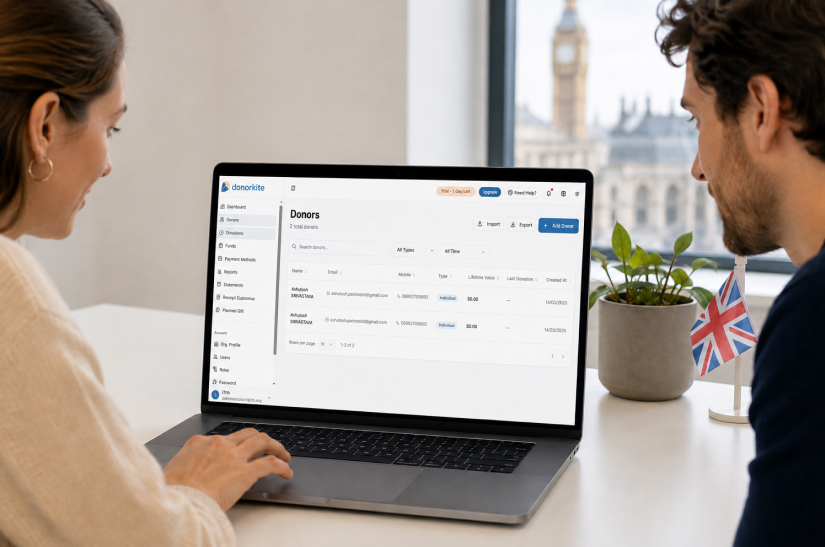
For charities mainly looking to improve donor and donation administration, DonorKite provides a focused solution. It helps organisations manage donor records, offline donations, donation histories, funds, campaigns, reports and receipts within one structured system. This makes it particularly relevant for charities comparing charity donation management software rather than looking for an oversized general-purpose CRM.
If your charity is already spending too much time maintaining spreadsheets, you can Try DonorKite for Free and see how a more organised donor and donation workflow fits your team.
What Is Charity CRM Software?
A charity CRM is software used to organise information about donors, supporters and their relationship with an organisation.
Although CRM traditionally stands for Customer Relationship Management, charities use these systems differently from commercial businesses. The focus is not on customers and sales pipelines. It is on understanding supporters, maintaining accurate donor records and keeping giving information accessible to authorised staff.
A charity CRM system may include donor profiles, donation history, charity giving records, campaign information, notes and reporting tools. The exact capabilities vary between products, but the central purpose is usually the same: to give the charity a clearer picture of each supporter.
This is important because storing contact details alone is not enough. If someone has supported a charity several times, authorised staff should ideally be able to see those contributions as part of that person's donor giving history.
Likewise, a £100 donation should not exist as an isolated transaction if the organisation already knows who made it, which fund it supported and whether the same donor contributed previously.
This relationship between people and donations is one of the main reasons charities also evaluate donor management software alongside traditional CRM platforms.
Why UK Charities Need Better Donor Management
UK charities can receive donations in many different ways. A supporter may contribute by cash at an event, send a cheque, make a direct bank transfer or donate towards a particular appeal, programme or fund.
Each contribution creates information that may need to be used again later.
The organisation may need to confirm who donated, when the donation was received, how much was given, which payment method was used, what the donation supported and what the donor has contributed previously.
When this information is maintained in separate spreadsheets, finding a complete answer becomes difficult.
Imagine a supporter contacts a charity asking for confirmation of the donations they made during the previous year. If donor records, donation records and receipt files are stored separately, a member of staff may need to search several locations before responding.
A charity CRM reduces this fragmentation by keeping related information together. Accurate charity giving records and a complete donor giving history become part of the same donor-management process instead of separate administrative tasks.
That is why charity CRM UK is such an important search category for organisations evaluating software. The issue is usually not whether data exists. The issue is whether staff can find, trust and use that data efficiently.
Charity CRM UK: What Are Organisations Actually Looking For?
A charity searching for charity CRM UK is rarely looking for software simply because other charities use it. There is normally an administrative problem driving the search.
Some organisations have duplicate donor records. Others cannot easily see previous contributions. Staff may be maintaining different spreadsheet versions, while donation receipts sit in separate folders with no clear relationship to the original transaction.
Reporting can create another challenge. If donations for different funds, campaigns or payment methods are stored separately, staff may need to combine several files simply to understand giving activity during one month.
Good charity CRM software should reduce these problems rather than reproduce them in a new interface.
For charities primarily focused on donations, the software should make it easy to understand who donated, how much they gave, when they gave, how the contribution was received, which fund it supported and what the donor giving history looks like.
If a charity CRM cannot make those everyday questions easier to answer, it may not be solving the problem that motivated the organisation to look for software.
Best Charity CRM UK: What Should Charities Look For?
There is no single best charity CRM UK option for every organisation.
Large charities may need extensive integrations, complex fundraising journeys, sophisticated marketing automation, volunteer management and other enterprise functionality. A small or mid-sized charity may have a much more focused requirement.
For many organisations, the priority is simply to maintain clean donor records, record donations consistently and understand giving history.
When comparing the best charity CRM UK options, charities should therefore look at the workflow rather than only the feature count.
A donor-focused system should make it simple to maintain donor profiles, record offline donations, connect donations with funds or campaigns, review donation history, generate useful reports and manage receipts.
Ease of use also matters. Small charities often do not have dedicated CRM administrators, so staff and authorised volunteers need to be able to work with the system consistently.
The best charity CRM software is not necessarily the product with the largest number of tools. The best charity CRM UK solution is the one that removes the most friction from the organisation's actual donor-management process.
Charity CRM Software UK for Managing Donor Records
A useful donor record should provide more than basic contact information.
When an authorised team member opens a donor profile, the charity should be able to understand the relationship with that supporter. That includes the contributions already recorded against them.
If someone has donated several times, staff should not have to search a separate transaction spreadsheet and manually match each contribution to the person's name.
A charity donor management software system should connect these records within the organisation's workflow.
This is one of the areas where DonorKite is particularly relevant. Donor details and donation history can be maintained together rather than treated as separate databases.
For charities trying to move away from fragmented records, donor database software provides a more structured foundation for maintaining supporter information and giving activity.
Donor Management Software UK and Charity CRM
Charity CRM and donor management software UK are closely related terms, although they do not always describe exactly the same type of platform.
A broad CRM may manage many types of organisational relationships. Donor management software typically focuses more specifically on the relationship between supporters and their contributions.
For a charity whose main operational challenge is donor and donation administration, this narrower focus can be useful.
Good donor management software UK should help staff maintain a reliable record of each supporter and the donations connected with that person. It should also make those records accessible to authorised users so donor knowledge does not remain trapped in an individual employee's spreadsheet.
This becomes increasingly important when teams change.
A charity should not lose visibility of historical donor relationships because a particular member of staff leaves. Structured donor records create continuity for the organisation itself.
Donor Database Software vs Charity Spreadsheets
Spreadsheets are a sensible starting point for many small charities. They are familiar, flexible and easy to set up.
A charity may initially maintain a simple table containing donor names, email addresses, dates and donation amounts. The problem usually appears gradually as more donors and donations are added.
A separate campaign spreadsheet appears. Someone creates another file for reports. Charity giving records are maintained somewhere else, while receipt information sits in separate folders.
Eventually, staff are working with several versions of what is essentially the same donor relationship.
Duplicate donor names may appear, spelling differences create multiple records, historical contributions become harder to find and teams may be unsure which spreadsheet is current.
Donor database software works differently because the donor has one organised profile and new donations build onto that person's history.
Instead of repeatedly adding disconnected rows, donor database software helps the charity maintain an ongoing supporter record.
For organisations reaching this stage, continuing to add more spreadsheet tabs often postpones the real solution. Moving to donor database software creates a stronger foundation for managing donors, donations and charity giving records together.
If your charity is already struggling to keep donor and donation spreadsheets aligned, Try DonorKite for Free and test a more structured way to maintain the same information.
Charity CRM for Small Charities in the UK
CRM software is not only useful for large charities.
A small UK charity may have hundreds of supporters but only one or two employees responsible for maintaining donor information. In this situation, administrative efficiency can matter even more because there is less staff capacity available for repetitive record keeping.
A charity CRM for small charities should therefore simplify work rather than introduce enterprise-level complexity.
Staff should be able to find donor information, record contributions, maintain giving histories, organise donations and produce reports without requiring specialist technical knowledge.
This is why charity CRM for small charities should be evaluated differently from large enterprise systems. The organisation should focus on the work it actually performs rather than buying functionality simply because it exists.
If the charity mainly needs donor profiles, offline donation records, funds, campaigns, reporting and receipt management, a focused charity CRM for small charities may be more practical than a much larger platform.
DonorKite concentrates on these core donor and donation workflows, making it relevant to UK organisations looking for a simpler small charity CRM.
Donation Management Software UK and Charity CRM
Donor management explains who supports the charity. Donation management explains what those supporters have contributed.
The two should work together.
Donation management software UK helps organisations create structured records around contributions. A useful donation record may include the donor, amount, date, payment method, fund or campaign and related receipt information.
When these details are maintained separately from the donor database, staff often have to reconstruct giving histories manually.
When donor and donation records are connected, every new contribution naturally becomes part of the supporter's history.
This is why charity donation management software and charity CRM software overlap so strongly. For many UK organisations, they are two sides of the same administrative need.
Charity donation management software becomes particularly useful when an organisation receives donations through several methods and needs one consistent record-keeping process.
Rather than treating donor management and charity donation management software as separate systems, charities can benefit from keeping people, donations, funds and giving history connected.
Charity Donation Management Software for Offline Contributions
Not every charity donation begins through an online payment page.
UK organisations may receive cash during fundraising events, cheques from long-standing supporters and direct bank transfers from individuals or businesses.
Those donations may already have been collected, but the organisation still needs to maintain a reliable internal record.
Charity donation management software can help staff record these offline contributions after they are received.
Where the donor is identifiable, the contribution can be linked with the correct supporter. The payment method can be recorded, the appropriate fund or campaign can be selected, and the donation becomes part of the donor's history.
This is particularly important for charities that want their charity giving records to reflect contributions received across different channels rather than only online donations.
DonorKite is specifically designed around this type of administration. It helps organisations manage donation records rather than acting as an online payment gateway.
Charities handling significant offline giving can also explore offline donation receipt software to keep these contributions and related receipt records better organised.
Donation Tracking Software UK for Cash, Cheques and Bank Transfers
Donation tracking becomes unnecessarily complicated when every payment method is recorded differently.
A charity may maintain cash contributions in one spreadsheet, cheque donations in another and bank transfers only within banking records.
This makes it difficult to review complete donor histories or prepare consistent donation reports.
Donation tracking software UK can create one process regardless of how the contribution was received.
When an identifiable cash, cheque or bank-transfer donation is received, staff can record the donation and associate it with the appropriate donor. The contribution can also be connected with the relevant fund or campaign.
Using donation tracking software UK helps ensure that these contributions become part of the same donor giving history instead of remaining isolated transaction records.
For growing charities, donation tracking software UK can also reduce the amount of manual checking required when preparing reports or answering supporter enquiries.
This is especially valuable for charities that handle a significant volume of offline giving and need consistent records across cash, cheque and bank-transfer donations.
How UK Charities Can Manage Donation Records More Effectively
The most effective donation-management systems reduce duplicate work.
If a donor already exists, staff should not need to create the person again every time they contribute. If the donation has already been recorded, the same amount and date should not need to be manually copied into several files.
A more organised workflow begins when a contribution is received. Staff identify the donor where appropriate, record the donation and connect it with the relevant fund or campaign. The contribution then becomes part of the donor's giving history. If a receipt is required, it can be generated from the recorded information and sent by email.
The important point is that each stage uses the same underlying information.
Charity donation management software supports this approach by keeping related records connected rather than forcing staff to recreate them repeatedly.
This reduces transcription errors and makes historical records easier to understand.
Charity Giving Records and Donor Giving History
Charity giving records help an organisation see more than individual transactions.
One donation explains what happened on a particular date. Donor giving history shows how that support has developed over time.
Authorised staff may need to know when someone last donated, which campaigns they supported, how much they have contributed during a particular period or which receipt relates to a specific donation.
These questions should not require staff to manually calculate totals from several spreadsheets.
A charity CRM can make charity giving records part of the donor profile, allowing authorised staff to review earlier contributions without rebuilding the information manually.
Maintaining a complete donor giving history also helps charities respond more efficiently when a supporter asks about previous donations.
For organisations with regular donors, donor giving history becomes an important part of everyday donor management because it provides context that individual transaction records cannot.
Accurate charity giving records therefore support both administration and stronger continuity in the charity's relationship with supporters.
Gift Aid Records and Charity CRM Software
Gift Aid adds another record-keeping consideration for UK charities.
Where an organisation claims Gift Aid, appropriate donor declarations and donation information need to be maintained according to the requirements that apply to the charity.
For charity administrators, this makes accurate Gift Aid records particularly important.
Gift Aid records can become difficult to review if donor information is duplicated across several spreadsheets or if contribution history is incomplete.
A charity CRM can support the administrative foundation by keeping donor and giving information organised.
However, donor-management software should not automatically be treated as complete Gift Aid claim-processing software. The charity remains responsible for maintaining the declarations and claim processes required for its circumstances.
For DonorKite, the relevant role is helping maintain donor records, donation history and giving information so Gift Aid records are supported by cleaner underlying donor data.
Reliable Gift Aid records are easier to work with when the charity has a consistent donor-management process rather than several disconnected databases.
Managing Gift Aid Donor Records
Gift Aid donor records deserve particular attention because the charity needs to be able to identify the relevant supporter accurately.
Duplicate donor information can make Gift Aid-related administration more difficult.
If one supporter appears several times under slightly different names, staff may have to spend additional time confirming which contributions belong to that person.
Structured donor records help reduce this problem.
When Gift Aid donor records are supported by one organised donor profile, staff have a clearer foundation for reviewing relevant giving information.
Maintaining accurate Gift Aid donor records also reduces the risk of internal confusion when supporters have made several contributions over time.
A charity CRM does not replace the charity's formal Gift Aid responsibilities, but reliable Gift Aid donor records can make the wider administrative process more organised.
Charity Donation Receipts UK
Charity donation receipts UK is another area where manual systems can create unnecessary administrative work.
A donation may be entered into a spreadsheet, while the receipt is later produced in a separate document. That document is saved in a folder and then emailed manually.
If the donor requests another copy months later, staff first need to find the original contribution and then locate the correct receipt file.
A more organised approach to charity donation receipts UK connects the receipt with the original donation record.
When the underlying donation record already contains the donor, amount, date and other relevant information, staff should not need to recreate those details from scratch.
DonorKite connects receipt administration with recorded donations so charities can maintain a clearer relationship between the contribution and its receipt.
For charities processing frequent contributions, improving the charity donation receipts UK workflow can reduce repeated data entry and make historical receipt requests easier to handle.
Organisations looking to improve this process can explore donation receipt software for managing donation records and receipts together.
Sending Donation Receipts by Email
Email provides a straightforward way for charities to send donation receipts to supporters.
With a manual workflow, an employee may need to generate the document, find the donor's email address, attach the file and create an individual message.
Connecting receipt generation with donor and donation information reduces those steps.
With DonorKite, charities can create a receipt from the recorded donation information and send that receipt to the donor by email.
The donation remains part of the organisation's records, helping staff find the relevant history again if the supporter later needs assistance.
This is particularly useful for charities trying to improve their charity donation receipts UK process without maintaining separate receipt folders and donation spreadsheets.
Charities specifically looking to simplify email delivery can review DonorKite's email donation receipt software.
Charity Donation Reports and Better Record Keeping
Good record keeping should make reporting easier.
If contributions are recorded consistently, staff should not need to create another database every time leadership asks for a donation report.
A charity may want to review donations received during a certain period, giving associated with one campaign, contributions recorded against a particular fund or the donor giving history of an individual supporter.
Structured donation records make these questions much easier to answer.
The information entered during everyday donor administration can later support reporting without requiring staff to enter the same data again.
This is another practical advantage of combining charity CRM software with charity donation management software.
Best Charity CRM UK: Bigger Is Not Always Better
When comparing the best charity CRM UK options, organisations can easily become distracted by very long feature lists.
More features do not automatically mean a better fit.
A large charity may genuinely need sophisticated automation, extensive integrations and complex supporter-management functionality. A smaller organisation may primarily need accurate donor records, donation histories, charity giving records, funds, campaigns, reporting and receipts.
Those charities have very different requirements.
The better approach is to identify what currently causes the most administrative friction.
If staff struggle to find previous donations, improve donor giving history. If contributions are spread across spreadsheets, improve charity donation management software. If receipts are disconnected from the donations behind them, improve the receipt workflow.
The best charity CRM UK option is ultimately the platform that makes these everyday processes easier for the organisation using it.
When Should a UK Charity Move Away From Spreadsheets?
There is no universal number of donors that determines when a charity needs CRM software.
Operational friction is a much better indicator.
A charity may have outgrown spreadsheets when donor records are frequently duplicated, several versions of the same file are circulating, older contributions are difficult to find, charity giving records need to be calculated manually, reporting takes too much time or receipts are disconnected from donation records.
At this point, adding another spreadsheet usually increases fragmentation.
Moving to a structured charity CRM allows donor information and contribution history to grow together.
For smaller charities, making this transition before records become unmanageable can also reduce the amount of data-cleaning work needed later.
If your charity is beginning to experience these issues, Try DonorKite for Free and see whether a centralised donor and donation system is easier for your team.
How DonorKite Fits as Charity CRM Software for UK Charities
DonorKite is designed for organisations that need a focused way to manage donors and offline donations.
UK charities can use DonorKite to maintain donor records, record cash, cheque and bank-transfer contributions, review donation histories, organise funds and campaigns, generate reports and manage donation receipts.
This makes DonorKite particularly relevant when the main reason for searching for charity CRM software is better donor and giving administration.
It can also suit organisations evaluating donor management software UK, charity donor management software, charity donation management software, donation management software UK or charity CRM for small charities without requiring a much broader enterprise system.
The key advantage is the connection between records. A donor is connected with their contributions, donations can be organised according to funds or campaigns, donor giving history develops as new contributions are recorded, and appropriate receipts can be generated and sent by email.
For UK organisations, this creates a practical way to maintain charity giving records alongside donor and donation information rather than spreading those records across different systems.
If this matches the problems your organisation is trying to solve, Try DonorKite for Free and explore the workflow with your charity.
What Donor Management Can Look Like With DonorKite
Consider a UK charity that receives a bank transfer from an existing supporter.
With a spreadsheet-based process, staff may open a donor file, locate the supporter, enter the new contribution, update a separate giving-history record and later prepare a receipt in another system.
Using DonorKite, the charity can follow a more structured process. The existing donor can be selected, the contribution recorded and the relevant fund or campaign assigned. The donation then forms part of the donor giving history.
If a receipt is required, staff can generate it from the recorded donation information and send it by email. The contribution remains available for future donor enquiries and reporting.
This is the type of workflow donor-focused charity CRM software and charity donation management software should create: less duplicate administration and more dependable information.
Why DonorKite Can Work for Small UK Charities
Small charities frequently need simplicity more than additional functionality.
They may not have a dedicated CRM manager or technical team. What they often need is a reliable way to stop maintaining donors and donations across several different spreadsheets.
DonorKite focuses on this administrative requirement.
It gives organisations one place to maintain donor profiles, offline donations, donor giving history, funds, campaigns, reports and receipt information.
For organisations considering charity CRM for small charities, this focused approach can be easier to adopt than a much larger system containing functionality the organisation does not currently need.
A charity CRM for small charities should reduce the administrative burden around donors and donations rather than introduce another complicated process.
One System for Donors, Donations and Giving Records
Donor information, donation records and charity giving records describe different parts of the same supporter relationship.
The donor tells the charity who is supporting its work. The donation records what was contributed. Donor giving history shows how that support has developed. The fund or campaign explains where the contribution was directed, while receipt information records how the donation was acknowledged.
A useful charity CRM connects these pieces rather than forcing staff to manage each one independently.
That is what turns a database into a useful administrative system.
It also reduces the amount of work required when staff need to answer donor enquiries, review historical contributions, maintain charity giving records or prepare donation reports.
Choosing Charity CRM Software in the UK in 2026
Charity technology will continue to evolve, but the core requirement remains straightforward: organisations need to trust their donor and donation records.
When someone asks who donated, how much they gave, when they contributed and which campaign they supported, staff should not need to search through several spreadsheets.
When a donor asks about an earlier contribution, the record should be easy to locate. When a receipt needs to be generated, staff should not have to re-enter information they have already recorded. When a report is needed, the underlying donation data should already be organised.
UK charities should also consider whether the software supports related administrative needs such as charity giving records, donor giving history, offline donation tracking and charity donation receipts UK without forcing staff to maintain separate systems.
These are the practical capabilities charities should prioritise when evaluating charity CRM software in 2026.
The biggest platform is not automatically the best choice. The right system is the one that gives the organisation a simpler and more dependable way to manage its donors and donations.
Try DonorKite for Your UK Charity
If your organisation is searching for charity CRM UK, charity CRM software UK, donor management software UK, charity donor management software, charity donation management software, donation management software UK or charity CRM for small charities because spreadsheets are becoming difficult to maintain, DonorKite provides a focused alternative.
Your charity can maintain donor records, record offline donations, organise charity giving records, review donor giving history, manage funds and campaigns, generate donation reports, create donation receipts and send those receipts by email.
Instead of waiting until donor spreadsheets become even harder to maintain, your team can start testing a structured approach now.
Try DonorKite for Free and start organising your charity's donors, donations and giving records in one place.